
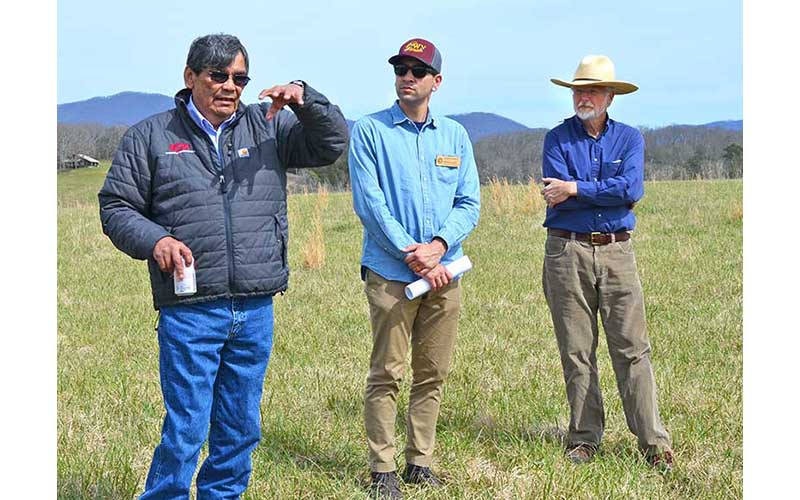
Traveling down Highway 28, just a few miles outside town, drivers may not even realize they are driving by a historic site dating back thousands of years. The Watauga Mounds offer not only a glimpse of our history but also a look into the science and culture that went into creating these ancient places.
Last week, staff from the North Carolina Department of Natural and Cultural Resources (DNCR) joined members of the Eastern Band of Cherokee Indians, State Rep. Karl Gillespie, and representatives from Mainspring Conservation Trust and Western Carolina University on a tour of the Watauga Mounds and the Nikwasi Mound.
The stop in Franklin on April 4 was part of DNCR Secretary Reid Wilson’s week-long tour of the Western North Carolina counties. Wilson was a speaker on a panel discussing the importance of public lands during the Outdoor Economy Conference last week in Cherokee.
Wilson said more than $800,000 has been allocated in the state budget for Cherokee mound sites in Macon County. “We’ve been hearing about this in Raleigh, it’s good to experience it in person,” he said.
Standing near the mounds with views of the surrounding mountains, Wilson said it was an amazing site and being there helps put you back in time to when people were there thousands of years ago. “You start to understand why this place is so important.”
Watauga Mounds
The Watauga Mounds site was privately owned previously, and the mounds are much smaller than their original size due to plowing and farming practices. In 2020 Mainspring Conservation Trust was able to acquire 40 acres that includes the mounds and a portion of the historic Watauga Town, one of the ancient Cherokee Middle Towns.
In 2021 Western Carolina University conducted geophysical surveys over nine acres of the site, using a gradiometer to detect and map magnetized archaeological objects.
“We could see a council house very clearly in that mound,” said Brett Riggs, WCU Sequoyah Professor. Not only could they see the council house but also the steps leading to the council house and the surrounding village. And then what really surprised them was a council house on the second mound.
“This was the first time twin mounds had been documented in North Carolina,” he said.
Riggs said they were able to see the central hearth and the council house doorway, which was situated to the sunrise on the winter solstice.
Dr. Thomas Belt, a retired Cherokee language instructor, said that alignment was not a coincidence and that the site could serve scientific as well as historical purposes.
“You could see things were not laid out at random,” he said.
Belt said the mounds could date back to before they were even Cherokee. “It’s not just an historical place,” he said. “They aren’t just historical based on superstitions; we knew about cycles.”
Belt said the placement of structures in relation to the sun and the moon and the observance of natural cycles are a part of Cherokee life. “It is extremely important to our beliefs, our knowledge, our Creator.”
The mounds have a rare 360-degree view of the horizon, and the plaza of the Watauga Mound council house was in direct line with Nikwasi in one direction and with the Cowee Mound in the other direction.
Belt stressed the importance of place in understanding who you are. “You don’t know who you are if you don’t know where you’re at,” he said, adding that things can become chaotic and unpredictable without that understanding.
“It (the mound) gives us place, not only here in Macon County, but in the universe,” Belt said.
Belt and Joseph Owle, secretary of agriculture and natural resources for the Eastern Band, both said sites like the Watauga and Nikwasi mounds give the Cherokee an opportunity to share their story with others.
“These sites give us place here on this continent,” Belt said. “It’s something we can share, something we can learn about.”
Owle said there has been a renaissance amongst the younger generation of Cherokee who are once again learning more about their history and culture. He said it would be great to have the opportunity to come out to a place such as Watauga and experience traditional Cherokee ceremonies or stickball games.
He appreciates that the tribe is taking a step back and looking at what partnerships can help “advance the interests and causes that benefit everybody.”
Owle acknowledged that there are parts of our past and history that can make you mad, but you can learn from it, and he wants the Cherokee people to have the opportunity to tell their story.
“Let’s interact with it, let’s engage with it, let’s celebrate it,” he said. “It’s cool to be making history.”
Wilson said his office can work with the others to help share their story. “There is so much more we can do to get that story out in North Carolina,” he said.
Jordan Smith, Mainspring executive director, said there is another 11-12 acres around the site they would eventually like to conserve, and they want to make it more accessible.
“We want people to experience these sites, but experience them from a place that protects them,” he said. He gave an example of how they constructed a viewing platform at the Cowee Mound that gives visitors an opportunity to see the mound without further damage to it.
Belk said he wants his grandchildren and great-grandchildren to be able to visit places like the Watauga Mound to learn more about their history and their place in the world. “We’re going to be the ones who leave, and these places will always be here.”
Wilson said he appreciates the partnership between the Eastern Band of Cherokee Indians, Mainspring Conservation Trust, Western Carolina University and the State of North Carolina.
“It shows you the power of people working together,” Wilson said. “No single entity could have done this alone.”
Rep. Karl Gillespie said he and Sen. Kevin Corbin appreciated Secretary Wilson taking time to visit Macon County and the district. “We appreciate the efforts of all those involved,” Gillespie said. “We will continue to support the efforts of these organizations.”