
Carter Giegerich for The Franklin Press
A proposed development in downtown Franklin took another step forward during the June 21 meeting of the Franklin Town Council, laying the groundwork for a feasibility study for new uses for businesses in the upper floors of a building on Main Street.
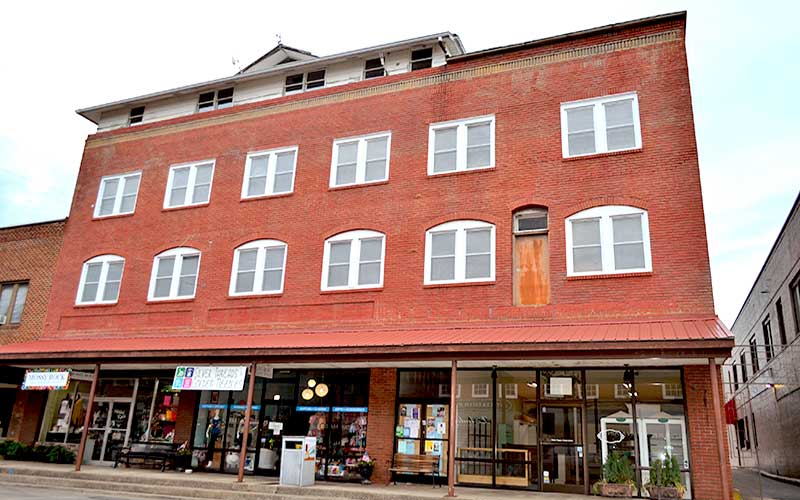
The Franklin Town Council voted to send a letter of commitment supporting the project, which could potentially bring a boutique hotel and restaurant to the upper floors of the old Scott-Griffin Hotel building, currently occupied by Mossy Rock and Silver Threads & Golden Needles in downtown Franklin.
The letter of commitment is a key part of the approval of a $65,000 grant from Opportunity Appalachia, a funding source that would support a study for the proposed use of the building. Town Council member Stacy Guffey said the scope of the study could potentially exceed the amount of the grant, at which point the town would likely be committed to helping cover the remainder of the costs.
“Under the scope of the services we’ve asked for a variety of services,” Guffey said during the meeting. “Just looking at that menu, you can imagine there’s a possibility that the scope would possibly come back more than the $65,000 we’ve been awarded.”
Council Member Joe Collins expressed hesitancy about making a financial commitment without specific numbers attached, as well as the ramifications of this type of partnership with a private entity for the town. The building is owned by the Jacobs family.
“I know that municipalities, states and counties are very restricted as to what they can do to draw new industries. We’re being asked to put hard-earned taxpayer money into a private project which could, number one, turn out to show feasibilities of not being very useful, or it could show valuable usages which would become very valuable to the owner of the property whether they built one of those uses themselves or sold it with increased value,” Collins said. “This, in my opinion, could be a bridge too far for us at this table.”
Franklin Mayor Jack Horton said the prospect of this type of public-private partnership might be daunting, but he also suggested it may be necessary in some cases for the type of economic development the town is seeking to encourage.
“Economic development has been a thorn in some people’s sides for a long time – we’ve had people sue towns and counties for putting funds into public and private projects,” Horton said. “But if we didn’t put any funds into public/private projects, there wouldn’t be any industrial parks, there wouldn’t be any business parks, there wouldn’t be anything out there that people would actually go put a business in. As a town, we don’t create jobs. All we can do is create an atmosphere and an environment where jobs will be created by the private sector, and that’s what we’re trying to do.”
Horton also said the lack of specifics about expected costs, which Guffey said wouldn’t be nailed down until after requests for proposals were submitted in late July, didn’t necessarily have to stop the town from showing their commitment to the project.
“I don’t know that we have to put a number in with the letter of commitment. We don’t have to pledge an exact amount of money, we just have to pledge that we’ll try to match the difference between what the grant is and what the actual cost turns out to be,” Horton said. “If the actual cost turns out to be much, much higher than we ever thought it would be, I guess you could have an escape clause in there.”
In the event that a feasibility study returned unfavorable results for the development, Council Member David Culpeper said it was important the town still gain useful information about the downtown area and the possibility of future developments through the execution of this feasibility study.
“If nothing else comes out of this, if the taxpayers are going to pay for this, it’s going to be our study. We need to know what can and can’t happen in our downtown, not just in this building but in all the buildings downtown,” he said. “That’s imperative, that we gain knowledge for our investment of money.”
The council ultimately approved a resolution to send a letter of commitment to the grantmaking body voicing the town’s support of the project without a specific amount of financial commitment, with the motion passing unanimously.