
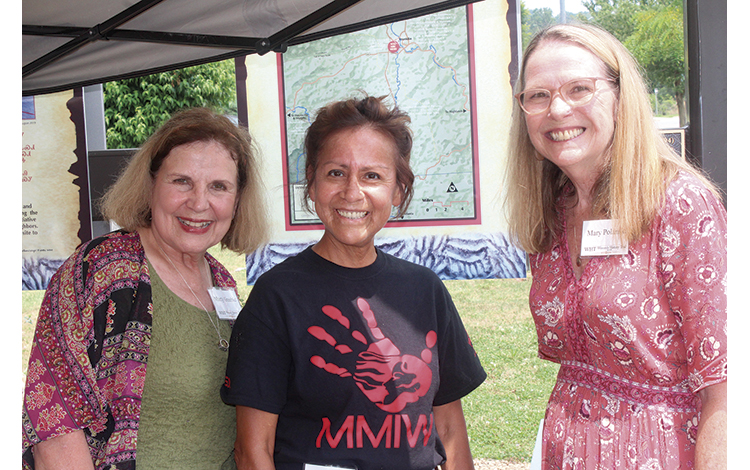
The newest installment in the Women’s History Trail is a plaque at the Nikwasi Mound dedicated to Na’ha Rebecca Morris, one of the most famed women of the Eastern Band of the Cherokee Indian to ever call the Nikwasi area home.
Born Na’ha in 1792, Rebecca Morris took her English name when she married Gideon Morris and became part of a 640-acre reserve across the river from the ancient Nikwasi town. After the United States government burned her family off their land, Morris successfully sued them and was compensated $3,000 in a major victory for the tribe. She was held in high esteem in Franklin in the 19th century and she even inspired the character of Little Deer in Robert Strange’s “Eoneguski,” North Carolina’s first known novel, but her true name isn’t widely known by most citizens, especially not compared to her brother Junaluska. Officials with the Women’s History Trail say that her relative discretion is a product of history’s frequent dismissal of female contributions.
“We all know the name Junaluska, but Rebecca Na’ha Morris? No,” said trail leader Mary Polanski. “This is part of how history is often different for men and women.”
The installment is the first on the trail to be sponsored by the Cowee School Arts and Heritage Center. School director Stacy Guffey said the school has always prioritized telling the story of Cherokee history in Macon County, but they’ve seldom put women at the forefront of those stories. He sees the installment as a good way to introduce new elements to that conversation.
“Part of what we do at Cowee School is tell the story of the Cherokee,” Guffey said. “This is a chance for us to not only continue that work but also do something unique by focusing on a Cherokee woman.”
The Women’s History Trail has 14 other exhibits that teach about retailers, innkeepers, beauticians, laborers, publishers and even state representatives, but Morris is the first Cherokee woman to join their ranks. It’s fitting that her plaque is on display at the Nikwasi Mound kiosk, the epicenter of Franklin’s recently renewed effort to celebrate Cherokee history and influence in the area. Juanita Wilson of the Nikwasi Initiative says it’s been heartwarming to see how much attention Cherokee heritage has gotten in the last couple of years.
“This community has really embraced us members of the Eastern Band,” Wilson said. “We’re very thankful for that.”
This was also the last installment on the trail to feature involvement from Barbara McRae, a member of the trail, the initiative and Franklin’s Town Council before her passing in March. While she wasn’t able to see the plaque officially unveiled last weekend, she got to preview it in the last days before her death, as well as a working model for a planned statue of Morris, Harriet Timoxena Siler Sloan and the slave woman Sally that artist Wesley Wofford is set to install in the area. If McRae were still around, her compatriots feel she’d be proud of the direction that the trail is moving in.
“Barbara McRae would be so tickled and excited to be here,” Polanski said at the unveiling ceremony last Saturday. “She was our visionary.”