
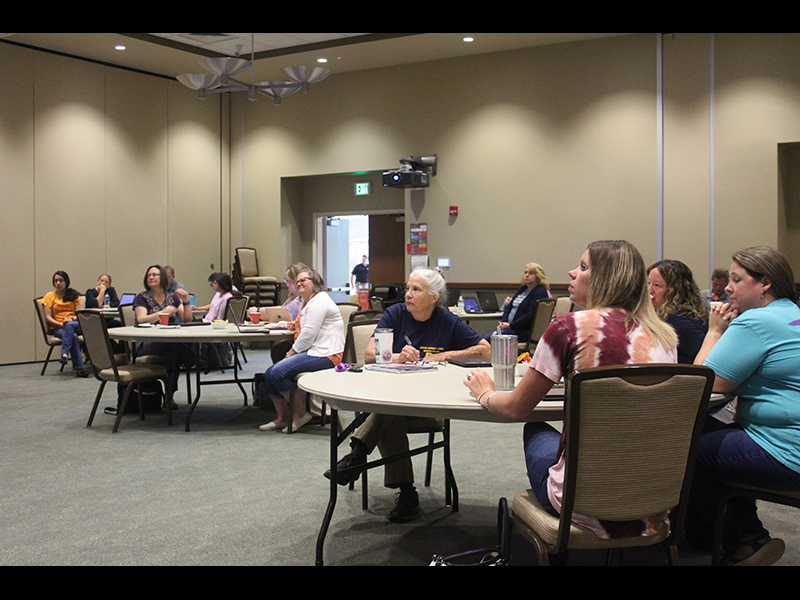
Summer vacation has started, but there was a little bit of work left to do this week for Macon County teachers taking part in a summer externship.
Sponsored through a grant from the Appalachian Regional Commission, the externship included several teachers from Franklin High School as well as dozens from schools all over Western North Carolina working together to think of more effective ways to teach kids in the next school year. The first day of the program sent the teachers on tours of businesses in the westernmost counties to hear from entrepreneurs about what skills and qualifications they’re looking for in new hires. Teachers were amazed to hear how diverse the positions available at local businesses were.
“We were at TekTone yesterday in Macon County and they have everything,” said Kathryn Moses, a business teacher at Jackson Community School. “Marketing, building, sales, a little bit of everything.”
With employment numbers rebounding slowly following the COVID-19 pandemic, many in Macon County are concerned about the state of the labor force. Part of the problem is that Macon County has a below average population of working-age people, a problem shared by much of the rural western part of the state. The teachers feel it will be important to inform their students of local employment opportunities so they don’t feel the need to leave for bigger cities.
“Did you know that there are 16 career clusters and that Harrah’s has all 16?” said Anna Hair, the career and technical development coordinator for the western region. “Even down to the health sciences.”
Just as important as where students can work is how they can work. The employers the teachers spoke with represented a wide variety of educational backgrounds, but they universally agreed that certain soft skills would be essential to the jobs they offered. Taking initiative when problems arise, communicating clearly and concisely in a variety of formats, always making a point to show up on time – these basics can get lost in the shuffle of standardized testing at school, but they’ll make someone a better worker in any profession.
“They’re looking for someone with communication skills, someone who’ll ask questions when they don’t understand something, someone who’ll read an entire email instead of just the first few lines… that’s what’s going to prepare you for any job,” said Franklin High School math teacher Hope Hawkins.
On the second day of the program, the teachers came together for an informal seminar to exchange ideas about what they learned. They all seemed to agree that the way education works now isn’t perfectly practical. They’d like to teach more to the individual student rather than pushing them all towards the same idea of success, both in their grades and in their post-graduation plans. Not every student will take the traditional four-year college route.
“North Carolina needs to get away from thinking that every kid is four-year,” said Smoky Mountain High School science teacher Daphne Hughes said. “There are so many jobs that are needed right now that we’re not training our kids for.”
The teachers will have to mostly stay within their curriculum unless they inspire some change in the state board of education, but they’ll definitely have some handy information to pass along to their students when they return in the fall.
“We want to give them something actionable,” said Dr. Jeremy Gibbs from the Department of Public Instruction. “We want them to go back in August and know how to use it.”