
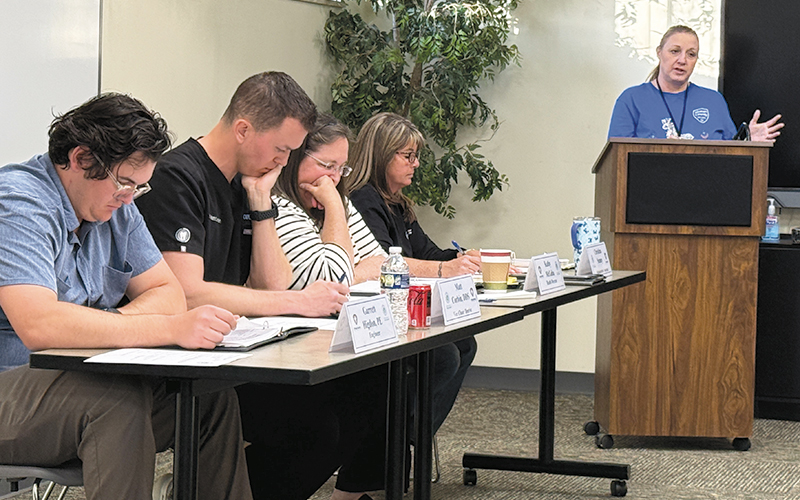
Filling vacant positions and pay rates for Public Health employees were among the topics of discussion during the department’s budget presentation at the Macon County Board of Health meeting on March 25.
Public Health Finance Officer Melissa Setzer presented the department’s budget as the county’s budget process gets underway for the new fiscal year that begins July 1.
Prior to Setzer’s presentation, Public Health Director Kathy McGaha said, “She [Setzer] probably has one of the most complicated budgets in the county, so I just want to brag on her about how she has put the budget together and how she keeps all the information.”
The health department collects fees for some services and receives state funding for some programs, as well as grants for specific programs. The revenue numbers presented at the March 25 meeting only include the revenue generated by the health department; it does not include funding allocated by the county in order to balance the budget.
On the revenue side, most line items remain the same for 2025-26, however due to some significant projected decreases, the total revenue is budgeted at $2,071,465, which is $58,581 less than the current year’s budget.
The biggest drops in revenue come from OB (obstetrical) Care Coordinator ($25,000), Care Coordinator for Children ($20,000), and Care Management for At-Risk Children and Care Management for High-Risk Pregnancies ($34,000). Revenue for WIC (state) is expected to increase by $13,290.
Expenses for the coming year are budgeted at $5,864,350, which is $253,551 less than the current year. When asked about employee raises, Setzer said, if the commissioners approved a bump in salaries that is not included in the budget as presented.
Those decreases in revenue are related to a staffing shortage, which is also a decrease on the expense side. McGaha said the OB and child case management were previously two full-time salaried positions. Now both jobs are covered by one contracted position at 10 hours a week. With the reduced hours, there will be less revenue associated with that position. McGaha said the 10 hours meets the minimum required by the N.C. Department of Health and Human Services.
“We struggled to hire anybody, so it’s hard to keep the programs going,” McGaha said. In trying to fill the positions they contracted with Alliance but that became too expensive based on the revenue coming in. “We do have a contract for 10 hours a week, and that’s all we can afford at this point. Because we can’t fill the positions, we’re having to make some decisions like this.”
McGaha noted the Health Department continues to advertise for openings and it’s challenging to fill all the positions. She said on the day of the meeting that there were 20 jobs posted on the county website with 12 being from the Health Department. “Most of them are medical-type positions, either medical office assistant or nurse,” she said.
The pay rate for some of the positions makes them difficult to fill.
“One of your biggest issues in today’s world is most people that are seeking a job are not-career oriented people,” said County Commissioner John Shearl, the liaison to the Board of Health. “They want all the money right now and they’re not looking 30 years from now.”
Shearl said people want to know what their take-home pay is going to be. “When you tell them that it’s whatever it is, they say, ‘I can’t survive off that.’”
He said the pay study that the county did is “not adequate to retain professional people.”
“They’re not looking for benefits, they want that paycheck at the end of the week,” Shearl said.
McGaha agreed and said most people that interview for the jobs are satisfied with the benefits, but it’s the pay that deters them, and changes in the economy makes it even more challenging.
“Everything has been changing so fast. The inflation rate, the cost of living has skyrocketed. The changes are happening faster than we can make an educated decision about what these salaries should be,” McGaha said. “I think we made them thinking that they should be there for five years. Well, in that five-year span, a lot has happened.”
Clinical Services Section Administrator Jennifer Garrett said she has been pleased with some of the qualified people that come in for interviews, but when the applicants run the numbers they decide they can’t accept the job.
“A lot are single mothers who are the primary home provider or they’re able to make a better salary at a private institution,” she said.
Jamie Waldroop, communicable disease nurse, said he sometimes worries about how the workers have taken on extra duties since they are short-staffed and how that could impact the level of service they are providing patients.
“I was raised here. I love the people here. I love working here because I feel like I’m helping the people,” he said, noting the time and money he invested in getting his nursing license. “I don’t want to jeopardize that. I don’t want to jeopardize my patients’ health.”
He said they are so short-staffed he has concerns that he “might miss something or something that could potentially cause harm to a patient. It could cause harm to my career.”
“We’re definitely at that point,” said McGaha.
Waldroop said if someone is out sick or on vacation, the remaining staff has to take on additional duties. “It’s not safe.”
Garrett said they have had to turn patients away some days because they don’t have the staff available to see them. “We have to meet certain measures, but we have cut some services due to short staffing,” she said.
Staffing in the Animal Services department has been one of the ongoing concerns discussed at several meetings this year. McGaha said they will request a position for that department, but it is not included in the budget presented, because new position requests are presented separately.
McGaha said one of the department’s nutritionists was moving out of county to complete a registered dietitian program, so they will soon have to hire another one.
The next Board of Health meeting will be at 6:15 p.m. Tuesday, May 27 in the meeting room of the Human Services building on Lakeside Drive.