
The South Korean drama Squid Game was the biggest streaming sensation of 2021, but your kids probably shouldn’t be watching it.
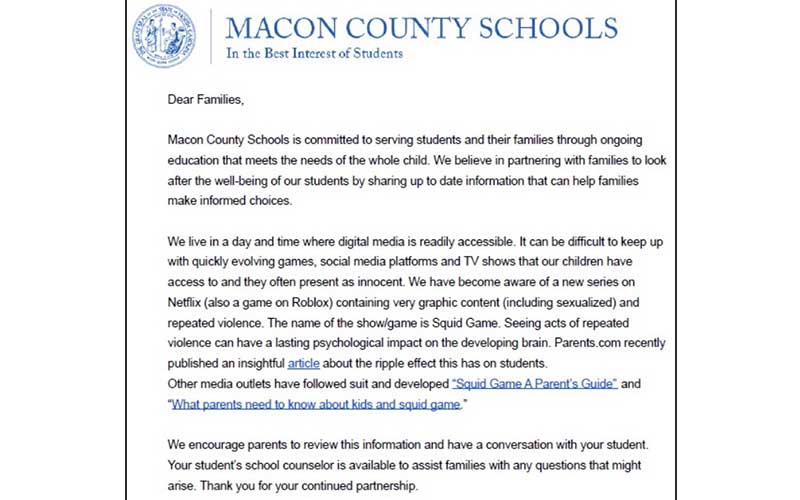
Last semester, a North Carolina Department of Instruction representative was visiting a Macon County elementary school when administrators were notified of children imitating games from the show, which was Netflix’s most watched show of the year. The violent nature of the show made staff concerned about the fact that kids were watching it and about what lessons they might be learning from it. The school system sent out a letter advising parents to monitor their children’s viewing activity in case they are watching the show.
“We live in a day and time where digital media is readily accessible,” reads the letter. “It can be difficult to keep up with quickly evolving games, social media platforms and TV shows that our children have access to, and they often present as innocent.”
In Squid Game, 456 people, all of whom are racked with crushing debt, are solicited by a mysterious organization and given the chance to participate in a series of playground games like Red Light, Green Light and Tug of War. If they win, they’ll be given enough money to escape their debt, but if they lose, they’ll be killed, often in extremely graphic ways. Creator Hwang Dong-hyuk intended the show as a commentary on the dehumanizing nature of economic inequality, but the games themselves have been the focal point for most mainstream viewers, inspiring (non-lethal) copycat tournaments on social media and in video games like Roblox.
Plenty of movies, TV shows and video games feature excessive violence not suitable for kids, but many parents and educators take issue with Squid Game specifically, not only because of its viral popularity, but also because the games are based on real children’s games. Dong-hyuk has stated that he used children’s games because they’re easy to understand, so viewers can spend less time trying to follow the rules and more time following the characters’ emotional journeys. The flip side of that, however, is that many of the activities in the show are easy to imitate.
"The games in Squid Game are made to appeal to kids and adults," said Dr. Karen Aronian, a parenting and education expert, in an interview that Macon County Schools is pointing parents towards. “For starters, they are, in fact, kids’ games from our youth.”
Even outside of the violence, Squid Game deals with heavy themes of poverty, divorce, sexual abuse, depression, existentialism and other topics that many viewers won’t be prepared to deal with regardless of age. Children of the same age can handle different things in their media, so it’s important for parents to do their research and make informed decisions based on what they know about their children before letting them watch mature content, if they’re going to watch it at all. Netflix recommends that nobody under age 17 watch their TV-MA rated content and they have several tools adults can use to moderate what children watch.
“Netflix sets maturity ratings by the frequency and impact of mature content in a title, such as the amount of violence, sex, adult language, nudity or substance use that may be present,” reads Netflix’s help page on maturity ratings. “Profiles with a set maturity level will only show titles that fit the selected maturity rating level. You can also block specific shows and movies from individual profiles.”
For more information on Netflix’s maturity ratings, go online to www.help.netflix.com/en/node/2064.