
The Southwestern Commission recently released its quarterly report on employment in the seven westernmost North Carolina counties, and for a community highly concerned about COVID-19’s impact on the workforce, it offers some insights into economic recovery.
The report states the region lost 504 workers, or 0.8% of the total workforce, between first quarter 2020 (January-March) and first quarter 2021. The industries with the most job loss have been educational services (-879) and healthcare (-451), both sectors where job descriptions rapidly changed to fit the pandemic. However, there have been net gains for other industries, most of all in government administration (+503). The 1Q 2021 numbers are forecasted based on a statewide industry-specific survey of businesses conducted by the U.S. Bureau of Labor Statistics.
David Garrett, workforce development director for the Southwestern Commission, said government services evolved quickly to meet constituents’ needs remotely, so fewer jobs were lost to begin with.
“It was a big shock to the system when everything shut down, but we figured it out,” Garrett said.
Unemployment has been a major concern for many Americans this year. A discouraging April job growth report led many state officials to make cuts to unemployment benefits, fearing workers were making too much on government programs to justify going back to work. North Carolina Gov. Roy Cooper was among them, saying that the need for an additional safety net had largely faded with the recession of the virus.
“Unemployment benefits have provided a critical lifeline for many North Carolinians living on the edge due to the pandemic,” Cooper said. “As our state emerges from the pandemic, we want to help people safely return to work as soon as possible. Reinstating the work search guidelines will help connect claimants with employers, resources and tools to help them return to the workforce.”
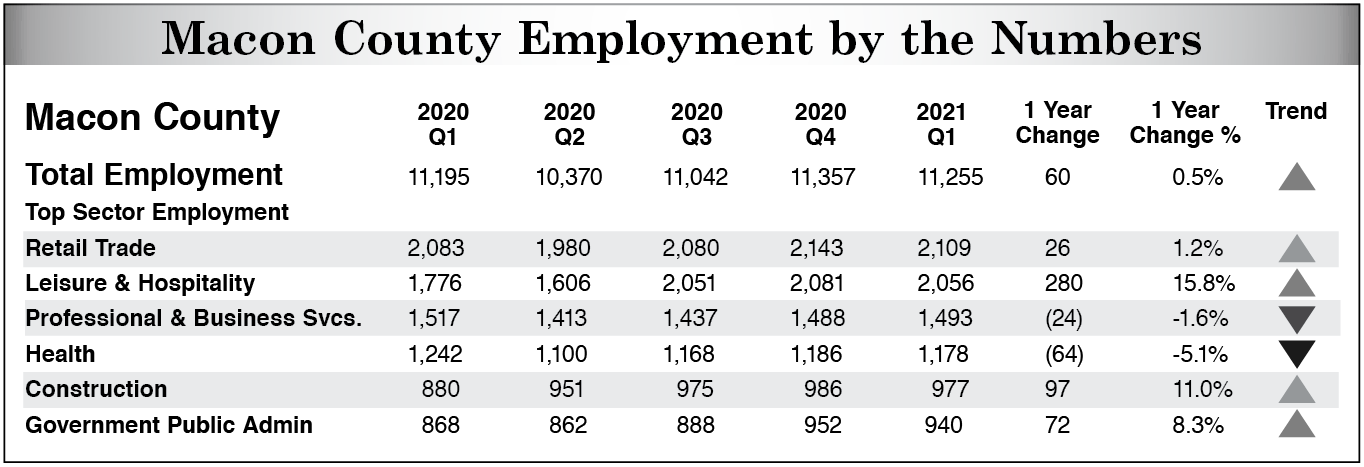
However, unemployment benefits are only one piece of the puzzle. In Macon County, many restaurants are understaffed to the point of reducing operating hours, but the county is actually leading the region in leisure and hospitality job growth. There are 280 more people working in this industry than there were at the same point last year – a 15.8% jump.
Garrett says that the real problem is a fundamental change in the makeup of the workforce. The workers who haven’t returned aren’t just fast food workers making more money on unemployment. They’re also parents who are still staying home with their kids and seniors who were well off enough to take an early retirement. This is a problem, Garrett says, because these workers are less likely to come back to work no matter how policy changes and, with national birth rates on the decline over the last several years, the population of eligible workers just isn’t growing fast enough to make up for them.
“There are more open jobs in our region than there are people collecting unemployment,” Garrett said. “This labor shortage was coming pre-pandemic and now COVID-19 has accelerated it.”
Macon County may be feeling this demographic shift more than most. At the beginning of the COVID-19 pandemic, the United States had a population of about 328 million people and a workforce of about 165 million people, so almost exactly half of the population was working. According to the Southwestern Commission report, however, Macon County’s workforce in Q1 2020 consisted of just 11,195 people. That’s only 30.7% of its estimated population of 36,442 in 2020. With the county’s population steadily growing and aging, labor shortages may get worse before they get better.
Garrett said recruiting older teenagers and young adults will be critical to closing that gap this summer. Many employers are also making financial concessions. It’s common to see signs posted around Franklin announcing higher wages at restaurants and retail shops. Paula Alter, director of Franklin’s NCWorks office, said employers are offering many applicants money up front to fill positions and that such strategies have jumpstarted interest.
“We are seeing employers looking for employees and are seeing some using starting bonuses and increased pay to incentivize applicants,” Alter said. “We continue to have new job seekers visit our career center. Some are on unemployment and want to find jobs. Some are new to the area and looking at available opportunities.”
Compared to last March, Macon County has netted 60 jobs for a modest 0.5% increase in employment. There were some losses in healthcare (-64) and business services (-24), but there were encouraging gains in construction (97), government administration (72) and retail (26) as well. That hospitality employment boom is perhaps the most critical metric of all – with COVID cases on the decline and the summer travel season starting, Macon County’s tourism industry will need all the help it can get.
“We want to bring as many people to visit the mountains as possible this year,” Garrett said. “We just hope we’ll have the opportunity to do so safely.”
For more information on workforce data regarding Western North Carolina, visit the Southwestern Commission online at www.regiona.org or call 828-586-1962. Macon County employers and jobseekers looking for localized help in their search can visit the NCWorks Career Center at 5 West Main Street or call 828-369-9534.