
Two rallies demand racial justice
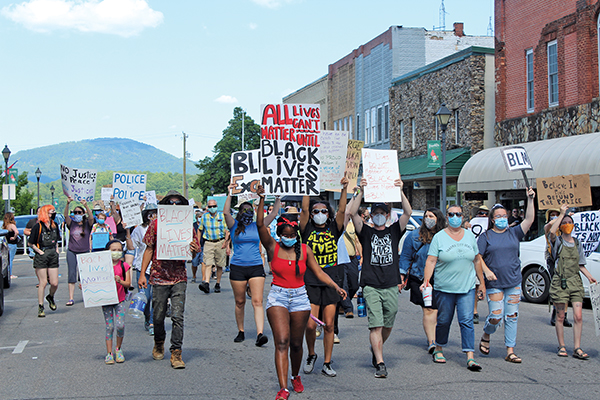
Marchers took to the streets of Franklin twice in four days, joining demonstrations nationwide calling for an end to racial injustice in the wake of the killing of George Floyd.
The first event, held on June 9, saw about 60 people assemble to march around the gazebo and display signs to Main Street traffic. This demonstration was organized in about a week and advertised primarily from person to person, so organizers were excited to see a fairly high turnout. Organizer Elizabeth Taylor said the number of marchers was indicative of the spike in attention paid to the Black Lives Matter movement in Franklin and across the country.
“It shows that a lot of people care about what’s going on right now,” Taylor said. “It’s great to see this much interest.”
The second event on Friday, June 12 drew about 200 people who marched down Main Street and back to the gazebo for an hours-long rally.
Though they all stood under a Black Lives Matter banner, the demonstrators espoused a wide variety of values during the event. Some of them made calls to defund the police, while others felt it was essential to work alongside law enforcement to address racial injustice.
Mark Wilkins, a 30-year Army veteran, joined demonstrators at the June 12 rally to protest President Trump’s decision to deploy military forces in his response to protests. He said that the president’s willingness to deploy armed forces on U.S. soil to quell protests, regardless of whether or not those protests become violent, represents a threat
to American values.
“We’ve always tried to avoid using the military here on our own soil,” Wilkins said. “That’s one of the tenets of living in a liberal democracy. Many vets around the country are speaking out against it, and I wanted to raise my voice as well.”
Protesting the protest
A group of counter-protesters assembled around the Confederate soldier’s statue across from the gazebo during the June 12 protest. Opinions were somewhat divided in their camp, as well.
John Cerri said he was wary of the protestors because he believed too many of them had come from out of town to call for changes in his hometown.
“I’ve seen a bunch of people who don’t look like they’re from Franklin,” Cerri said. “I don’t want to see them coming here and trying to change the way things are done in Franklin when it’s none of their business.”
Rick Davis, on the other hand, was sympathetic to the issue that sparked the protests, but he felt that demonstrators were making too much of a leap by trying to blame all police for the actions of a few.
“What happened was a tragedy,” Davis said. “A man needs to stand trial and face the consequences along with the three other men who let it happen, but some of these people are taking it too far.”
Despite some tense moments, the protests remained peaceful. While some demonstrations across the country have become infamous for devolving into rioting and looting, it was important to local organizers that they be diplomatic in their approach. A few heated exchanges occurred between protestors and counter-protestors, who were separated at all times on different sides of the street, but other participants encouraged their colleagues to keep a level head.
“If you want to change somebody, you have to show them that you love them,” demonstrator Dinah Harrison said.
Protesting in peace
Officers with the Franklin Police Department and the Macon County Sherriff’s Office were on hand to see that the protests remained peaceful. Police presence during both events was strong as officers escorted marchers down the street and were standing by during both rallies.
Sheriff Robert Holland said he was satisfied with how the demonstrations went. While he was unhappy with anti-police chants aimed at his officers, he said the priority was making sure things stayed peaceful.
“We were here to do our jobs today and make sure that everybody stayed safe, and looking at how things went, I’d say mission accomplished,” Holland said.
Police chief Bill Harrell agreed with Holland.
“I’m very grateful that it was a success for all intents and purposes, and as far as is being reported to me, everyone was safe at the end of the event,” he said.
Even if things hadn’t gone so smoothly, Synethia Owens said she would have still felt the need to attend the demonstrations. She came to the June 9 event with her nieces and felt that it was important for them to see that members of their community were willing to stand up for them.
“We’ve got to be willing to take a chance with our lives if we’re going to save some lives,” Owens said.
Father Jonathan Stepp of All Saints Episcopal Church, who prayed over demonstrators at the June 12 event, remembered the 2015 merger of the primarily white St. Agnes’ Chapel and the primarily black St. Cyprian’s Chapel as an example of how, with enough time and effort, people of different racial backgrounds can come together like a family. He hoped these demonstrations would encourage local residents to listen to each other.
“All Saints has the blessing of being a racially integrated church,” Stepp said. “Race relations can be hard, but it’s work worth doing.”
Sarah Cochran, who spoke before the full crowd of protestors right after their march, encouraged them all to remember that they weren’t there for the sake of starting a fight, but instead to make the case for a more peaceful future.
“No matter how small our group is or how large our group is, no matter how destructive it can be when it gets angry, the point of this is for future generations to be able say they grew up in a place that wasn’t racist,” Cochran said.