
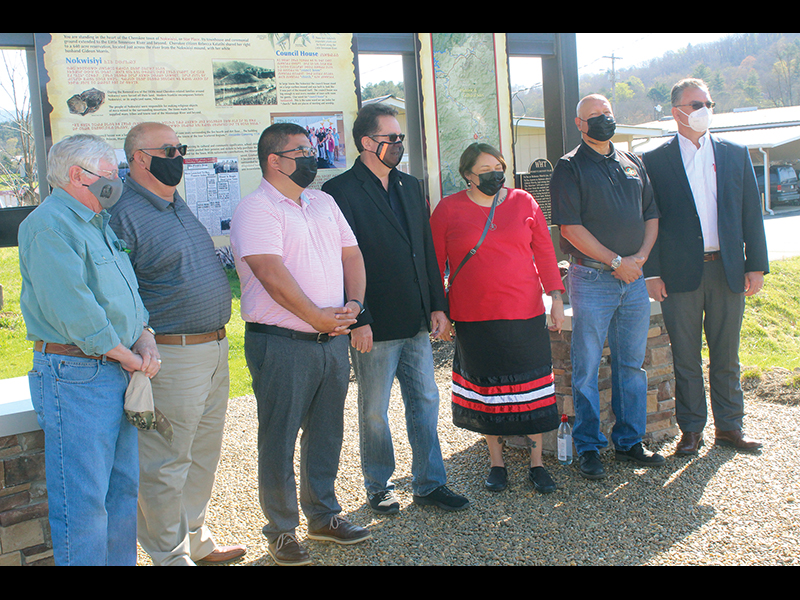
The Nikwasi Initiative hosted members of the Eastern Band of the Cherokee Indian Tribal Council for a visit to the Nikwasi Mound on Monday morning.
About a year after the Town of Franklin transferred the deed to the mound to the initiative, they finally got their information kiosk installed last summer. The board members have since been developing plans to offer more educational and cultural resources at the site, including a green space for growing Cherokee crops, restaurants to serve traditional foods and an entertainment space to host tribal dances. While things are slowly but surely progressing, the tribal council doesn’t often get to gather at the site, so on Monday, they had the chance to walk around the mound, commune with other local leaders and enjoy the significance of the site.
“We wanted them to come over and enjoy and get in touch with their homelands here,” Nikwasi Initiative board member Juanita Wilson said. “We’d like them to guide us on what they would like to see next.”
Though it may seem that development at the mound site is moving slowly, continued conversations about it are worthwhile to the Cherokee community. It’s exceptionally rare for mounds to remain in tact for as long as the one at Nikwasi has. Not only does its preservation make it ideal as a centerpiece in cultural tourism for Western North Carolina, it also makes it an indispensible opportunity for Cherokee people to feel closer to their heritage.
“I’m glad that this mound is still here and I’m very thankful for the people who have taken care of it so far,” said Perry Shell, who represents Big Cove and Tow String on the tribal council.
Thomas Belt, Western Carolina University’s former Cherokee Language program coordinator, spoke at the gathering on Monday and explained that the mound site has unique potential to make Cherokee history feel more real. He says that much of what is taught in schools today about the tribe is either inaccurate or outright fabricated, largely because so much of the culture has been lost overtime. Even the word Nikwasi, it turns out, is an inaccurate translation of the original name Nokwisi, which the initiative now favors.
“These are our words and even we don’t always know what they mean because they’ve been so Anglicized and so changed,” Belt said.
As a result, Belt says it’s easy for younger Cherokee people to feel disconnected from their heritage. His hope is that the mound will be diligently preserved going forward and that its site will provide an engaging cultural experience that will make it clear that the tribe is still alive and well.
“If we don’t preserve these things, then we’re relegating an entire generation to be relics,” Belt said. “My granddaughters are not relics.”
For more information on the Nikwasi Initiative and their plans for the Nikwasi Mound site, call executive director Elaine Eisenbraun at 541-620-0752 or go online to www.nikwasi-initiative.org.