
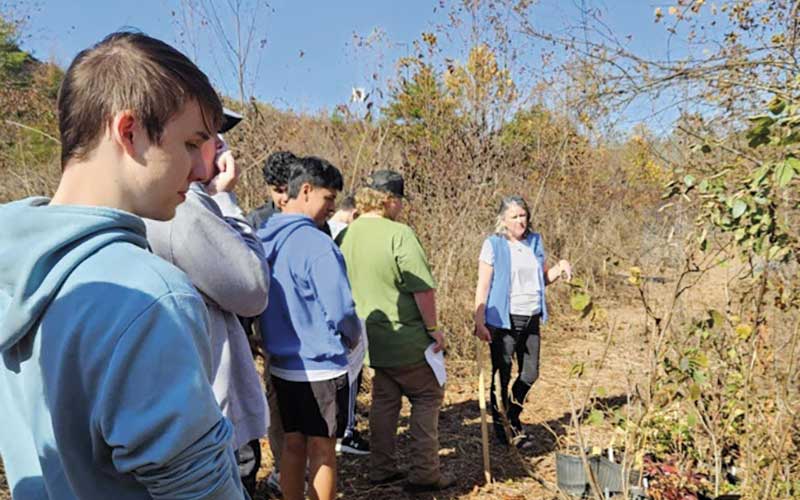
Looking down into the cove in front of Mountain View Intermediate School, you can see dozens of wire cylinder cones around new trees in the mostly deforested habitat.
This means the multi-year Cove Branch project is underway with trees planted, signage ready to be installed and fences coming soon to the area.
“I’m relieved that it’s finally happening. To see kids down here running around and learning about what we’re doing and why we’re doing it,” Macon County Schools STEAM Coordinator Jennifer Love said. “It’s not just the kids, I hope that this will be a demonstration site for other folks that have creeks in their yards, that this is one way to be a good steward, to make sure that we are maintaining a good buffer, protecting the banks, thinking about biodiversity and what critters might be here using these resources.”
The area has long been the subject of potential, especially once Mountain View Intermediate School was completed in 2009. A group of MVI teachers and administrations, along with local conservation groups and the county, built a covered pavilion in 2011 adjacent to the creek, according to a history compiled by Shade Your Stream, a program run by Bill McLarney, senior acientist and aquatic specialist at Mainspring Conservation Trust.
The school used the site for teaching purposes. However, many of the cove’s streambanks are eroded, meaning vertical drops up to five feet into the shallow creek. Love says she’s hoisted or lowered children into the creek to get water samples.
In April 2018, pressure from the surrounding community due to feeling the site looked bad led to unnamed individuals clearing it out by bush hog. A backlash charged up calls to restore the space to better than it was before.
Now in 2024, Macon County Schools, through a series of grants and student programs, is in the midst of a push to turn the cove into an educational site, a park and an ecological gem to the community.
Planting
The last several months of work were from Macon County Schools’ contract with Forest Stewards, a nonprofit that hired Western Carolina University students to get hands-on practical skills.
With two instructors and between three and eight upperclassmen WCU student interns at any one time, Forest Stewards planted 272 trees, 100 live stakes and cleared innumerable non-native invasive plants. According to WCU Associate Instructor in the College of Arts and Sciences and Biology Sonja Himes, the young trees were placed in cones and tubes to keep beavers from eating the trees and encouraging straight, vertical growth.
Himes said the Cove Branch site was covered with non-native invasive plants, which took “a lot of chainsaw work” and backpack herbicide sprayers.
Himes explained that “live staking” is taking a twig or branch off a plant and planting it as a cheap and easy way to grow a new tree.
Love said the planted trees are native to the area and historically significant to the Cherokee people, like pawpaw, persimmon, honey locust and more. Himes said there are now over 30 different species on site.
“In years to come, people can go out and see different flowering trees and fruit trees,” Himes said.
Himes said most of the native plants previously on site were near the stream, protecting the waterway from the non-native invasive plants.
“We really enjoyed working on the project,” Himes said. “It was a great opportunity for students.”
The fact that Cove Branch floods at least once a year and looks like a giant bathtub was taken into consideration when planting the new trees, according to Love.
The trees are planted in the “buffer zone,” Love said, which will protect the streambanks from erosion and stabilize the area.
On the other end of the climate spectrum, Love said after around half the trees got planted, there was a drought and the other half were still in pots. Students heard of the need to water the trees and offered to do it themselves.
“We collected a bunch of old containers and buckets, and so we had a whole bucket brigade,” Love said. “I have a picture of them down here doing a bucket brigade, watering all the plants, so they were really excited about it.”
In summer 2025, Love hopes to get a grant for “one more shot” of herbicide to get rid of the last of the exotic and invasive species. Himes said that non-native invasive species always come back, and she expects to have the chance to do more work in the future.
Love stresses that the project won’t just be planting a bunch of trees and waiting for them to grow. The site will need continuous maintenance for the next several years.
The trees, once they get big, will shade the creek. Love explained that certain types of fish, like salamanders, don’t swim into sunny areas of a waterway, saying it’s like a brick wall for them.
A wildlife passage
A Franklin High natural resources class visited the site and found something interesting on the black mats surrounding the young trees.
“They were looking at wildlife tracks…it had just rained, and on almost every one of these little black mats, there were these little footprints everywhere, so [the students] were coming out with their little ID cards and trying to figure out what kind of critters we have, and we actually have a couple of wildlife cameras set up,” Love said. “We found fox, coyote, deer, possums…a little pair of raccoons that were cruising along.”
Several beavers are also making the cove home. Up to five beaver dams have been constructed. This creates a mini lake with sediment backup, provides different habitats and has “terraced” the creek, making some of the streambanks not as steep.
The area is a bit of a wildlife passageway as there’s a culvert under Wells Grove Road toward the Little Tennessee River, which leads animals to the cove where they have caught fish. It has also led to snakes coming to the area.
One advantage of the site and the ecology is that the water is often pristine. Much of the area’s trash comes from littering motorists along Clarks Chapel Road.
Making the cove a park
Love said the hope is to install a split-rail fence around the perimeter to delineate the buffer zone/no-mow area. This would be an aesthetic addition because community members are still concerned about the area looking too “unkempt,” as Love and others put it. The fence has already been funded and work will start as soon as March.
“We are going to kind of make it look a little more park-like,” Love said of the Cove Branch area and the split rail fence.
A new addition to the project will be a trail on each side of the creek, which Love hopes to have open for student access. The trails will connect to a nature trail that goes up and behind the school, meaning this can complete a loop around the building.
Love noted Lewis Penland recently used a bush hog to clear out trails and areas away from the creek. A local Boy Scout troop also reached out about completing projects to receive their merit badges.
Next is installing new informational signs created by Signs Express of Franklin, Love said. These three signs will include information about the site, flora and fauna.
Love said MCS got a Duke Energy grant to buy science equipment that students can take to the cove.
“What’s so awesome about this is that I don’t have to arrange a bus, field trip forms, pack lunches and all that kind of stuff to get kids out in the woods or to get kids out by stream,” Love said of getting the science equipment.
There are other potential grant opportunities Love keeps on thinking of, such as adding wildlife cameras, binoculars and more. Another idea is using a 50-pound bag of native grass seed and letting students spread them out.
Love credited Doug Johnson of the Macon County Soil and Water Conservation District office for writing many of the grants and working on the project’s reports and budgets. And the grant writing is far from done.
“I think we’re both, we’re both ready to see this phase finished so that we can get more folks down here and then start writing more grants to do the next project,” Love said.
One of those next phases could be tree tags, which would have to be another grant-funded project. A dream Love has is for a bridge that crosses the stream.
With growing trees, Love is excited about how the site will look in the summer of 2025.