
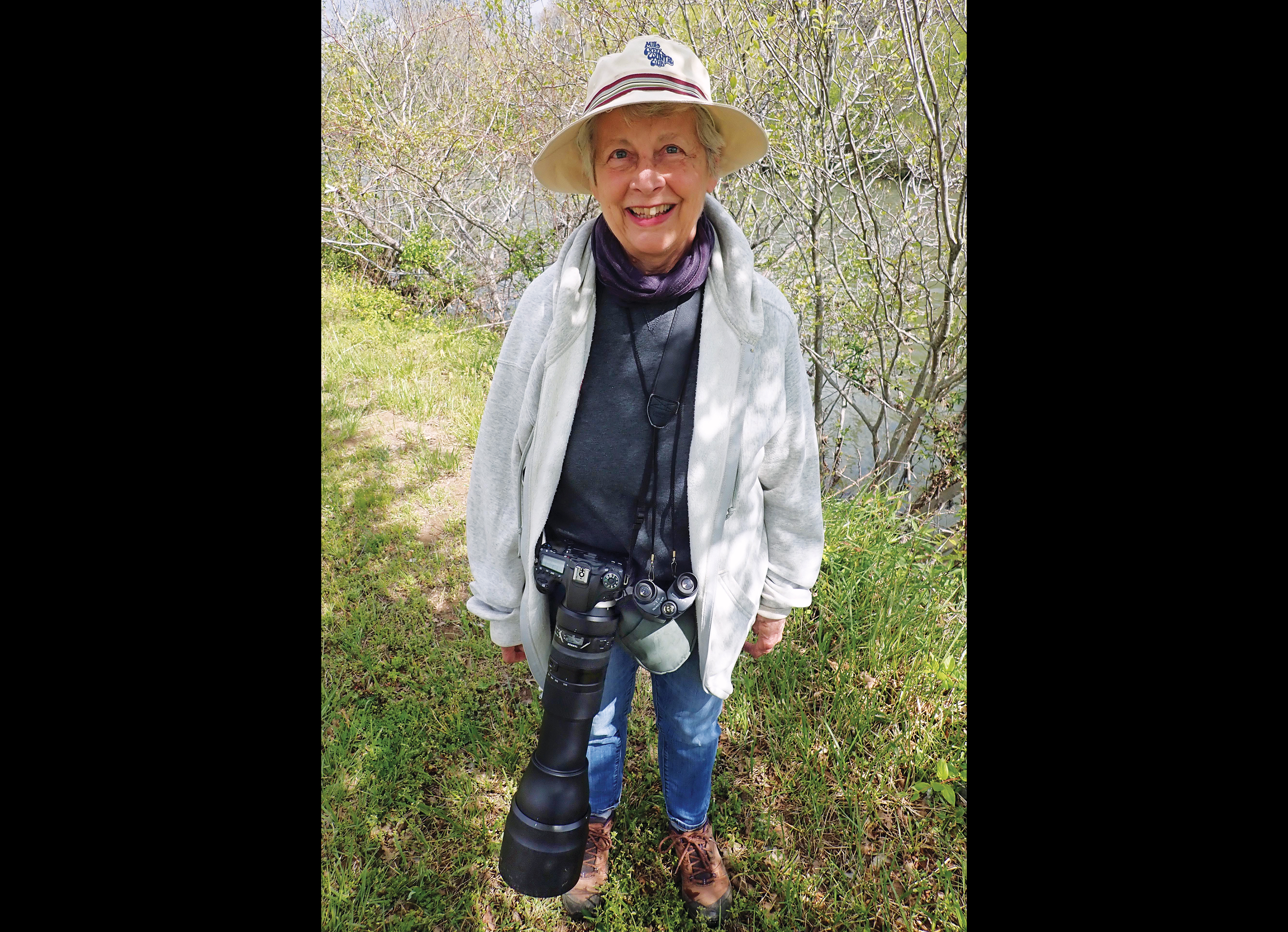
When Barbara McRae died March 2 at her Harrison Avenue home after a battle with cancer, her adopted hometown lost much more than its vice mayor. Franklin lost a prized historian, a chronicler and defender of the area’s natural beauty, and a voice for right.
She was Macon’s Renaissance Woman, her life driven by an insatiable curiosity, a desire not only to know the what of things but the why as well.
Barbara Sears McRae grew up as a military brat, the daughter of Bob and Martha Sears. Her father, a lieutenant colonel in the Army Air Corp, was a highly decorated WWII B-24 pilot who was shot down and served time in a German POW camp.
She earned a degree in biology at Saint Louis University and was working for IBM in Atlanta as a systems engineer when she met her future husband and love of her life, Jim McRae, at an art class he taught at night.
They moved to Franklin in 1973, where she worked for The Franklin Press as a reporter, and then for Nantahala Power & Light, later Duke Power, in corporate communications and marketing.
After retiring from Nantahala Power in 2003, she became the editor of The Franklin Press, continuing in that position for 10 years before retiring again.
“When I asked why she majored in biology, Barbara explained that her natural interests were in the humanities, especially art, history, and literature,” said Fred Alexander, who hired McRae away from the Press to be the editor of Nantahala Power’s magazine. “She would learn more about those subjects on her own, she said, but to be well rounded, she needed a science major because she wouldn’t have the self-discipline to study that on her own. Biology seemed good because it would help her understand the world around her better.”
Know Your County
McRae shared that understanding in her weekly “Know Your County” column about local history.
The thoroughly researched accounts of Macon history were the articles many Franklin Press readers turned to each week. She interviewed and wrote about Macon’s elders to preserve their stories about families and place names long gone.
She looked at Macon’s history through a love of the area, but she never shirked from what she saw as her responsibility to tell us about the less savory aspects of that history.
The multi-county civic group, the One Dozen Who Care, honored Barbara for her many contributions to the community, including helping author Ann Miller Woodford with the publication of her book, When All God’s Children Get Together.
“Barbara McRae was a treasure, a dear friend to me,” Woodford said. “She wasn’t just a dreamer, she was a visionary, a wonderful, caring person who wanted to draw the whole community together.”
McRae wanted to help tell the African American story in Macon, and she and Woodford quickly became good friends.
“African American people are basically left out of history,” Woodford said. “She gave me information about Macon’s African Americans and about my own family. It was just wonderful.”
McRae fought for the land and the region she loved at every turn. She was deeply involved in the development of the Little Tennessee River Greenway and championed efforts to stabilize the eroding banks of the Little Tennessee River along the trail.
Her fascination with the world around her helped make McRae one of the most authoritative amateur naturalists anywhere. She was a common sight along the Greenway, cameras and binoculars around her neck, chronicling the lives of the birds and other wildlife found in the area. Her column, “Backyard Naturalist,” became another Franklin Press reader favorite.
Mayor Bob Scott said of Barbara, “She could name every plant and animal on the Greenway.”
Born for public service
After 10 years as editor of The Franklin Press, McRae retired a second time and plunged into public service. Franklin mayor Bob Scott had known Barbara for decades, becoming a friend – and often a political adversary. “We shared two common passions: writing and photography,” he said. But when it came to politics, the two did not often see eye to eye. When McRae was elected to the board of aldermen in 2013, those differences sometimes went public.
“I’m not sure we really shared a lot of political views,” he said. “We were often on different sides of the fence.”
McRae was re-elected in 2017 and selected to serve as vice mayor. The biggest political rift between the two arose over the future of the Nikwasi Mound, the historic remnant of an ancient Native American culture. McRae and others, with the backing of the Eastern Band of the Cherokee Indians, put forward the idea of transferring ownership from the Town of Franklin to a nonprofit, the Nikwasi Initiative, that would elevate the mound’s position as a cultural and historic centerpiece.
Many local residents, their forebears having saved the mound from destruction in the 1930s, were adamantly opposed to giving up the mound property, and Scott agreed. Their split grew even wider when McRae, already serving as a town council member and vice mayor, filed to challenge Scott for the mayor’s office. The divisive issue may have helped Scott win re-election, but now he thinks he was on the wrong side of history.
“I just hate we got crossways on the Nikwasi thing,” Scott said. “Barbara saw the long-range view of it, and I was looking at the short range.”
That long-range perspective was one of the qualities that made her a natural for elected office.
“She had a passion for public service,” Scott said. “I don’t know that Barbara ever did anything except what was best for the community.”
A champion of women
Mary Polanski got to know McRae several years ago when Barbara began floating the idea of a way to celebrate the accomplishments and contributions of Macon County women. The two became fast friends.
The idea evolved into the Women’s History Trail, a walking trail through Franklin honoring the women who made their marks on Macon County even if their accomplishments were largely ignored.
The placards that mark the sites along the Women’s History Trail won’t be the only visual reminder of McRae’s impact on the community. A seven-foot bronze statue will depict three symbols -- a white woman, an African-American woman and a Cherokee woman -- examples of all the women who helped shape Macon County life.
“From three different cultures, it was magic,” Polanski said. “The project that Barbara leaves us with is going to happen. The community will be thrilled with the stories of these matriarchs.
“Barbara and I knew in January that she was not going to see the finished piece,” Polanski said. So Wesley Wofford, the sculptor, quickly finished the one-third size model of the final piece, and filmed a 360-degree video of his work. Days before her death, he brought it to McRae’s home to show her.
“She got a strong voice, she sat up, and she was so happy. She looked at Wesley and said, ‘It’s beautiful and it’s perfect.’
“That was Saturday, and she passed Tuesday,” Polanski said. “She got to see the 1/3-scale model ... that will be enlarged to seven feet and then be bronzed.”
As McRae continued her battle with cancer, Polanski took her Asheville for her infusion treatments, and the two grew even closer.
“I had so much quality time with this amazing woman going to Asheville. Barbara said, ‘Who would ever believe us, Mary, that we had so much fun going to cancer treatments!’
I was just impressed with her vision. The more I came to know Barbara, I began to see that she was a true visionary. I started seeing things through Barbara’s eyes,” said Polanski.
Polanski helped care for Barbara for the last several weeks as her condition declined rapidly. She and Barbara’s stepson, Sam, were with her at the end. “She wanted to die in that house on Harrison Avenue, surrounded by Jim’s paintings.”
Fred Alexander marvels at how many people McRae touched in the community – some of whom didn’t even know her.
“In the days since her passing, people who either knew her barely, or not at all, contacted me to share their senses of personal and community loss,” Alexander said. “They felt that our place is uniquely diminished by her death. I think so, too.”
Barbara McRae, the little woman with a gigantic curiosity who undertook a boundless quest for the truth, had a mighty and lasting impact on this Macon generation, and those to come will be all the better for her presence.
See Barbara McRae’s obituary on page 6A in today’s paper. A small service is planned for family and close friends. A public celebration of her life will be held later this spring. McRae’s wish was that memorial donations go to the Women’s History Trail Sculpture Project, care of Folk Heritage Association of Macon County, at P.O. Box 1416, Franklin, N.C., 28744.