
Despite a recommendation from the Water Quality Advisory Committee against it, the Macon County Planning Board voted 4-3 to recommend amending the Macon County Watershed Protection Ordinance to allow RV parks to be built along Franklin’s and Highlands’ drinking supply watersheds.
The recommendation would strike from the ordinance the sentence “recreational vehicle parks shall not be eligible for a SNIA,” within the watersheds along Cartoogechaye Creek that supply the Town of Franklin’s drinking water, and Big Creek, Houston Branch and Rattlesnake Branch in and around Highlands. An SNIA is a Special Non-Residential Intensity Allocation and is required to increase the built-upon area as specified in the Watershed Ordinance.
Vice Chair Lee Walters included a request to the County Commissioners “to review and further strengthen RV park permitting for septic systems to meet or exceed any commercial or residential requirements.”
The vote at the Oct. 3 meeting was 4-3, with Walters, Marty Kimsey, Chair Jean Owen and Barry Breeden voting in favor. Town of Franklin Planner Justin Setser, Town of Highlands Planner Michael Mathis, and Ben Laseter voted against. Larry Lackey, Mark Berry, Ben Ledford and Luke Jakushev were not present.
The proposed change now goes to the Macon County Board of Commissioners. Since the commissioners held a public hearing on this proposed ordinance change and a proposed change to the Flood Damage Prevention Ordinance in July, a second public hearing might not be required.
Due to the quick turnaround to the Oct. 8 commissioners meeting, the watershed ordinance change was not on the agenda published on Oct. 4. The next regular commissioners meeting is Nov. 12.
A proposed amendment that would change the Flood Damage Prevention Ordinance to allow up to 25% outside fill per acre in a floodplain was unanimously tabled until the next Planning Board meeting.
The Planning Board was revisiting the proposed change after it was pointed out a recommendation from their board was required before the commissioners could act on it. Also, the towns of Franklin and Highlands asked to be involved in the process since any changes could possibly affect their water supplies.
The Macon County Planning Board voted at their last meeting on May 2 to table all proposed ordinance changes until they could be reviewed. Yet the commissioners had moved forward with discussion on the changes and held public hearings in July.
To start the Oct. 3 meeting, Commissioner Josh Young said there are misconceptions about this issue, saying it has nothing to do with RV parks in the floodplain. Young said people think this is coming from a place of money and greed, but he believes this is a way to help people out. Young also pointed out that he was driving down the road earlier that day and saw people breaking ordinances.
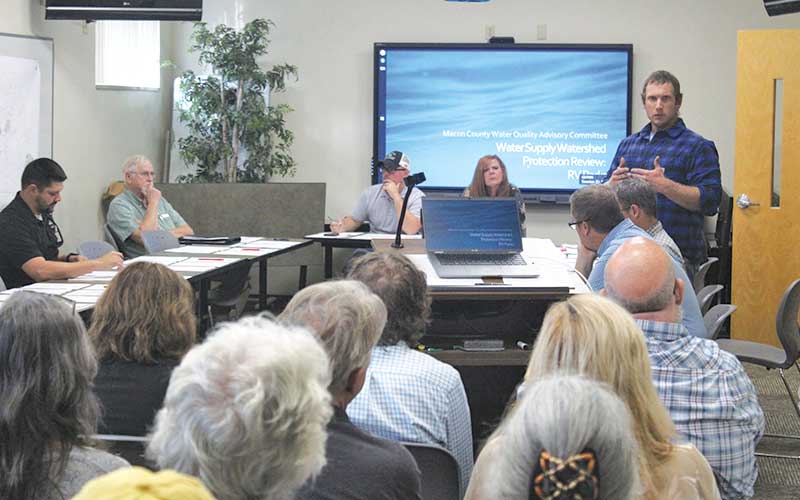
Highlands Biological Station Associate Director Jason Love presented a slideshow on behalf of the Water Quality Advisory Committee. The slideshow had reasons to allow (housing crisis, campgrounds for outdoor recreation and private property rights) versus reasons to not allow (putting RVs in flood-prone areas, more impervious surfaces, higher density areas and possible septic/waste disposal issues).
Overall, the Water Quality Advisory Committee recommended that RV parks remain ineligible for a Special Nonresidential Intensity Allocation (SNIA). But if the board chooses to allow RV parks in these watersheds, they strongly recommended that they not be placed in floodplains, they should have robust waste effluent systems in place and follow the guidelines set forth under cluster developments.
Love also told the Planning Board their committee said the entire ordinance needs to be addressed, such as typos, making sure the watershed designations are consistent with the updated state designations and taking a look at some of the activities allowed in drinking watersheds. That includes the application of treated sewage sludge (residuals) in these watersheds. Love said residuals can have high metal content and PFAs (forever chemicals).
During public comment, Nathan Pannell chided the board for taking up these ordinances right after Hurricane Helene. Sarah Johnson said after Helene, other WNC towns and cities would rethink their ordinances about watersheds and floodplains if they could and urged the Planning Board to take their time. Walters responded to Johnson, saying a house being washed away is the same thing as an RV being washed away.
The meeting became an open dialogue forum with the crowd, at the encouragement of Young, who said they can’t have this at a commissioners meeting, and said he was willing to talk with the public after the meeting.
Phillip Gibson, a French Broad Riverkeeper, said there’s enough science to say don’t build in the watershed, saying forested landscapes help address pollutants.
Bill McLarney said events show county governments should do everything feasible to limit impervious surfaces and add more forest cover.
Katie Price, who is on the Water Quality Advisory Committee said she spent the previous few days cleaning RV debris from Fontana Lake, including septic tanks.
“Just because it’s secure doesn’t mean it won’t be in the water,” Price said.
Walters and Kimsey asked most of the questions and did the most talking among the board members. Kimsey said he could argue there are commercial developments worse than RV parks allowed in watersheds and called out the hypocrisy of how the county didn’t allow an RV park at the Parker Meadows site and then bought the property and used outside fill dirt to build the ballfields.
In response to going over the entire watershed ordinance, Walters said the Planning Board was tasked with looking over one sentence.
County Project Manager Jack Morgan said people aren’t busting down doors to build RV parks and said in his opinion there’s not a lot of fairness in the watershed ordinance.
Kimsey said it seems like RV parks are unfairly targeted in the watershed ordinance, saying they’re less egregious than other types of buildings. Johnson said if there are worse monsters out there that could be built in watersheds, then the county should tackle those issues as well.
Kimsey put forth a motion to recommend the proposed change and ask the commissioners to send back the watershed ordinance for “further changes for the safety of RV parks in floodplains and other recommended changes by the Water Quality Advisory Committee.” The vote failed 2-5, with Kimsey and Breeden in favor.
Then Walters made his motion to recommend passing the change in question and review and fully strengthen RV park permitting so septic systems meet or exceed any commercial or residential requirements. That passed 4-3.
Where are RV parks allowed?
Several speakers mentioned the confusion surrounding the proposed change to the Macon County Watershed Protection Ordinance. Even though the change strikes one sentence out, it’s impossible to know what that one change affects just from reading the ordinance.
According to the N.C. Department of Environmental Quality, there are different types of designated water supply areas, from Water Supply I to Water Supply V.
The first four types of Water Supply watersheds (I to IV) are “for drinking, culinary, or food processing purposes.”
Water Supply I (WS-I) is on land in public ownership and located in underdeveloped watersheds.
Water Supply II (WS-II) is roughly the same as WS-I but is in “predominately undeveloped watersheds.”
Water Supply III (WS-III) are waters “generally in low to moderately developed watersheds.”
Water Supply IV (WS-IV) are waters in “moderately to highly developed watersheds.”
Water Supply V (WS-V) are generally upstream to WS-IV waters and are “waters used by industry to supply their employees with drinking water or as waters formerly used as water supply.”
There are no WS-IV or WS-V waters in Macon County. Each of those types of watersheds is either a critical area or a protected area. Critical areas are adjacent to a water supply intake or reservoir. Protected areas are adjoining and upstream of the critical areas.
The Macon County ordinance allowed Special Nonresidential Intensity Allocations (SNIA) to build on up to 70% of an approved area in a WS-II Balance Area, WS-III Balance Area and Watershed-EQW (Excellent Quality Waters). The SNIA is an increase from the 12% built-upon area allowed for a WS-II Balance Area and 24% for a WS-III Balance Area. SNIAs aren’t allowed for Critical Areas.
The ordinance does not explain where those watersheds are in Macon County. The NC DEQ divides the water supplies into “Critical Area” and “Protected Area.” The definition between the DEQ’s “Protected Area” and Macon County’s “Balance Area” is somewhat the same, as the area adjoining and upstream of the critical area. However, a Balance Area is upstream of a WS-II or WS-III watershed, while a Protected Area is upstream of a WS-IV watershed.
According to the N.C. Department of Environmental Quality, Macon County has a 29,329-acre WS-III Protected Area and a 170.69-acre WS-III Critical Area for Cartoogechaye Creek, which serves the Town of Franklin’s drinking water.
In the Highlands area, there are six designated watersheds: a 4,953.71-acre WS-III Protected Area and a 935.73-acre WS-III Critical Area for the Cullasaja River/Lake Sequoyah, a 2,982.85-acre WS-II Protected Area and a 167.39-acre WS-II Critical Area for Big Creek, a 113.35-acre WS-I Critical Area for Houston Branch and a 109.89-acre WS-I Critical Area for Rattlesnake Branch.