
More than 90 Macon County residents signed a letter to the Board of County Commissioners condemning the county’s lack of oversight on contractors charged with waterway cleanup and urging the county leaders to more closely monitor the remediation of riverbanks by those same contractors.
Following the conclusion of the U.S. Army Corps of Engineers work on waterway cleanup, in which the Corps and Western North Carolina counties hired subcontractors to remove Hurricane Helene debris from local waterways, Michelle Ruigrok sent a letter signed by 97 Macon County residents that condemned much of the work conducted by these subcontractors.
“We solicited each name individually,” Ruigrok said. “I know that many people were happy to see the rivers ‘cleaned up,’ but I want it to be made clear that there was a higher quality of work done elsewhere.”
The cleanup, which concluded on June 1, was criticized by residences and businesses who saw the work being done as unnecessary and excessive, with contractors working in sections of river that had seen little to no Helene-related debris. Comments from conservationists, locals and business owners made at the April and May commissioners meetings condemned the lack of oversight from the county that led to large sections of the Little Tennessee and Cullasaja Rivers and Cartoogechaye Creek to be stripped of naturally occurring debris. There were concerns that the local tourism economy and the local ecology, including habitat for at-risk or endangered species, could be harmed through the excessive removal and the overuse of heavy equipment in the waterways.
“This work was allegedly done in the name of public safety. However, Macon County had a fraction of the debris of other counties from Hurricane Helene, and comparing our ‘debris removal’ to the scale of destruction in other counties is disingenuous,” the letter read. “In the face of lack of oversight from US ACE, the County should have taken agency over the situation and supplied local oversight at the sites where the contractors were working to make sure they were within the guidelines. Instead, we had to take it upon ourselves to document the damage from the contractors.”
The letter noted the difference in service seen in Macon County and the service seen in Henderson County through its subcontractor, Southern Disaster Relief. Ruigrok said that SDR generally received high praise from locals and conservationists, working closely with both local leaders and biologists when making decisions.
“To be clear, we do not fault the County for opting to work with US ACE and its contractors for this work, and we are not against appropriate debris removal,” the letter read. “But there are numerous examples of this work going well in other counties that chose to work with state contractors or manage the contracts themselves with the promise of reimbursement from FEMA.”
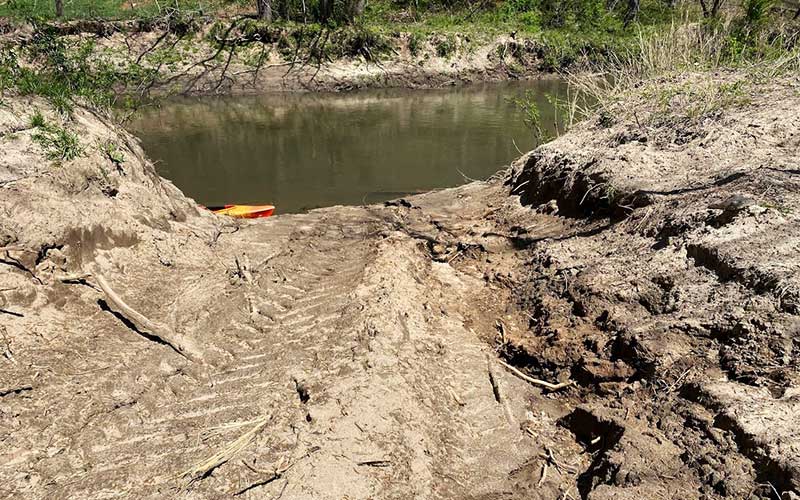
“Macon County government still has a chance to step up and lead us through the final phase of this process,” the letter continued. “We are concerned about remediation at the ingress/egress sites, and we hope that you take this seriously. Disturbed sections of banks that have been stripped to bare soil pose serious and long-term risk for erosion and bank instability, but they must be remediated in a hydrologically effective manner that protects wildlife.”
Highlands Biological Center Associate Director Jason Love said remediation of the riverbanks has seen mixed results and estimated that only a quarter had been properly remediated as of July 11. After contractors clear pathways and riverbanks to allow equipment to access the waterways, those pathways need to be reseeded to prevent erosion in the long term. According to Love’s observations, some ingress and egress sites have been reseeded while others have been neglected. Love said some of this may be because it is up to local property owners to work with contractors to allow them to access the land for remediation.
“Some sites are pretty badly eroded and those haven’t been touched yet,” Love said.
In the worst case, at a site near Prentiss Bridge Road, a nylon mesh erosion control mat was laid down. Love said these meshes are banned in some states and are known to harm wildlife, which get caught in the mesh. Just days after being installed, Love said he found four nonvenomous, native snakes — three black rat snakes and one water snake — dead in the mesh. He said he cut out the snake carcasses and removed the mesh at the site.
Love said many sites along the Cullasaja were still a disaster, with trash left at the collection sites without having been collected. Though Love said this trash appears to have been dumped, he said it shouldn’t have been hard to go ahead and collect the trash while the equipment and contractors were on-site.
The situation is complicated through the use of multiple subcontractors in the area. “Maybe some contractors are doing the right thing,” Love said, “but some contractors look like they haven’t gone back” to engage in remediation.
“We believe you that ‘next time’ will go very differently,” the letter to the commissioners concluded, “but this is still happening, and we need you to make sure that contractors are not allowed to get away with any more negligent damage to our rivers. We, as citizens of Macon County, ask that you please devote county resources to the careful remediation of disturbed areas from US ACE contractors. We can help with guidance and resources, or to help advocate on your behalf to get it done. ‘Next time’ is now.”
Angela Faye Martin, co-owner of Alarka Expeditions, cosigner of the letter and a vocal advocate against the corps’ debris removal in Macon County waterways, said the work that was done came “at the grave expense of the ecology.”
“I hope that next year I have a season where the river feels like it’s not under siege,” Martin said.
“I can’t get over that it could’ve been done differently,” Ruigrok said. “As happy as people may be … it’s just not good enough.”