
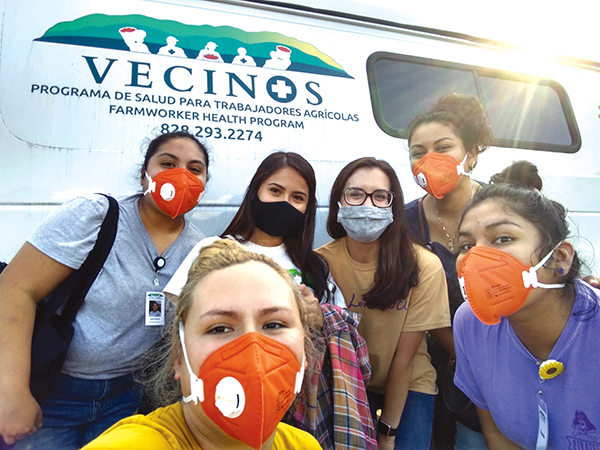
Macon County’s Latino community has been hit hard by the COVID-19 pandemic, but their neighbors have stepped up to help reduce their risk and slow the spread of the virus.
“Vecinos” is Spanish for “neighbors,” and the nonprofit Latino advocacy group bearing that name has been working with Macon County Public Health to track and shut down outbreaks among Latino farmworkers and their families. They distribute PPE supplies and information to families that are sometimes isolated and disconnected from the health care system.
Vecinos operates mobile clinics that visit farmworkers after their workdays. The organization aims to help the two main groups of Latino farmworkers – migrant workers who travel to find jobs, and seasonal workers who live in the community, said Marianne Martinez, Vecinos’ executive director.
In 2019, Vecinos worked with 281 Latino patients in Macon County. That’s about 30 percent of the total from the eight WNC counties they serve.
“There are a lot of sizeable farms in Macon,” she said. “Most of our folks in Macon are going to be migrant, but there’s also a sizeable number of seasonal folks.
“In Western North Carolina we see [migrant workers] coming up from Georgia and Florida, and on work visas from Mexico.”
Martinez pegs those numbers as some 170 migrants and about 100 seasonal workers.
Reaching out
The health department has been working with Vecinos to reach out to the Latino community.
“We made a concerted effort to go out to migrant farms and do some education,” said Kathy McGaha, director of Macon Public Health. “Vecinos have been great partners. They’ve helped with interpretation and messaging.”
Providing information is essential to controlling the spread of the coronavirus. The health department currently has three Spanish-language interpreters on staff. Two are employed by the department, with another provided by the State of North Carolina.
“They get one-on-one education anytime someone gets tested,” McGaha said. “They’re being educated about how to take care of themselves. For a person who’s positive, we reach out to them on a daily basis.”
Greater impact
According to numbers compiled by Macon County Public Health, the coronavirus has disproportionally affected the county’s Latino farmworkers and their families.
Latinos account for 60 percent of the COVID cases reported in Macon County, according to a Sept. 2 report from Macon County Public Health.
The numbers may be misleading, though, because of the heavy testing done among Latinos after two outbreaks.
“We happened to have an outbreak early in the pandemic with a primarily Latino church, and we also had the Norton Creek Farms outbreak,” McGaha said. “We’re definitely doing contact tracing and identifying people those testing positive have been around and possibly exposed.”
The Macon numbers may be skewed, but Latinos – and African Americans – are suffering most from COVID nationwide. According to the Centers for Disease Control, 26 percent of people who’ve died from the disease in this country were Latino.
What accounts for more positive cases and deaths in Macon’s Latino community?
“That’s the million-dollar question, what’s going on, why this particular part of the population has a higher rate,” Martinez said. “There are some contributing factors that other populations might not be seeing.
“Some of the factors that we have seen have stemmed from employers that are not taking this seriously, not requiring PPE on the job site, not requiring employees to take it seriously,” she said.
There are other challenges in identifying, treating and tracing positive COVID cases among Latino farmworkers. Some, especially undocumented workers, are reluctant to draw attention to themselves and distrustful of any government agency.
Many of the Latinos in Macon County work on farms, and for landscaping and construction crews.
“The vast majority are going to be young single men,” Martinez said.
Farmworker housing, in particular, is conducive to the spread of the virus.
“Any congregant living situation – whether it’s migrant farmworkers’ housing, nursing homes or jails – is at risk of rapid spread of the virus,” McGaha said. “If it gets into that population it spreads very easily. Latino individuals, many of them are essential workers. They tend to have multi-generational living situations.”
Martinez agreed that living and working conditions can make COVID more of a threat to Latino communities.
“With the congregant living situations that our migrant farmworkers, in particular, live in, you see why the numbers are adding up,” Martinez said. “They live together and travel together to work in very close quarters.”
Martinez added that tracing the contacts with Latino residents who] test positive can be problematic.
“There’s sort of a general mistrust of government and an unwillingness to share with whom you spend your time,” she said.
Vecinos, based in Cullowhee, is a nonprofit organization. To donate or volunteer to help with their work, go to vecinos.org.