
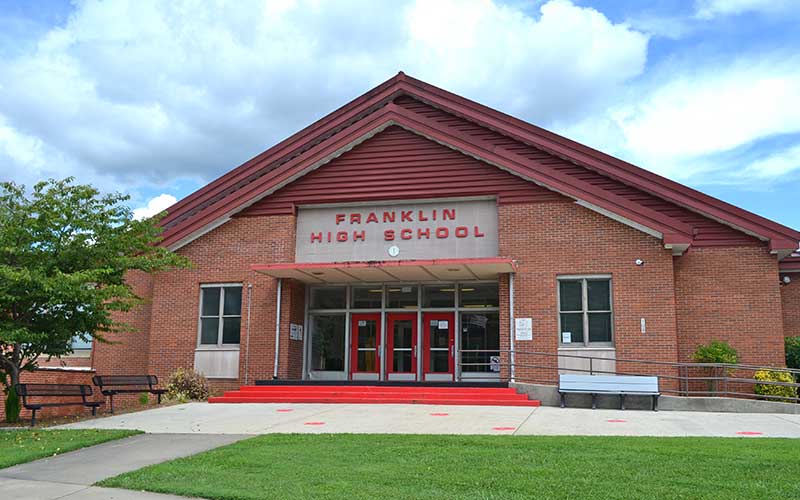
The Macon County Board of Commissioners voted last week to proceed with the contract to begin the schematic design of a new Franklin High School.
The $476,161 contract will be with LS3P, which is the company that conducted the study of the current campus and compared the cost of remodeling ($111 million) to that of building new facilities ($118 million). The results of that study were presented at a July 26 special meeting of the County Commissioners and the Board of Education.
The county has allocated $819,381 in the 2022-2023 budget for the FHS project.
During the Aug. 9 Board of County Commissioners meeting, County Manager Derek Roland said the $118 million is “obviously a very healthy price tag” and many people are questioning how the county will pay for it.
The full price tag, with financing and rolling in existing debt, is estimated at $245 million.
Roland said the county will reapply for the state’s Needs Based Public School Capital Fund grant. The county’s grant was not approved in the first round of funding, but they will reapply for the maximum amount of $50 million. If awarded in full, there is a 5% match requirement ($2.5 million).
Local option sales tax
The commissioners approved a resolution to have a local option sales tax placed on the ballot for the Nov. 8 election.
The county has produced a brochure to help educate people about the quarter-cent sales tax prior to the election.
The brochure states: “The ¼ cent local option sales tax will help share the burden of funding capital needs in the Macon County School system among non-property owners, as well as those traveling to Macon County.”
By comparison, a property tax increase would only be paid by property owners.
Roland said the county has continued to see sales tax revenue increase each year, even during the pandemic. If approved the quarter-cent local option sales tax would generate an estimated extra $2 million in revenue each year.
The local option sales tax would not apply to groceries (unprepared food) or gas. If approved, the sales tax you pay on a $75 purchase would increase by 19 cents from $80.06 to $80.25
As of October 2020, 44% of counties in North Carolina have levied the additional quarter-cent local sales tax option. Six surrounding counties – Jackson, Haywood, Swain, Graham, Cherokee and Clay – have adopted the local option sales tax.
The wording on the November ballot will give voters the option to vote for or against “Local sales and use tax at the rate of one-quarter percent (0.25%) in addition to all other State and local sales and use taxes.”
In a Franklin Press online poll 46% said they would support a sales tax to support capital school improvements, and 54% said they would not.
Franklin High School teacher John deVille addressed the commissioners at the Aug. 9 meeting. As part of his comments, he responded to those in the community who would not support any sort of tax increase.
“The easiest thing to say in American politics is ‘no’ to taxes. It’s an easy applause line because we fundamentally want to keep our money. Saying no on taxes takes no thought on the part of the speaker nor the listener – it’s all a reflexive act,” deVille said. “What is harder for both political leaders and taxpayers is to say ‘yes’ to the tax because doing so requires outlining a vision, it means explaining that vision, it means demonstrating that the investment in the public good will serve the greatest number of the community members well, at the lowest possible cost. I believe the July 26 presentation was an excellent start, and to those who may fall sway to the ‘no taxes’ argument I ask you to ask what the cost is to yourself and to your community if we fail to invest and invest now.”
deVille said he could find no good reason to listen to the “smattering of ill-founded naysaying” from those who are saying the projected new school is too small or that it should be moved somewhere else. He asked where they have been during the past 20 years when the need for improvements at the high school were discussed.
He said students who travel to other schools for academic or athletic competitions and often come back and ask “How come they have such a nice school and we don’t?”
He answers, “Because that state/county has the political vision and the political will, and we do not – it’s not because we’re broke because we’re not.” He said that leaves students puzzled about what the county’s priorities are. He concluded by saying that he hoped the community would provide the support for solving that puzzle.
School location, size
Dylan Castle also spoke during the public session and posed several questions to the board such as what other properties were looked at, is it mandatory that the school be in the city limits, will the proposed school be big enough to accommodate future growth and the comparison of renovating versus new build.
To the matter of location, Roland said access to city water and sewer was necessary. Costs would increase even more if the county had to build infrastructure on the site.
When speaking as part of the program at the Aug. 10 Rotary Club for Franklin meeting, Superintendent Chris Baldwin said they started looking at potential sites in 2016 and identified eight possible locations for a new school. One of those sites was 60 acres in the southern part of the county and it would have cost at least $7 million for excavation. They also had to consider costs associated with infrastructure, road access, water and sewer and parking. “It all kept coming back to the current site,” he said.
Commissioner Ronnie Beale said in addition to looking at other sites, they also took into consideration what would happen to the existing buildings and campus if the high school moved.
In addressing the issue about enrollment growth, Baldwin said they looked at how much the school system has grown in the past 40 years and used that 16.6% growth rate to project future enrollment.
“Twelve hundred students is a pretty good estimate,” he said, referring to the projected capacity of the new school. The enrollment at Franklin High School was 993 in 2021.
In response to Castle’s questions about the size of the school, Paul Boney, LS3P senior vice president, said, “We plan for the future, and we plan for exactly what you are saying.” He said if they went ahead and built a school for 1,600 students there would be classrooms sitting unused or the enrollment might not ever reach that number. He equated it to building a church for Easter Sunday when the congregation attendance is much larger than a routine Sunday.
Boney said the FHS plan will include an option for where additional classrooms could be built in the future if needed.
“No one knows exactly what is going to happen,” he said. “We build on what is reasonable. It is a reasonable number for the growth that is expected.”
Baldwin said as an example, when he was principal at Nantahala in 2008, they had between 120 and 140 students, and it was predicted they would have more than 200 students by 2020. There are currently 85 students at the school. “That projection was inaccurate.”
Regarding FHS growth, Baldwin said, “I think a 200-student increase over 40 years is probably pretty accurate.”
Commissioner Gary Shields said they looked at three areas when considering the FHS project: athletics, academics and ADA compliance. He invited anyone to sit with him and review the project plan and the comparison of renovating or building new structures. He said another public meeting will be held in October.
Highlands Mayor Patrick Taylor and FHS Principal Mickey Noe both spoke in favor of the new school.
“I can say without any reservation it’s a blessed place to be,” said Noe, who is starting his second year as principal.
Noe said the nostalgia at FHS amazes him and he thinks the school should remain at its current location, but that’s not to say it doesn’t need to improve.
“The school is worn out, it definitely needs to be redone,” he said.