
Barbara McRae
bmcrae60@gmail.com
Relaxed on his comfortable back porch last week, Dick Jones reminisced over the cases and characters he has known during nearly six decades as a Franklin lawyer.
He grew up with a lawyer father and lawyer uncles who worked in the Franklin firm started in 1878 by the patriarch of this legal dynasty, George Andrew Jones.
With a background like that, Dick’s career path should have been obvious from the start, but he says he didn’t know what he wanted to do.
In 1956, after graduating from Davidson College – still trying to decide on a path forward – he volunteered for the Army. Because he had two years of ROTC he went in as a corporal, but it was a quiet time and he found it boring, or worse. He vividly remembers the mosquitoes he faced while camping in a Louisiana marsh – they were a shock for this mountain boy.
His stint in the service had one big benefit, however. It gave him a couple of years to think. By the time he got out, in 1958, he knew what he wanted: the law. He wanted to go home and practice with his father.
Dick graduated from law school in 1961 and had a few months before getting his license – time for “fun things” like going to the courthouse and doing research. In September, with law license in hand, he joined the firm, got a private office and did some real estate law.
That was nearly six decades ago. Whatever you might think of Louisiana mosquitoes, they clearly put Dick Jones on the right path.
He is the fifth Jones lawyer to work in the firm his grandfather founded. Through the years, he practiced with his father, Richard Sr., and two uncles, Lyle and Gilmer, and then with his son, Fred, the fourth generation of Joneses to serve here.
Melissa, Dick’s wife, came in to help temporarily 50 years ago, when his secretary fell ill. Her role proved indispensable, and she stayed on. She still describes her role in the office as “helping.”
Today, the 142-year-old family tradition continues. Fred is at the helm now, with his wife, Jennifer, as his assistant. The well-worn paths through the hall of the office still beckon to Dick, however. There must be something seductive in the scent of those old legal tomes.
A quintessential country lawyer
For nearly 60 years, Dick has served a rural community and done so with gusto, even when it meant taking his fees in oranges and “valuable uncut gemstones” (a.k.a. rocks), Fred says.
The Jones office moved around a little over the years, but always within the same Main Street block. Dick wore out the pavement going back and forth to the courthouse, his upright figure, unfailing courtesy and trademark smile a reassuring and unmistakable part of the Franklin scene. When time permitted, he would sometimes join the storytellers on Main Street benches, where swapping tales was a way of life, or offer a kind word of free legal advice to a worried acquaintance met on the square.
Like most old-time Franklin residents, Dick Jones appreciated the many characters nurtured by the town – a character being someone who did things his or her own way, often with a certain degree of flamboyance, and gave the storytellers meat for their favorite pastime. Some were his clients, and he remembers them fondly.
For example, there was Bob McClure who, in Melissa’s words, “traded real estate like most people trade chewing gum.”
“He had so many files that, when he died, we gave him his own cabinet,” she said. McClure would trade anything for land – a car, for example. The Joneses ended up with a station wagon as payment in one of those deals.
“There was a hog in connection with that one, too, wasn’t there?” she asked.
“I think that was a different one,” Dick replied. He remembers that it was a cow.
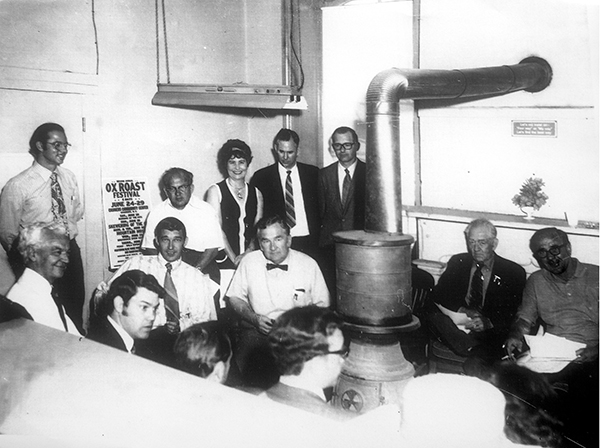
He studies a black and white news photo of a county commission meeting, circa 1970, in the old courthouse. “Here are some characters,” he remarks, passing the photo over. The photo shows commissioners and other officials and dignitaries of the day, gathered around a boiler in a room with no other decoration than a poster advertising “Ox Roast.” Dick is standing next to the stove. Chairman Oscar Ledford is in front of him. Ledford famously brought home the bacon for Macon County through his generosity in distributing country hams around the state capitol.
A busy life in the law
From his calm manner, you might not guess Dick was a workaholic. But, the hours he put in worried his little boy. Fred says his earliest memory of the office was his dad sitting behind a carved desk. The figurines on the desk looked like gargoyles, he recalls.
“I had just seen Dickens’ Christmas Carol and was terrified by the thought of a ghost in chains haunting a man who worked too much,” Fred recalls. “I was so afraid that Dad’s desk was haunted by the ghost of Jacob Marley.”
Dick’s busy work life meant traveling outside the county for trials, serving 25 years as county attorney, 12 years on the North Carolina Board of Law Examiners and as “president for life” of the county bar association. As the other Jones lawyers did before him, Dick also played key roles in myriad community organizations: First United Methodist Church, Franklin Jaycees, Franklin Rotary Club, Franklin Cemetery Association, Angel Community Hospital and Western Carolina University, among others.
His specialty has been property law. According to the North Carolina Bar Association (NCBA), his work in this field earned him a reputation “as a preeminent real property attorney handling matters ranging from county purchases and condemnations, to residential and commercial closings to his bread and butter – the land lawsuit.” It was a specialty to which his heritage, upbringing and personal inclinations ideally suited him.
When the NCBA inducted him into the General Practice Hall of Fame in 1999, the presentation recognized the unique approach Dick took to legal matters involving land, saying, “Rarely is anyone, let alone an attorney, as happy as Dick Jones when ‘walking the lines’ of mountain property.”
A favorite memory
Though Dick Jones has handled innumerable cases, civil and criminal, in his long career, it is hardly surprising that he counts a land dispute as one of his favorites.
He settles back – it’s a long story, and not one involving murder, mayhem or the usual kind of drama. As he sets the scene, it becomes clear how he earned a reputation in realty law. He loves the mountain land. It shows in his eyes and the smile that plays on his mouth when he talks about the terrain.
“Go up the Wayah Road, past Arrowwood … to an open field on the right at the foot of the mountain, before you start up, there is the McNish farm. There’s a little driveway that goes through the farm, up the hill to a dam and around a little lake. …”
You have to understand the land to understand the case, he explains.
A man named R.B. Dorman had retired from a textile company in Atlanta about 1939 and built a retirement home on a tract of land, 30 or 40 acres, above the McNish farm. He cleared about 10 acres and dammed a creek (a tributary of Wayah Creek) to make the little lake. He also diverted the creek for a fishpond. It was a “very pretty” place, Dick recalls.
Dorman enjoyed the place for 15 years before tragedy struck. He was dynamiting a stump on the side of the road when something went terribly wrong. “It blew up everything, including him,” Dick said.
His heirs continued to use the pretty mountain place he had built. Then Edgar McNish brought a lawsuit against the Dormans over the access road and locked a gate to prevent them from using it.
Dick took the Dormans side in the lengthy legal battle that ensued. Fortunately, he obtained a restraining order to allow them to use the access road while the case was being decided.
“McNish had a good litigator,” he said. “They beat us in Superior Court.”
The Dormans appealed, and won. McNish appealed, and the Dormans won again.
The senior McNish died (in 1964) during this lengthy process, but his heirs continued in his memory. It took three appeals and two or three years to settle the suit in the Dormans’ favor.
“The original trial was the really fun part,” Dick said. “At least five local individuals who knew the land testified that the Dormans had used the access road for 25 years, though there was no written easement. It was a long, drawn-out case, but to win it was exciting.”
Tragedy at the office
Something else happened about this time that illustrates Dick’s ability to shrug off events that might strike other people as traumatic. Thoughtful, measured and calm are adjectives that seem tailored to him.
Melissa still shakes her head over the events of Dec. 2, 1966.
“How was your day? Did anything happen?” she asked, as she usually did, when he came home that evening.
“No, it was a good day. Everything was fine,” he answered.
A friend called her a short time later, blurting out, “Isn’t it terrible what happened at the office today?”
Another attorney, Guy Houk, who had the office next to the Jones firm, had killed himself with a rifle.
Houk, who moved to Franklin in 1922, had served as superintendent of schools and had won two terms to the N.C. House of Representatives. After retiring, he set up a law office in Franklin and was appointed to serve as judge of superior court. He held that office only a year and a half before resigning, a few months before his suicide. Houk cited health reasons for his resignation, and those may have led to his death. He left his legal files to the Jones firm.
A Franklin institution
Family lore claims that George A. Jones ran away from home following a dispute with his father. He walked from his Buncombe County home to Franklin, arriving in town with his only pair of shoes slung over his shoulder. He had a cousin here, Dan Jones, who ran the Franklin Academy. George attended the school and met his future wife, Lily Lyle, there. After they married in 1875, the two took over the academy, while George studied law in his spare time. He won his license to practice in January 1878.
He quickly made a name for himself and rose in his profession, becoming solicitor of what was then the 12th District for two four-year terms, and then became judge of the newly established 16th District in 1901. He was being considered for the Democratic nominee in the U.S. Congress race in 1902 because of his strong reputation. However, his supporters recognized that he stood little chance against a powerful Haywood County candidate because that county so outnumbered the rest of the district.
An admirer, John O. Harrison (later a mayor of Franklin), pushed for George’s nomination, telling the Asheville Weekly Citizen: “I have heard nothing but words of commendation of him wherever he has gone, and a more upright and painstaking jurist never graced the bench of North Carolina.”
Harrison went on to say that George never sought political office, though friends had talked him into a successful bid for the N.C. House of Representatives in 1889, and he thought he could be persuaded to run for office again. It didn’t work out in 1902, however, and George never got another chance. Four years later, he was dead at the age of 57.
He left a large legacy, including nine surviving children. Three of the boys – Lyle, Gilmer and Richard – followed him into the law and worked in the family firm, as did his grandson, Dick, Richard’s son.
George also left a very large mantle of community service to his descendants.
One of his interests was a new cemetery, which he saw as critically important for the town of Franklin. However, he passed away before he could make it reality. His son Gilmer took up the cause, serving for years as chairman of the Franklin Cemetery Association, which oversees Woodlawn Cemetery. Dick Jones later took on this responsibility after Gilmer had him appointed to the cemetery board.
George’s role in establishing the Bank of Franklin in 1903 helped usher the town’s economy into the 20th century. Years later, his grandson Dick would serve a long tenure on the board of First Union National Bank, the successor of the old Bank of Franklin.
The law firm had its office above the Bank of Franklin. When the handsome old building burned in November 1940, the fire consumed the law library. It was a painful loss, but Jones and Jones moved down the street to the Ashear Building and kept going. Later, they moved down the street to the former Bryant hardware store and kept going. Today, it’s the oldest firm in the county and still going, 142 years and counting: six Jones lawyers; four generations – all intricately tied to mountain land and community and the law.