
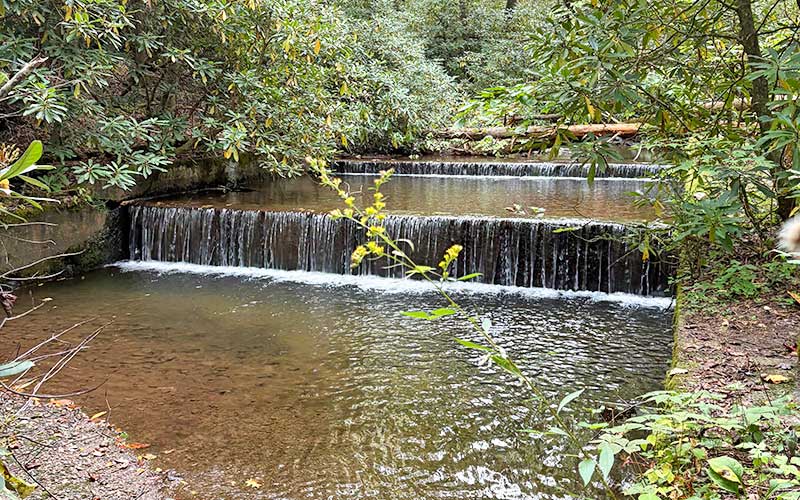
The Coweeta Hydrologic Laboratory could face closure if a federal reorganization effort moves forward unchallenged.
A memo from Secretary of Agriculture Brooke L. Rollins outlined a reorganization effort for the U.S. Department of Agriculture that seeks “consolidation, unification and optimization of functions” to “ensure … confidence in our programs to fight disease, feed the needy, manage our land and forests and work for all of American agriculture.”
The reorganization would result in the consolidation of nine stand-alone research stations, including the Southern Research Station in Asheville, into a single location in Fort Collins, Colorado. The memo did not specify when this transition would take place.
Sarah Farmer of the Southern Research Station said, “The secretary’s announcement was a first step. Some aspects of the reorganization will take place over the coming months, while others will take more time.”
The memo said the Fire Sciences Lab in Montana and the Forest Products Laboratory in Wisconsin would be retained due to their importance. It made no such assurances for the Coweeta Hydrologic Laboratory in Otto. It is unclear how research would be conducted with the Southern Research Station’s operations in Asheville being transferred to Colorado. Farmer did not comment on how the reorganization would affect the future of the Coweeta Lab.
Sept. 30 is the deadline for public comments on the proposed reorganization. Email comments to reorganization@usda.gov.
Coweeta Lab history
According to the USDA website, the land for the Coweeta Hydrologic Laboratory was purchased in 1918 and began collecting “rainfall, streamflow, climate and forest growth” data in 1934. Since then, the lab has conducted a variety of research while continuing to collect rainfall data. Research from the facility has been used as recently as 2025 to explore the effects of clear-cutting on catastrophic flooding by the University of British Columbia. The lab was also involved in the Long-Term Ecological Research program, which collected a broad set of ecological data from 1980 to 2020.
Through the Southern Research Station, the lab is currently researching the Hemlock Woolly Adelgid, an invasive pest that damages eastern hemlock populations, and the effects of prescribed fire on forests.
State legislators respond
Rep. Karl Gillespie and Sen. Kevin Corbin each made a statement of support for the laboratory alongside letters to Sens. Ted Budd and Thom Tillis and Rep. Chuck Edwards.
Corbin said, “Apparently there is a proposal to close [Coweeta Hydrologic Laboratory] and other scientific labs and combine into one or very few such labs across the country. Coweeta is unique in that it is the flagship rainfall study lab for the Southeastern U.S. I believe their research and service to be invaluable as we navigate landslides and natural disasters due to rainfall and flooding … I support this lab in my district and will advocate to keep it open.”
Gillespie said, “I write this letter to formally express my strong support for the continued operation of the United States Forest Service’s Southern Research Station, Coweeta Hydrologic Laboratory, located in Macon County. It has come to my attention that the federal government is considering a reorganization plan that would consolidate several independent research stations into a single location outside of North Carolina. If such a proposal were to move forward, the Coweeta Hydrologic Laboratory would be forced to close … The contributions of Coweeta cannot be overstated, especially as our state and region confront the challenges of landslides, flooding and other natural disasters linked to extreme rainfall events. I respectfully request your advocacy in support of keeping this critical facility open.”
Congressman Chuck Edwards’ office did not return a request for comment.