
Cops coping with intense scrutiny
Lee Buchanan
editor@thefranklinpress.com
Local law enforcement leaders, while acknowledging that changes to police practices may be necessary, urge caution about a rush to reform.
Macon County Sheriff Robert Holland and Franklin Police Chief Bill Harrell both condemned the actions that led to the death of George Floyd in Minneapolis and triggered a national outcry.
“What happened with Mr. Floyd was atrocious,” Holland said. “It made me sick.”
Despite calls to abolish chokeholds and no-knock warrants, those actions are needed in extreme circumstances, Harrell and Holland said.
“We already have a no-choke policy, with the exception of a life-and-death situation,” Holland said. “You’re not supposed to choke unless you’re in an absolute life-and-death struggle. But it makes officers concerned if you say an absolute ban. There are situations where there’s no other way of getting control of an individual.”
“That has to be a literal deadly force issue for that to be any option whatsoever,” Harrell said.
They also agreed that no-knock warrants, like the one that led to the shooting death of Breonna Taylor in Louisville, Kentucky, still have a place in law enforcement.
“If there is enough intel to almost guarantee that there’s an imminent threat, or a hostage situation, there would be a place for that,” Harrell said. “We need to be able to do what we need to do to protect the greater good.”
A community conversation
Holland said he recently met with leadership in his department to stress the importance of equal treatment for everyone, including minorities.
Harrell plans to step up training.
“We will be doing more training with regard to minority sensitivity,” he said. “Those are specific curriculums that are offered by the state and locally. Just so we can have a better understanding as to where some of these legitimate concerns are.”
Holland said the first step to reform should be starting a community dialogue.
“What needs to happen, there needs to be serous conversations to begin looking at both sides and having a sincere conversations about what the issues are,” Holland said.
“I think there needs to be some change, and I think there needs to be some accountability,” Holland said. “And I’m good with that. If there are changes that need to be made, then I think community leaders and community members need to have conversations.”
Harrell also stressed the importance of establishing and nurturing law enforcement’s ties to the community.
“When we talk about community policing, that is not just a catch phrase,” he said. “We will continue to grow, strengthen and foster those ties to the community.”
Harrell said he has not seen overt racism among officers that he’s served with.
“That doesn’t mean it can’t happen,” he said. “I’m not naïve, but I don’t think that any of the people I’ve gotten to know over the past two weeks are cut from that cloth. I’m really convinced that’s not who these officers are. And I’m certainly not going to tolerate it if it happens. I’ll deal with it swiftly and appropriately.”
Holland said he has never received complaints about racism.
“As a sheriff, I get lots of complaints, but I cannot recall a single time where individuals have come to me and accused our officers of being racist,” he said. “I’m not gonna say that there isn’t racism and police brutality. There absolutely is, and we all know that.”
Safe, peaceful Protests
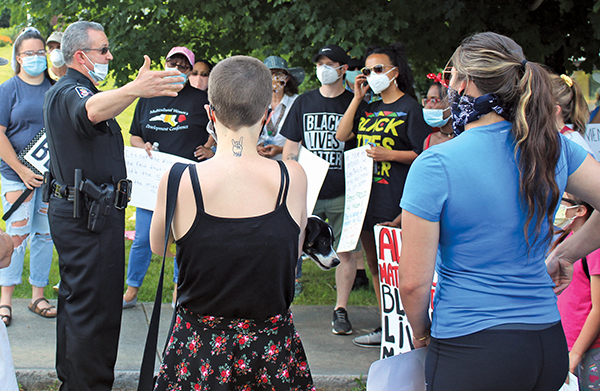
The two Black Lives Matter protests in Franklin took place without any serious incidents, but the actions of some protestors caused some hard feelings, Harrell said.
“There have been questions and debate about the way we handled the two protests,” he said. “At the end of the day, everyone went home safely – no injuries, no destruction of property. That for us is a win,” adding that “people have every right to have their voices heard.
“And we did a lot more than the public will ever know to give them that opportunity and make it as successful as it was,” Harrell said. “It wasn’t just closing down an intersection, there were days of planning that went into it. We did a lot of reconnaissance. People don’t know about the allegations and threats, and the potential threat assessments.”
Holland said he and Harrell reached out to the organizers of the protests, telling them, “We want you to have a peaceful, successful protest. We’re hear and we want to help you.”
The sheriff said he was disappointed by the actions of some protestors.
“They were absolutely disrespectful by chanting [ACAB], Holland said. “You have one person holding a sign that says ‘love, not hate’ and at the same time chanting ‘all cops are bastards.’ And it wasn’t just a few people.”
Holland said he was proud of his officers for not responding to the insults.
“We took the high road and maintained professionalism,” Holland said. “I’m incredibly proud of every officer that was out there that day. Because you know that they were upset, but you couldn’t tell it. They maintained their composure and shined.”
Morale suffering
Both men said that low morale, already an issue in law enforcement, has taken a big hit because of widespread public condemnation.
“Morale is tough,” Holland said. “There’s a lot of stress, there’s a lot of anger, there’s a lot of concern. Families worry about our safety.”
Positions are going unfilled due to a lack of interest in law enforcement as a profession.
“There’s not a lot of people interested in gong into law enforcement right now,” Holland said. “I have vacant positions right now and no good applicants.”
Harrell said interest in law enforcement as a career is in free fall.
“When I began in the early ’90s, my class at the public safety center had 40 in the class,” Harrell said. “Today, they struggle to get 10. And it’s only going to get worse because of the climate our nation is in.
“It’s a dying breed that wants to do this,” Harrell said. “There’s just not enough appreciation and acknowledgment given to the dangers and the complexities of doing this job. It is so taken for granted. Just like every occupation, there’s good and bad. We are not perfect.”