
Early College students use art to present climate change solutions
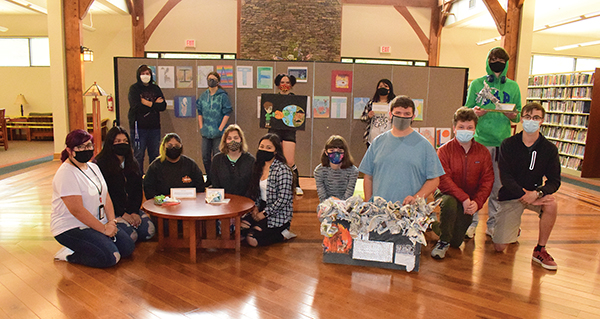
Macon Early College students in Gloria Painter’s earth environmental science class recently completed a project that paired lessons on climate change with art. The Climate Solutions unit encouraged students to investigate solutions for climate change and present their ideas through art.
“One of the things the Early College system teaches is innovation in teaching, part of that is Project Based Learning (PBL),” said Painter, who has been involved with Early College learning for 14 years. “I’ve done a lot of training in PBL, because PBL works.”
Over time, Painter has developed her own PBL lessons based on the availability of people, resources and issues that come up. She designs the units to reflect the students’ interests and what they want to discover. The Climate Solution PBL looks at all the things that can influence climate change.
Painter said, “The driving question the students continue to reflect upon is: what are the main dangers of climate change, why is it happening, and how can we most effectively use art and the power of speech to decrease the rate at which our Earth is being impacted?”
As part of the project, the ninth grade students participated in En-ROADS, a simulation with climate change data conducted by Southwestern Community College, the American Library Association, and Citizens Climate Education. They conducted labs concentrated on global warming and carbon emissions from vehicles.
Cameron Rodewald said one thing they learned was how refrigeration units, such as refrigerators and air conditioners, contribute to climate change. Refrigeration units typically use large amounts of electricity, which is produced by burning fossil fuels that emit carbon dioxide into the atmosphere. He suggested one solution would be for companies to start making environmental-friendly refrigerators.
The Art Connection
The students observed various types of art that expresses climate change and learned how to create podcasts as a way of sharing information. Painter arranged a Google meet with a representative from Blue Ridge Public Radio to teach the students about broadcasting and podcasting.
Their final assignment was to take the knowledge they gained through the project and create a piece of art that demonstrates a compelling message to influence others to take action. Their art is on display at the Macon County Public Library through the end of June.
Rodewald’s group created a project titled “Money’s Killing Trees.” The piece features what looks like a dying tree covered in money. The message: “This shows how money fuels the cutting of trees. Trees are cut down to make room for people and farmland. When trees are removed, they generate a large amount of wealth for the people behind the actions. Money encourages deforestation without stigma.”
Rosita Franco Valencia suggested better education in developing countries would be a step in solving the world’s climate problems. She and her project partners created “Earth’s Puzzle” to show how different factors come together to damage the Earth. The puzzle consists of four clay pieces that form a circle. Three large pieces show climate change issues, and the fourth, and smallest piece, is how little of a green world remains.
“Human Destruction” is the title of Logan Bradley and Kylie Sanfilippo’s project. The piece addresses the pollution and carbon dioxide emitted from a factory. A cloud of newspapers represents pollution and “to show how the news media misinterprets climate change.” Rising temperatures create a drier climate more at risk for wildfires and melting ice caps cause rising sea levels. All these images are on a black background representing “the future air quality if nothing is done about this threatening situation.”
Bradley said the project helped him realize how many things in our everyday lives can influence climate change. “Whenever you look at it, a whole bunch of things are connected to it.”