
In as little as a few of days, places of worship may be allowed to reopen their doors and resume regular services (albeit with restrictions on capacity), but not every church thinks that it’s time to go back to business as usual.
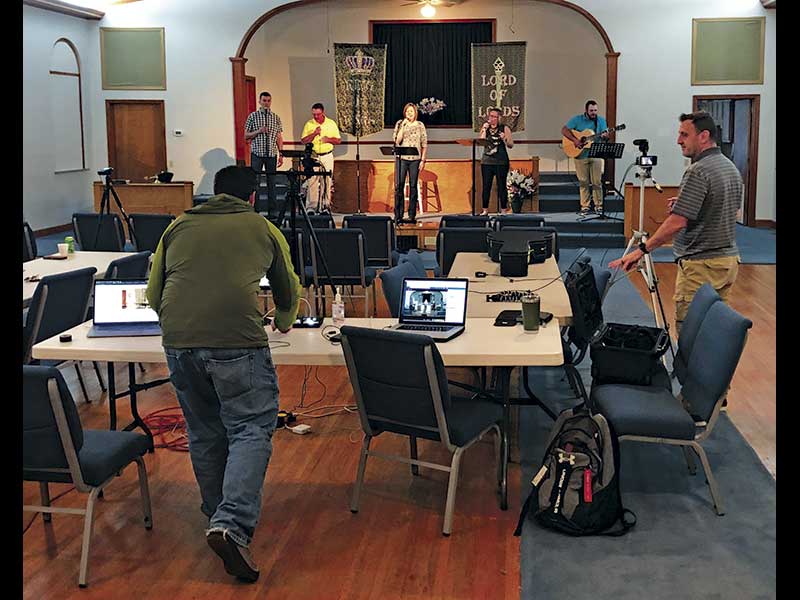
Churches had to adapt rapidly at the beginning of the shutdown to figure out how to keep having services when gatherings of 100, 50 and finally 10 people were banned, but a lot of innovation has been born out of the struggle.
Services live almost entirely in a virtual space now, as do some morning devotions and small group classes. Over time, other options have been experimented with to appeal to those without reliable broadband access, such as Holly Spring Baptist Church’s new drive-in services. Pastor Donnie Seagle said that the high attendance at the drive-in is indicative of how much everyone wants to get back to the normal fellowship routine.
“On our first Sunday with drive-in church, we thought it would be a good turnout if we saw 30 or 40 cars,” Seagle said. “What we got was closer to 85 or 90 cars. That’s about as many people as we would expect during a normal service and it wasn’t even all our members.”
Church staff is feeling the strain of the new normal. At Iotla Baptist Church, pastor Brandon Breedlove said that his week now mostly consists of preparing his sermon for Sunday and making phone calls alongside his deacons and other staff to make sure all members are having their needs met.
“The biggest challenge I’ve faced is keeping up pastoral care,” Breedlove said. “We want to be as wise as we can in caring for our more vulnerable populations, but it does make a big difference in my days.”
Finance is another consideration. Pastor Stephanie Thompson of Hickory Knoll United Methodist Church said that social distancing guidelines prohibit many of the church’s fundraising efforts, like their weekly fellowship breakfasts. Many members have chosen to tithe their stimulus checks, which have gone a long way, but she still expects a major revenue shortfall this year.
“We depend on fundraising to do the work of God,” Thompson said. “I would conservatively say that for the months since this started, we’ve lost about $8,000 in fundraising.”
But even with all of these issues in mind, none of these pastors are eager to rush back to traditional services.
Breedlove said that the same issues he has caring for his church’s aging populations from afar are also reasons to move towards reopening slowly and carefully so as not to put their health in jeopardy. He expects the church to return to services in phases with reduced capacity, even if the state provides looser guidelines.
“I don’t know about opening up immediately,” Breedlove said. “We have met with our deacon body and talked about some of our options and we seem to be better suited to slowly phase back into normal services.”
Hickory Knoll is part of the Western North Carolina Conference of the United Methodist Church, which has given an opening date of May 31 for regular services, but Thompson expects that her church will take even longer. They want to have everything fully disinfected before welcoming the congregation back in, and seating will have to change to make sure that everyone has six feet of space, perhaps even pouring into the lobby with chairs set up in front of screens.
“A big part of this is making sure that we have everything set up for us to be together again,” Thompson said. “We’ll have to do it when we’re comfortable. We’ll have to wait for god to show us what to do.”
Seagle thinks that his sanctuary should be able to accommodate his whole congregation split between two services with plenty of distance, depending on the laws at the time. Phase two of the governor’s plan could open up churches as early as May 22, but it’s unclear how strict additional guidelines will be. In any case, he’s sure that drive-in church will do just fine while they evaluate the safest path forward.
“We need to get that gathering limit to at least 50 or 100 again before we can begin to legitimately open as normal,” Seagle said. “Giving us a percentage of seating capacity would be even better since we can seat about 600.”
In the meantime, while the church family misses the closer fellowship that they enjoyed before the pandemic, there have been some advantages to shifting to a mostly digital environment. Breedlove said many members who aren’t regulars at services have been tuning in online more often because of the easier access, while Facebook also allows members to spread the word about the church more easily than ever.
He also said that while coping with the changes in the world that have come so quickly over the last few months, the entire church is taking greater notice of the brevity of life, counting their blessings and taking advantage of chances to help their neighbors endure the rough stretch. Just because they aren’t assembled in one building doesn’t make them any less of a church.
“It gives us an opportunity to be the church instead of just going to church,” Breedlove said