
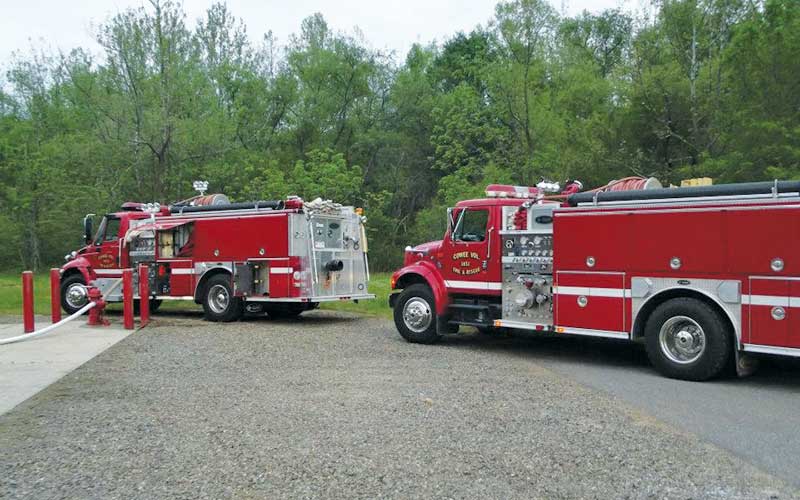
North Carolina firefighters must obtain several certifications from the Office of the State Fire Marshal to recognize hundreds of hours of training and preparation to respond to emergencies and save lives.
With volunteer fire training being a topic of discussion at recent county commissioners meetings, the Press reached out to Curtis Dowdle, dean of public safety training at Southwest Community College, and Dustin Pendergrass, chief of Cowee Fire & Rescue and chair of the Macon County Fire and Rescue Commission, to discuss the current state of fire training in the county.
The N.C. Firefighter Training Certificate requires 247 hours of training for volunteer firefighters spread across communications, health and safety, personal protective equipment, gear and fire behavior, among others. On top of that certificate, Pendergrass said there are additional certifications including the Driver Operator Certification and the Pump Operator Certification and a rescue certification series.
Classes and training are offered through educational institutions like Southwest Community College, by individual fire departments from certified instructors, and through dedicated fire academies, such as the one that used to be offered through SCC.
The fire academy offered classes on the weekends, which provided comprehensive fire training for the firefighter certification as late as 2019, but it was ultimately closed as SCC was unable to justify the cost of the fire school against its low enrollment.
Nowadays, Dowdle said SCC asks departments to submit requests for classes they want to hold at their stations. The college will help provide classes for these fire departments, with departments collaborating with their neighboring departments and with neighboring counties to ensure all their firefighters are able to complete the required training. This arrangement comes with its own benefits, Dowdle said, as the sharing of firefighters between departments helps to build relationships between departments – which improves the quality of responses involving multiple departments.
“On a large event, you’re going to have multiple agencies working together, it builds camaraderie,” Dowdle said. He said the current model helps the college use its instructors more effectively and they have actually increased the scope and frequency of specialized classes.
Pendergrass said part of the challenge in organizing across fire departments is managing firefighters’ work schedules, a challenge exacerbated by some classes requiring multiple days to complete. In general, Pendergrass said most classes could be held on Tuesdays, Fridays and Saturdays, but some classes could run all weekend and into Sundays.
Cowee held between eight and 10 classes at its department last year, with SCC also providing monthly medical continuing education classes on top of those. Pendergrass called SCC’s classes “top-notch.”
Dowdle said SCC delivers certifications and training for fire departments within SCC’s service area and serves all agencies with volunteer departments in that area. The college offers a series to help volunteers train for their firefighter training certification, with specialized training at different levels.
The limited number of certified instructors, many of which have separate full-time jobs, makes it difficult to offer all the required courses, according to Dowdle. The college has between 20 and 25 certified instructors, some of which can teach solo and some who must be paired with others. The college must manage this handful of instructors in a way that will maximize the amount of training they can offer while preventing burnout. Dowdle said this is the biggest constraint.
Another challenge comes from the individual fire departments. Dowdle said some of the departments have relatively few volunteers working with them, and it can be difficult to arrange trainings when the volunteers, who often have other full-time jobs and families to attend to, are able to attend training - without cutting down on the department’s ability to respond to emergencies.
Pendergrass said departments that face this issue should “step up to the plate” and send multiple people to get their own training certifications, which will enable them to provide some basic training in topics such as personal protection equipment. However, Pendergrass maintained that SCC “will work tirelessly” to ensure that training is available.
Dowdle said the region’s legislators are well-devoted to the training of firefighters in the area, securing fee-exemptions and securing other investments, seeing the costs as a taxpayer investment in public safety.
“We are so appreciative of the men and women … who keep our communities safe,” Dowdle said.