
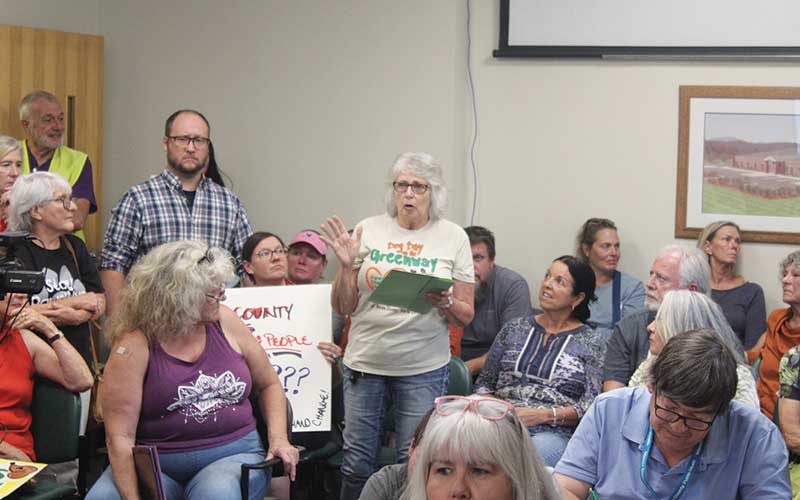
Volunteers and supporters filled the meeting room for the Sept. 24 Macon County Board of Health meeting. They want the board to ease the strain caused by understaffing and undersized facilities at the Macon County Animal Shelter.
At the end of the discussion, the Board of Health paused any recommendation about asking for funding or staffing increases until its Nov. 19 meeting after digesting the information presented.
Several speakers presented information over the first hour-plus of the meeting. Then, after the crowd left, health board members talked about it for another 40 minutes.
Marcia Doty said she knows there’s dogfighting in the area, noting one place she’s observed “with rows of dog houses and chains.” Doty said she’s adopted three pit bulls from an animal shelter in Clayton, Georgia, and that one shelter has more than 200 pit bulls in it. Pit bulls are the common breed of dog used in dog fighting, which is illegal.
Doty said they need a strong animal control element to keep out dogfighting “and the gang element” that follows, specifically mentioning the Latin crime gang syndicate MS-13.
“If we don’t make it uncomfortable for them to fight dogs here, and chickens too, then they’ll be here,” Doty told the health board. “Maybe not this year, maybe not next year, but they’ll be here.”
Stephanie Price spoke on behalf of Pawsitive Shelter Volunteers and Noah’s Ark Human Society. Price said data shows shelters nationwide are facing a crisis of overcapacity, driven by high intake rates and low adoption numbers.
“Primary drivers of low adoption rates are economic constraints, the high cost of veterinary care and housing limitations,” Price said. “All these factors are at play in Macon County.”
Price recommended implementing emergency funds to address critical staffing shortages, assessing the viability of the current Macon County Animal Shelter building, and considering reallocation of the current salary budget for Macon County Animal Services by having two animal control officers budgeted through the Macon County Sheriff’s Office and reduce the current county-mandated 10-day stray hold to four days. North Carolina law mandates a minimum 72-hour hold.
“Macon County Animal Services has experienced a 150% increase in animal intakes in the last four years,” Price said. “Now, also in those last four years, we have not received any additional shelter staff to care for the animals.”
Steve Grissim, like many other speakers, praised the volunteers for their hard work and invited the Board of Health and the county commissioners to visit the shelter and see the conditions for themselves.
Grissim later seconded Price’s idea of having MCSO animal control officers, saying they’re trained on how to handle dogs.
Betsy Carson said she began volunteering a week ago and after one day, cried from the work that the employees and volunteers do.
“It’s unbelievable. I mean, this is disgusting,” Carson said. “And I’m not even a cat person and I’ve been helping the cats.”
Ashley Higgs, manager of the nonprofit Appalachian Animal Rescue Center, mentioned their shelter took in 692 animals in 2023 to try to ease Animal Control’s burden.
“We have at least one person per 10 animals. They do not have that, at all,” Higgs said.
Higgs said they’ve gone from 300 adoptions last year to half that so far this year, saying it’s likely because of the lack of housing in Franklin.
“Animal Control, that’s who I depend on to do the groundwork for me,” Higgs said. “I get the animals from them to where they don’t have to put them down. And they need more kennels. We have more kennels than they do, and that is not right…I’m the second line of defense. They’re the front line.”
Higgs said that for those who have euthanized the animals, it’s a mental load on them. AARC does not euthanize, but Macon County Animal Shelter does. Jimmy Villiard, the health department’s population health section administrator, said the euthanasia rate is comparable to a no-kill shelter.
Meg Kremer said as a former animal shelter executive director in Chicago, she regularly would get animals from southern shelters. Kremer said in Chicago, owners who surrendered animals would be fined if the pet wasn’t vaccinated, chipped or spayed/neutered. Lax animal policies lead to overcrowding, Kremer explained, and volunteers doing work they shouldn’t have to.
“The volunteers should be socializing the animals. Why are we also having to break our backs, hurt our knees, end up in burnout, which is a very real phenomenon for anyone that’s been in this kind of job,” Kremer said. “Burnout is very serious and very real. Why are we being subjected to this? It doesn’t make any sense. We need the support of the county to provide for the paid employees who are not doing it for the money, believe me. They’re doing it for the love of the animals.”
Doug Kersey said as a volunteer of 2.5 years, he’s realized volunteers were being used to cover staffing shortcomings.
“I know one lady in particular who forks out $200 a week of her own money to get food and things like that for the animals,” Kersey said. “There’s not one of us who has not paid for veterinary care to one of the animals. I mean, we’re constantly coming out of our pockets. We don’t mind, but it wasn’t the intent of what’s supposed to be happening.”
Lynette Wiles said she’s worked in Franklin for 13 years and specifically, with the cats in Macon County.
“We have cat colonies, for crying out loud, it’s a health concern,” Wiles said. And when you don’t have the staff and those leaders, it’s only going to get worse.”
Wiles said a lot of people think if they turn in pets, they will get euthanized, and volunteers are trying to educate people about vaccinations and spay/neutering.
Volunteer Joan Evans said she was shocked at the amount of work done each day.
“All they want is to love you and they want to be petted. And that’s what I thought I would be doing mostly when I volunteered. I thought that I’d come out with whatever they need, but I’d also have time to play with the animals and give them a little human touch,” Evans said. “I very rarely have time to do that as a volunteer….And I can’t tell you the amount of times that I’ve gone home crying, because I fostered 13 kittens over the summer just to get them out of the shelter so they don’t keep getting sick. They keep passing diseases back and forth. It’s very sad.”
Jennifer Barrington talked about how employees rely on volunteers working all the time and can’t publicize what’s going on. She supports lowering the 10-day stray hold, saying any responsible pet owners know within two or three days if their pet has been picked up.
A letter from former Macon County Animal Shelter employee Chloe McMillan was read, talking about ceiling paint chips falling into dogs’ drinking water, there are holes in walls fixed with duct tape and cardboard, rusted dog kennels, water damage and other hazards in the current building.
“It has become too easy for the ones in charge to ignore the problems that they do not have to physically see or personally suffer from every single day,” McMillan’s letter states. “I believe that frustration fuels evolution, and I believe with the right amount of exposure, we can encourage those responsible for this neglect to do right by the animals and people they are actively failing. I urge everyone, no matter how comfortable it may feel, to please speak up and demand change.”
After an hour of public comments, Board Chair Jerry Hermanson thanked everyone for showing up and spoke about their passion for public health.
“But we don’t appreciate it when looking at statistics. So public comment like we had this evening makes a difference to us,” Hermanson told the crowd. “And I’m gonna encourage the board members to go by and spend some time. I know it’s hard to understand. We believe what you told us, but we wanna see it for ourselves. That makes us more invested.”
Board Member Matt Corbin said he felt the passion in the room and appreciated them bringing forth issues they didn’t know about.
“And this just gives us a little bit more power to ask for those things in the future,” Corbin said. “So we represent you all, and we thank you again.”
Later, Macon County Public Health Director Kathy McGaha said the public speakers “are very much correct in that the workload is too much for the number of staff we have.”
“We’re outgrowing the facility and we don’t have the number of staff,” McGaha said. “And yes, we do rely on the volunteers to get done the basic duties of running the shelter.”
Animal Control statistics
Villiard presented pages of statistics to the board members about the animal intakes and service calls. As of Sept. 5, there have been 1,072 animal intakes and 635 service calls. In all of 2023, there were 1,390 animal intakes and 543 service calls, which were significantly higher than the 625 intakes and 372 service calls in 2020.
“So the workload continues to increase with the current staffing that we have, that has not changed,” Villiard told the board.
Out of the 1,072 animals Macon County has taken in so far in 2024, 536 are cats, 526 are dogs, plus six “barnyard animals,” one horse, one pig and five “unknown wildlife.”
Just under a third, 301, have been adopted and 142 were returned to their owner. Another 250 were transferred outside of the community, 27 to Macon County Humane Society (AARC) and 81 transferred within the community or coalition.
So far in 2024, there have been 22 non-euthanization in-shelter deaths, 21 of which were cats, and 33 euthanizations. Out of those, 29 were vet-mandated, which included one skunk, one raccoon, two possums, one bird, nine dogs and 15 cats.
In calls for service, 128 were for nuisances, 100 for stray dogs, 84 for welfare, 76 for aggressive dogs, 50 for stray cats, 49 for trap delivery, 43 were livestock related, 28 for abandoned dogs, 13 for abandoned cats, 12 for injures animals, 10 for welfare emergencies, nine for wildlife, seven for cruelty to animals, six each for abandoned animals and agency assists, four for sick animals, two each for trap pickups and animal bite and one each for unlicensed dog, stray animal in complaintant’s custody, confined animal, deceased animal, malnutrition and “other.”
Villiard said “agency assists” are typically animals left behind after the owner/s are arrested.
Villiard added that while the volunteers buy extra treats for the animals, he didn’t like the impression that shelter animals have gone hungry.
“No new staff”
Board Vice Chair Ellen Shope asked if there were any budget increases requested for animal services. McGaha said no because County Manager Derek Roland (who recently submitted his 60-day notice) gave a directive to department managers that said “no new staff.”
This follows a 2023 attempt by Public Health to change an administrative position to an animal control position. However, the commissioners removed that position entirely.
McGaha said she put that position back in her budget request this year, “but from the time that I submitted it to Derek [Roland] to the time that it made it to the commissioners, [Roland] had taken it out again.”
Currently, there are three animal control positions, of which one is half of a shelter position, then a full- and part-time shelter worker. Currently, one of the three animal control positions is vacant. McGaha said they’ve lost staff because of the low pay and work required. Corbin warned about asking for new staff when they have trouble filling the current positions.
“Jimmy and I have scraped together all extra funding in the animal services budget that we can,” McGaha said. “And we’re funding another part time job.”
Villiard said they’re trying to get additional lighting in the dog aisles, saying there’s one kennel that’s too dark to use.
Villiard said the health department requested new doors for the kennels in the last two budget cycles but were not included in the version presented to the commissioners.