
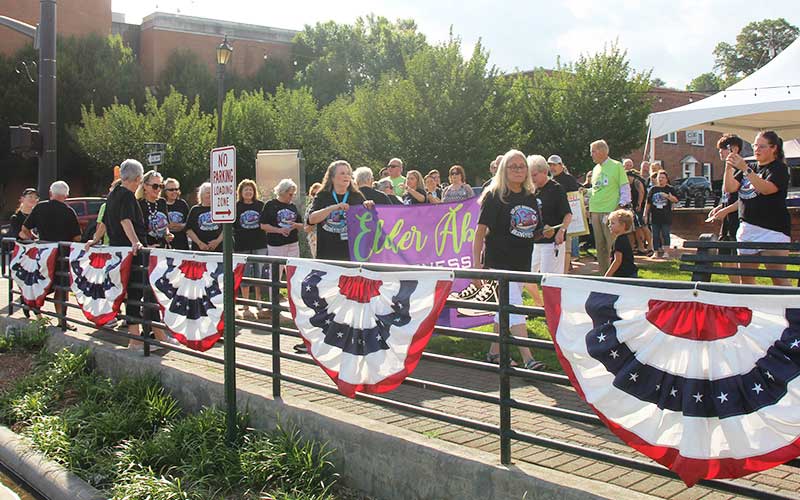
Residents and local lawmakers gathered Monday, June 16, at the gazebo in downtown Franklin to advocate for seniors and to spread awareness at the Area Agency on Aging’s annual Elder Abuse Awareness Walk. The program began at 5:30 p.m. with about 62 people joining the brief walk up and down Main Street.
Representatives of the Crawford Senior Center gave a brief presentation on elder abuse, where and how it happens and what to do about it. According to the National Center on Elder Abuse, as few as one in six cases of elder abuse are identified, and estimates suggest between 700,000 and 3.5 million seniors per year experience abuse, neglect or exploitation.
The center lists several risk factors, including dementia, mental health and substance abuse issues for either the victim or perpetrator, social isolation and poor health. In a large portion of these cases, the abuse comes from a loved one or close family member, which could lead to some family members being too ashamed or afraid to report the abuse or seek help.
Victims may also be unwilling to report due to feelings of denial or guilt, fear of retaliation or fear that they will be forced into nursing homes, which the center says can happen.
Franklin Mayor Jack Horton and Macon County Commissioner Gary Shields spoke at the event, encouraging those in attendance to report abuse.
“Don’t just assume that it’s going to be all right,” Horton said, “because you might be the only person who speaks up … it’s up to each of us to be their advocate.”
Senior Tar Heel Legislature Advocate Pat Hedrick asked for neighbors, caretakers and family members to make sure they speak up for seniors they suspect are being abused, noting that those at the department of senior services are legally required to report.
“I just encourage you all to please speak up, don’t be afraid to stand up for our elders,” Hedrick said.
At 6 p.m., synchronized with senior centers across North Carolina, the attendees joined senior services organizers to walk east down Main Street toward Town Hall, before crossing the street at the Scottish Tartans Museum to march back west to the gazebo. The walk was kept short out of a tradition established in consideration of Dot Crawford, the namesake of the Macon County Senior Center who was in her 90s when the walk started, said Senior Services Administrative Officer Jennifer Hollifield.
After the walk was completed, cupcakes and refreshments were served.
Advocating for seniors
In an interview about the state of senior care in Macon County, Hedrick discussed existing policies and resources alongside her active work with the Senior Tar Heel Legislature. The advocacy group, which has members from most North Carolina counties, seeks to advance legislation on behalf of state seniors.
The goals of the Senior Tar Heel Legislature align closely with the goals of senior centers: to improve quality of life for seniors and to keep them at home for as long as possible, allowing them the freedom to age in place while receiving necessary and effective care. The Senior Tar Heel Legislature advances programs and encourages legislation that will enable those goals.
Hedrick mentioned first the federal Older Americans Act, which provides funding for Area Agencies on Aging, which organize and advocate for improved senior care across the states. In spite of uncertainty on which federal programs will continue to receive funding in the future, Hedrick said she was able to confirm that AAA programs would retain their funding for the coming year.
Hedrick also discussed the state’s Long-Term Care Ombudsman program, which establishes both a state ombudsman office and regional ombudsmen to advocate for residents in nursing homes, adult care homes and family care homes. The local ombudsman’s goal is to understand the law and to resolve issues brought forward by residents of long-term care facilities or their families about the quality of care they receive.
Community Advisory Committees (CACs) have also been established for most counties, which allows for volunteers to visit long-term care facilities to observe, take notes and come up with suggestions on how to improve care alongside the ombudsman.
The Senior Tar Heel Legislature’s 2025-26 agenda highlights staffing shortages and requests additional staffing and funding to bolster the ombudsman program and better support CACs. The group’s current agenda also encourages funding and statutory changes to support Adult Protective Services, senior centers, nursing homes and the healthcare workforce.
Seniors are also in need of access to affordable housing, according to a Senior Tar Heel Legislature fact sheet. A 2022 AARP survey found that just over 50% of older adults want to “age in place,” with an additional 30% looking to relocate to “accessible, safe, affordable housing.” The legislature advocates for improving funding for housing support and incentives, while implementing property tax relief not only to reduce inflated housing and maintenance costs but to decrease the risk of homelessness.
Senior needs in Macon County
Hedrick said Macon County has specific needs to prioritize, the first one being to maintain the present adult daycare services offered at the Crawford Senior Center that allows for caregivers to drop aging parents or other family off while they go to work. The service can provide necessary relief to full-time workers who have found themselves thrust into the position of being full-time caregivers as well. Senior services arranges games, activities and exercises to improve seniors’ quality of life rather than simply leaving them sedentary and alone at home.
Hedrick has been pushing for a new senior center as well. They have outgrown the current Crawford Senior Center on Wayah Street, and senior services has found itself needing a new facility.
“That’s something we really want to see happen,” Hedrick said.
Hedrick has been pushing for more long-term care facilities in general. She said that 37% of the Macon County population falls under older adults, and as that population ages they will need more space. Hedrick said she has begun to wonder what will happen to her as she ages and wants to be certain that she will be able to access quality care as that happens.
These additional facilities would be aided by allowing residents to visit the facilities to see what they look like, what kinds of care and activities residents have access to, Hedrick said, allowing them to prepare plans for what their long-term care will look like for them and their loved ones when the time inevitably comes that they find themselves in need of it.
In particular, the county needs a strong continuum of care system, something that is not present in counties west of Asheville, Hedrick said. These facilities have multiple options available for homes and apartments, to advanced or specialized care facilities to help to ensure that seniors can receive quality care even as their needs advance with their age.
Having such a resource in the county would be a vital resource for aging Maconians, Hedrick said, and the act of building would also give the county, and likely surrounding counties, crucial insight into the needs of seniors in the area.
“Don’t wait until you are in a crisis, begin thinking now about what your future plans are … be aware before you have to make a decision,” Hedrick said.