
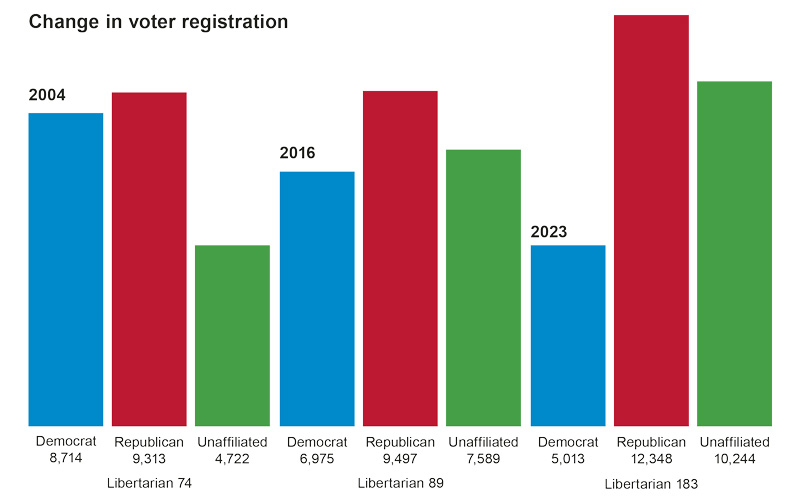
The gap between the number of registered Republicans and Democrats has widened several times over the last 20 years in Macon County and across rural North Carolina while the number of unaffiliated voters has also been climbing.
According to voter registration data from Jan. 1, 2004, the oldest data available through the N.C. State Board of Elections, there were 9,313 Republicans and 8,714 Democrats in Macon County. In the last 20 years, there was a drop in 3,701 Democrats and a gain of 3,035 Republicans. The gap between the two parties went from 599 to 7,335.
Between Jan. 1, 2004, and Jan. 1, 2016, Macon County Democrats were steadily losing numbers and Macon County Republicans were slowly gaining numbers. In that time, Macon County Democrats lost 1,739 voters, going from 8,714 to 6,975. Macon County Democrats lost 50 voters in 2016, as they had during the election years of 2012 and 2014, and the decline has continued. As of July 15, there were 5,013 registered Democrats in the county.
Macon County Republicans gained a net of 184 voters from 2004 to 2016. The party gained roughly 1,000 new voters over the next year and the numbers have been climbing since. In the last eight years, the number of Macon County Republicans swelled from 9,313 to 12,348.
Since 2004, there has been a gain of roughly 5,000 voters in Macon County, peaking at 28,191 after the 2022 election, now at 27,790 (there is usually a drop after general and mid-term election). Not all the Democrats’ losses are going Republican. The number of unaffiliated voters has more than doubled in the last 20 years, from 4,772 to 10,244 currently, with a high of 10,377 in January 2023.
Democrats’ share of the voters in Macon County has diminished from 38.1% in 2004 to 18.04% currently, a 20% drop. Despite their increases, the Republican share of Macon County voters has only increased by 3.72% in the last 20 years. Most of the Democrats’ losses have moved to unaffiliated, whose share of voters grew from 16% to 36.86%. Libertarians, with 183 registered Macon County voters as of July 2023, have a 0.66% share of the voters.
The gap between Republicans and Democrats in Macon County is mirrored throughout rural North Carolina. The N.C. Rural Center designates 78 of the 100 counties in North Carolina that have an average population density of 250 people per square mile or less (Macon County has roughly 72 people per square mile) as “rural.”
In those 78 counties, from Jan. 1, 2004, to July 2023, there has been a decrease in 292,496 Democrats, an average of almost 3,750 fewer Democrats per rural county. The reverse is true for Republicans, who gained 286,305 people in that same period, or an average of 3,670 people per county. Libertarians grew by 12,469 voters or 160 voters per rural county.
The voting population of the 78 rural counties grew by 585,106 people in those same 20-plus years, which is mostly accounted for in the 578,480 new rural unaffiliated voters, or an average of roughly 7,416 people per county.
In North Carolina’s 78 designated rural counties, only four had increases in registered Democrats over the last 20 years. In those four counties, there was five-figure voter growth and Democrat growth was far exceeded by unaffiliated and Republican growth.
In the state’s 16 “suburban” counties, 479,220 of the 663,593 new voters are unaffiliated. Republicans gained 167,469 suburban N.C. voters while Democrats gained 4,394 voters. There were more new Libertarian suburban voters (12,147) than Democrats.
Republican voter gains in the state’s 94 rural and suburban counties in the last 20-plus years are almost entirely counteracted by the state’s six urban counties. In those counties, there has been an increase of 1,013,832 voters. Of those, more than two-thirds (667,100) are unaffiliated, and most of the other third (308,823) are Democrat. Republicans gained a net of 12,831 urban voters, slightly outpaced by Libertarians, who had 14,560 new urban county voters in the last 20 years.
There are still more Democrats in North Carolina than Republicans (2.4 million to 2.2 million), but unaffiliated voters are now the single-biggest block at 2.62 million. Statewide, Democrats gained a net of 20,721 new voters; Republicans gained 466,605; and Libertarians 39,176, in the last 20-plus years. The number of unaffiliated voters accounts for a vast majority of the 2.262 new voters in that same time period with 1.734 million.