
Christopher Lugo
editor@highlandsnews.com
During former N.C. Congressman Mark Meadows’ time as White House Chief of Staff, he was vocal about voter fraud during the general elections in 2020.
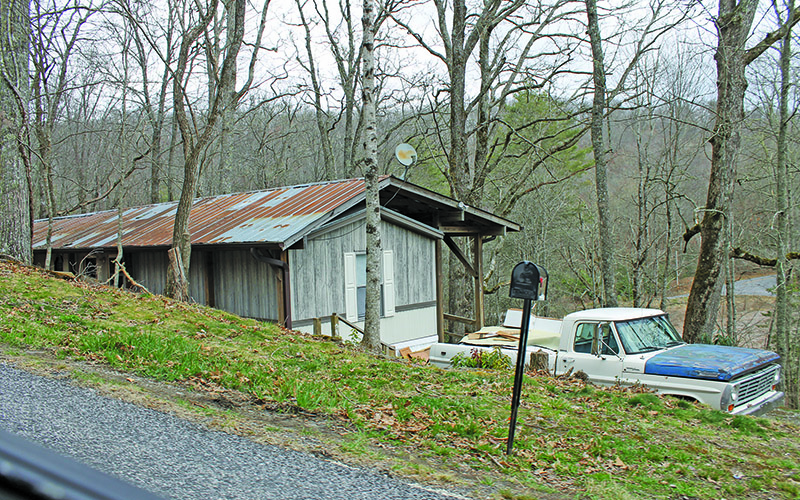
On March 6, The New Yorker released a report that connects Meadows with possible voter fraud and a mobile home in Scaly Mountain that he has never owned or even stayed at.
According to the report, by Charles Bethea, on Sept. 19, 2020, about three weeks before North Carolina’s voter-registration deadline for the general election, Meadows filed his paperwork, but on the line that asked for his residential address, he wrote down the address of a 14’x62’ mobile home at 495 McConnell Road in Scaly Mountain. He listed his move-in date for this address as Sept. 20, 2020.
The previous owner of the mobile home owned the property since 1998 and sold it to Ken Abele in 2020, according to Macon County property tax records.
North Carolina voter registration records show that Meadows and his wife registered to vote at the mobile home and show that Meadows voted absentee by mail from that address.
Macon County Board of Elections director Melanie Thibault confirmed the records.
“Yes, the Meadows are listed on our voter rolls with the McConnell Road, Scaly Mountain address,” Thibault said. “They both voted absentee by mail.”
North Carolina law requires that a voter live at their address for 30 days before the election in which they are voting. It is a felony to file a fraudulent voter registration application, although prosecutions are rare and typically do not lead to jail sentences.
“We are not the residential police,” Thibault said. “It is up to the voter to provide us with true and accurate information on their voter registration form. It is a class 1 felony if it is proven that they have given false information.”
A person does not have to show proof of residency when changing the address on their voter registration. “They don’t even have to come into the office,” said Gary Tallent, deputy director of the Macon County Board of Elections. People can change their addresses online or print off a form that is mailed to the Board of Elections.
The owner of the home, Abele, did not respond to The Highlander for comments, but in the New Yorker report, he said, “When I got it [the mobile home] it was not the kind of place you’d think the chief of staff of the President would be staying.” When asked what he made of Meadow’s listing the property as his place of residence on his voter registration form, Abele told the New Yorker, “That’s weird that he would do that. Really weird.”
Why are people concerned about voter fraud in this situation? Western Carolina University professor Dr. Chris Cooper said because it is impossible to separate the messenger from the act.
“Mark Meadows has been vocal in his opposition to voter fraud and his insistence that voter fraud is real,” Cooper said. “The fact that he is the one getting caught here, I think, is one reason why people are worked up. This isn’t just any politician, this is a politician who has certainly pedaled the narrative that voter fraud is rampant. I think that is why the vast majority of re-actions are the way they are. It also appears to be pretty clear cut. This was not a house that they owned, this was not a house that they rented, this was not even a house that Mark Meadows stayed in as a favor. This was a friend’s address. So, it doesn’t appear that there’s a lot of wiggle room here for Mark Meadows.”
Why did Mark Meadows do this? Cooper said it may come down to expediency.
“Either way, this did not swing an election,” Cooper said. “I think this is frankly the way that real voter fraud happens. It’s not a massive conspiracy. This is somebody who felt connected to the region and wanted to vote here, but Mark and Debbie Meadows voting in the 11th Congressional District did not elect their preferred candidate. So, why do it? It’s a great question, but I think sometimes people don’t realize the consequences to these small actions. Clearly Mark Meadows should have, given his position and rhetoric, but again, I don’t think this was a grand conspiracy and didn’t tilt the outcome of the election. This was a dumb decision by somebody who should have known better.”
In 1972, the North Carolina Supreme Court ruled that “residence simply indicates a person’s actual place of abode, whether permanent or temporary. Domicile denotes one’s permanent, established home as distinguished from a temporary, although actual, place of residence.”
The State Board of Elections has the authority to investigate potential election law violations and refer cases to prosecutors when it determines such steps are warranted.
“Challenges shall not be made indiscriminately and may only be made if the challenger knows, suspects or reasonably believes such a person not to be qualified and entitled to vote,” according to state law.
“The State Board of Elections could definitely get involved,” Cooper said. “I don’t think we have heard the end of this. Again, because of who Mark Meadows is. I think if this was an average person, one, we wouldn’t know and two, the odds of prosecution are very low. Because of who Mark Meadows is and what he has advocated, I wouldn’t be surprised if this doesn’t go away.”
Meadows did not respond to questions from The Highlander.