
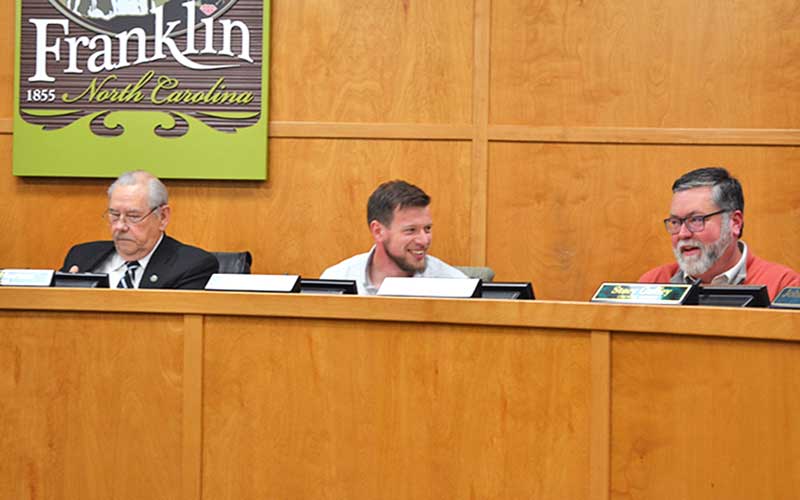
In a 4-2 vote, the Franklin Town Council passed an amendment that will make conditional zoning part of the Unified Development Ordinance.
“Conditional zoning is another tool in the toolbox for rezoning,” said Town Planner Justin Setser during the Dec. 4 meeting. He described conditional zoning as a hybrid of traditional zoning and special use permitting.
The council first discussed conditional zoning at its October meeting, passing it to the town Planning Board for review. The Planning Board reviewed the proposed amendment at its October meeting and recommended adoption.
Conditional zoning differs from traditional zoning or special use requests in that the Town Council and the developer can discuss potential uses for property and all parties must agree to the conditions put in place. Those conditions are then filed in the Clerk of Court office as part of the official property record. The ordinance also requires that the developer host a neighborhood meeting so nearby property owners can give input and learn more about the proposed use of the property.
Where the council members differed was when the conditional zoning rule applies. The town’s Unified Development Ordinance defines a major development as anything over 30,000 feet. At the previous meeting Stacy Guffey had suggested lowering the threshold to 12,000 feet.
During this month’s meeting, council member David Culpepper said he could see where conditional zoning could be helpful, but if the threshold is set too low, it could catch “regular people” trying to start a business. “It could be another hoop people have to jump through,” he said.
Town Attorney John Henning Jr. replied it is a “more flexible” hoop than requiring a special use permit.
Guffey said decreasing the threshold would help protect neighborhoods where certain commercial businesses might not be in the best interest of the neighborhood. As an example, he cited the recent rezoning request from KAVOD Communities to build a gym/karate school/after-school program facility on Golf View Drive. That request has since been pulled following concerns about how it might change the residential neighborhood. The developer of that project said at the October meeting that they wanted to wait until conditional zoning was allowed.
Guffey also liked the aspect of getting input from the neighborhood as part of the conditional zoning process. “In my mind, you’re not only giving the neighborhood more options, you’re giving the developer more options,” he said.
Mayor Jack Horton said conditional zoning is a tool for both sides and allows for compromises.
Culpepper said while it opens possibilities for some it could become more restrictive for others, noting that 12,000 square feet is not that big for a business. “I worry that we’re taking a step forward to try to help those situations, but we’re going to end up hurting other folks in the long run.”
Henning said the town needed to look at “protecting the public and what they feel about the use of properties right next to them.”
At last week’s meeting it was suggested changing the square footage requirement to 15,000.
No one signed up to speak during the public hearing on the amendment at the Dec. 4 meeting. The ordinance passed with the square footage set at 15,000. Guffey and Culpepper cast the opposing votes.
During the public comment portion of the Town Council meeting, Jim Akins from the Scottish Tartans Museum and Cory McCall of Outdoor 76 addressed safety concerns with people driving too fast on Main Street. Akins said although the Department of Transportation has recently made efforts to make Main Street safer with the new crosswalks, that more needs to be done. “We need to slow people down and start enforcing the law,” Akins said.
In other business, the council:
• Approved the reappointment of Amie Owens as town manager, John Henning Jr. as town attorney and Nicole Bradley as town clerk.
• Approved the 2023-24 meeting schedule. Council meetings will be held at 6 p.m. on the first Monday of the month, with the exception of January and September due to the holidays. The January meeting will be held on Tuesday, Jan. 2 and the September meeting will be on Tuesday, Sept. 3. The council meets in the board room on the lower level of Town Hall.
• Approved the 2023-24 holiday schedule, following the state schedule.
• Approved a resolution supporting the N.C. Department of Transportation’s recommendation for construction of an acceleration lane/on ramp from East Main Street onto the 441 Bypass. Sen. Kevin Corbin and Rep. Karl Gillespie are working with DOT to obtain funding for the project, according to the report presented to the Town Council.
• Approved a change order in the amount of $88,025 for the Phillips Street and Harrison Avenue sidewalk project. The change is due to the added cost of widening the sidewalks to meet ADA standards, multiple driveway aprons that tie into the sidewalk, and a tree that must be removed on Phillips Street. The town is using American Rescue Plan Act funds for the project.
Town Hall offices will be closed Monday-Wednesday, Dec. 25-27 for the Christmas holiday and Monday, Jan. 1 for New Year’s Day.