
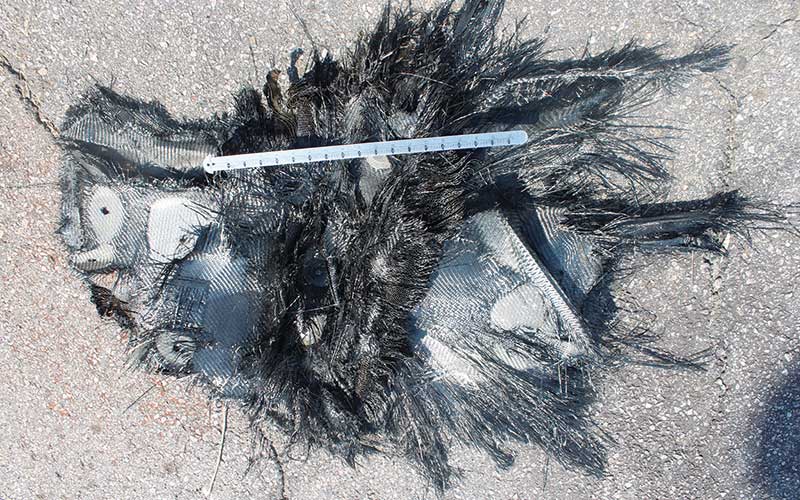
Multiple Western North Carolina residents, including at least two from Macon County, now can claim something from space landed in their yard.
Jeff McDougall of the Holly Springs community recalls finding something interesting in early June.
“It was about 100 yards from the house. I noticed, it looked like a barrier to stop erosion,” McDougall said. “Never thought to stop and look at it.”
McDougall figured it had been out there for a couple of weeks as the grass beneath it was dying when he found it. The object had at least eight layers of a mesh-type surface on each side of a light metallic-honeycomb texture, all bolted together. The piece is around 36 inches long and 27 inches at its widest point.
But as days passed, other similar findings happened in Western North Carolina. The biggest was near Canton along a hiking trail, measuring over four feet and too heavy to carry. According to media reports, Mike Wooten of Franklin heard one piece land on his roof in the twilight of May 21. A Jackson County woman, Katrinka Barnett, found a smaller piece in her yard, around five miles from the Haywood County line.
But what is it? Jonathan McDowell, an astronomer and astrophysicist at the Harvard–Smithsonian Center for Astrophysics who tracks reentry events, said the debris is consistent with being a bit of the SpaceX Dragon Crew-7’s trunk.
McDougall said on June 8, after media reports about the other pieces started popping up, his father-in-law asked about the strange debris. The next day, while scrolling through Facebook, McDougall said he saw a story about Barnett’s mystery debris.
“It looked exactly like what was up the road from my house: black, fiberglass-y, weird circles on it,” McDougall said. “I said ‘holy cow, I think it’s a piece [of the spaceship].’”
McDowell explained on X, formerly known as Twitter, that the Dragon Crew-7 jettisons the trunk into orbit as a standard operating procedure before the spacecraft returns to Earth from the International Space Station. The trunk carries unpressurized cargo such as small deployable satellites, solar panels and thermal radiators up to the space station.
Dragon Crew-7 safely splashed down in the Gulf of Mexico near Florida on March 12, more than nine weeks before the pieces from the spacecraft’s trunk began to land in WNC. The mission launched in August 2023, carrying four crew members to the International Space Station. According to McDowell, Dragon spacecraft trunks randomly re-enter Earth’s atmosphere, sometimes months or even years after the main spaceship lands.
Over two dozen trunk reentries have occurred in recent years from past missions, which began in 2019. Only four of these trunk reentries resulted in debris found, as most occurred over an ocean or in a remote area.
“The discovery of SpaceX Dragon trunk debris from the Crew-7 mission in North Carolina, following debris from the Ax-3 trunk in Saskatchewan (Canada) and from the Crew-1 trunk in (New South Wales) Australia makes it clear that the materials from the trunk regularly survive reentry in large chunks,” McDowell posted on social media.
According to McDowell, the trunk made a northeastern track in the Gulf of Mexico, going across Western North Carolina, re-entering the Earth’s atmosphere above WNC where it broke apart. According to NASA’s Orbital Debris Program Office, the breakup of anything coming in from space happens between 72 and 84 kilometers above the surface.
For those wondering about the potential of getting hit by space debris in the future, McDowell said this debris incident shows there’s a chance.
“I do think this suggests a (small but not negligible) danger to the public from future Dragon missions,” McDowell said. “If one of these hit you on the head it would not be good.”
When asked what the public should do with these debris pieces, McDowell said it’s of interest to reentry experts.
“Locals should offer it to SpaceX or the experts at the Aerospace Corporation in El Segundo, Florida,” McDowell said.
McDougall said he has no plans on what to do with his space debris, except for using it as a talking piece.
“To know it’s been up in space and to see it is pretty wild,” McDougall said.