
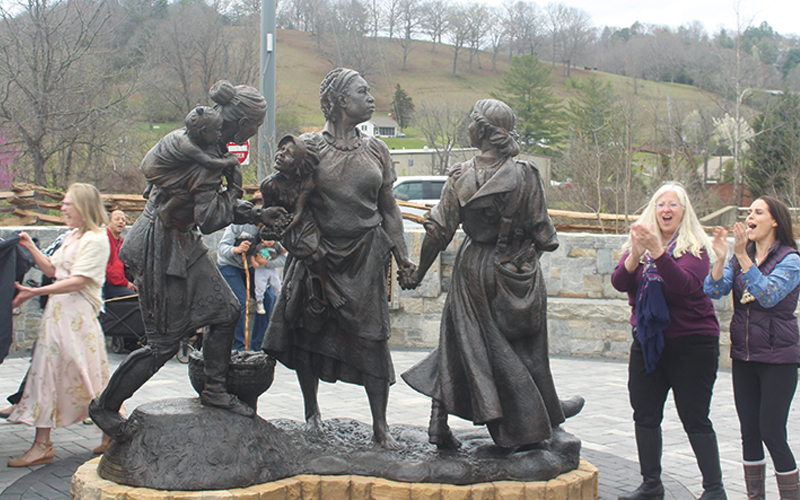
After six years of planning, fundraising and construction, the Women’s History Trail of Franklin has its centerpiece, as Sowing the Seeds of the Future was unveiled and dedicated on Saturday, March 23 in front of hundreds.
The crowd filled the new pocket park sandwiched between both sides of Main Street, Big Bear Lane and the Little Tennessee River, taking up every available chair and many stood around the speaking platform for the hour-plus ceremony.
The statue at the center of the park depicts three women, Na-Ka Rebecca Morris, Salley and Harriet Timoxena Siler Sloan, some of the most influential women in the early history of Macon County.
Former Chief Joyce Dugan, the first female chief of the Eastern Band of Cherokee Indians from 1995-1999, spoke on Na-Ka Rebecca, a Cherokee born in the Qualla Boundary who lived in Nikwasi.
Na-Ka Rebecca married Baptist minister Gideon Morris and in the Treaty of 1819, obtained 640 acres near the Nikwasi Village in what is now East Franklin. Dugan said Rebecca had at least nine children, with some reports claiming up to 16.
After being burned out by white settlers, the couple won a lawsuit and got new land across the river in the new town of Franklin. In 1852, the couple moved to Valley River in Cherokee County, and then 20 years afterward they moved to Oklahoma with roughly 70 relatives, where they lived out their days.
“Through oral history, it’s been reported that Rebecca Na-Ka worked to preserve her homeland. We are thankful today that others picked up the charge to preserve it, to preserve the mound,” Dugan said. “To include Na-Ka in the monument is a testament to the Cherokee history and influence in Macon County. Her efforts to protect her homeland have not gone unnoticed and it’s fitting the monument is located close to the mound she loved.”
Salley was a Black slave owned by the Morris family and later sold to the Siler family. Salley is the link between the other two women, working for Rebecca Na-Ka and later helping raise Timoxena. There isn’t a lot known about Salley other than that she lived and worked in the Nikwasi Village and likely spoke both Cherokee and English.
Ann Miller Woodford, a friend of the late Barbara McRae who wrote a book and helped write the plaques for the park, spoke on Salley’s history.
“Since Salley was born into slavery in 1799, we’ll never know for sure whether she was…a free woman,” Woodford said. “But it is in her far-off gaze that she may have hoped for freedom.”
Woodford spoke on how Salley couldn’t live where she wanted or do what she wanted but maintained that hope through stories through her ancestors of the motherland. Woodford said the depicted version of Salley creates a portal to the past and shows the power of art to transcend the time and moment of a person. It also shows the suffering of Black people in America going back to 1619.
A direct descendant of Harriet Timoxena Siler Sloan, Kate Jones, spoke on her ancestor’s history.
Timoxena, born in 1835, was raised along the Little Tennessee River and had seven children. After being widowed, Timoxena and Salley, took care of the household. Timoxena is portrayed twice in the statue, once as a little girl receiving corn from Na-Ka and the other as a pregnant woman walking into the future.
Jones described Timoxena as “bold” in every aspect of her life and spoke about the challenges many people face in blooming in their own lives.
“In today’s world where ecological, social and political challenges loom, we must remember the importance of tending to our collective garden. We must learn from the mistakes of our past and acknowledge our shared history and the injustices perpetrated by my ancestors and work tirelessly to create a more equitable future for all.”
Delphine Kirkland, the main model for Salley, sang before the ceremony. Janet Jacobs Greene, who gave the invocation, also gave a Timoxena Sloan monologue at a donors reception on Friday night. Rebecca Stacey, a descendent of Na-Ka Rebecca, was in attendance, along with several Silers and Cherokee.
Mary Polanski of the Women’s History Trail leadership team noted Franklin had the first Women’s History Trail in North Carolina. This was the vision of the late Barbara McRae, whose portrait was on the podium.
“When you look at them, you’re going to be mesmerized and it will change your life, I absolutely believe that and I hope it touches you in that way,” said Women’s History Trail leadership team member Marty Greeble.
Anne Hyder, Women’s History Trail leadership member and chair of the Folk Heritage Association of Macon County, recounted meeting with McRae six years ago over lunch, which is where the trail idea sprouted. The Folk Heritage Association raised money for the sculpture and has gifted it to the Town of Franklin.
Drew Christy, director of Governor Roy Cooper’s Western Office, spoke in place of N.C. First Lady Kristen Cooper, who could not attend. After Christy, the Women’s History Trail Leadership Team, sculptor Wesley Wofford, studio director Odyssey Wofford, Rebecca Stacey and children cut the ribbon and unveiled the statue for the crowd to see.
After the unveiling, the Women’s History Trail team presented Franklin Mayor Jack Horton with a miniature bronze replica of the statue as a measure of thanks for his efforts to make the day a reality.
Horton thanked the town for supporting the project all the way through and talked about the first time he saw the sculpture in Wofford’s studio in Cashiers.
“As I looked at that sculpture, it had an effect on me and I tell you it’ll have an effect on you,” Horton said. “It touched me, it touched my heart and my emotions. When you see these characters and this sculpture, and what they represent, you’ll be moved by it as well.”
Wesley Wofford called it the honor of his life to work with so many different groups on this statue and cited the nurturing influence of all the women in his life.
“As the token male of the project, all those women’s voices are just passed through me into that, and I’m honored to be that megaphone,” Wesley Wofford said of the sculpture.
Women’s History Trail’s Theresa Ramsey said along with the statue, they were dedicating two more sites to the Women’s History Trail; plaques for the late McRae and Margaret Ramsey, who had family members present.
Margaret Setser Ramsey founded the Folk Heritage Association of Macon County in 2004, with Theresa Ramsey calling her an active volunteer with a heart for social justice.
Barbara McRae’s son Sam teared up as he talked about her, reading letters he recently found among her personal belongings.
Throughout the day and the weekend, people stopped by the statue, gazing at the bronze finish, reading the plaques, and becoming the centerpiece envisioned some six years ago.
“The Sowing the Seeds of the Future is going to forever stand on this site and it’s going to be a living tribute to women and it’s going to help us keep our heritage alive,” Ramsey said.