
Several residents attended a public hearing at the July 3 Franklin Town Council meeting to speak against the proposed rezoning for their properties. One resident spoke in favor of the rezoning saying it was a step in the right direction.
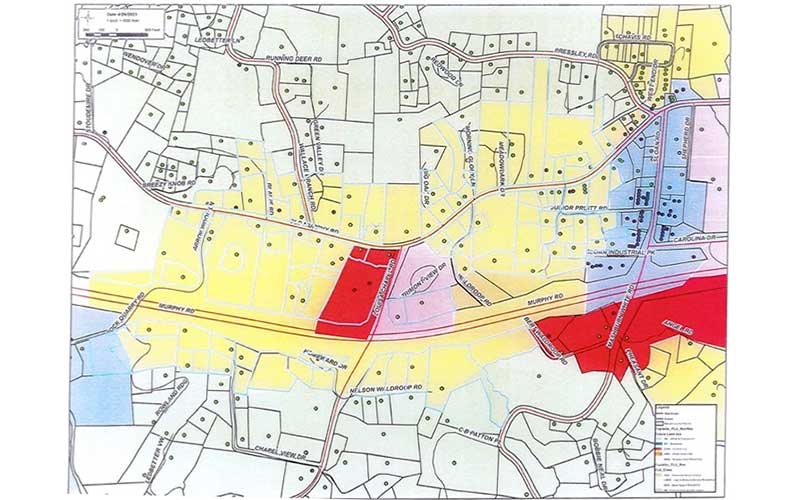
Town Planner Justin Setser said the rezoning came up as part of the town’s comprehensive plan as some areas were not zoned correctly. There are about 354 parcels totaling 509 acres under consideration for rezoning.
“The purpose behind this rezoning is to bring all of these parcels into compliance with what the current uses are of those said parcels,” Setser said.
Setser and the town’s Planning Board spent three months reviewing seven areas in town where the zoning doesn’t match how many of the properties in those areas are used.
For example, along Lake Emory Road there are areas zone R-1 (residential), which allows only frame or “stick-built” and modular homes. Setser and the Planning Board recommended rezoning that area R-2, which would allow for mobile homes; currently the majority of residences in that area are mobile homes. Setser said under the current zoning if someone needed to replace a mobile home due to something such as a fire, that would not be allowed to because of the R-1 zoning.
An example of the opposite is Town Mountain, which is zoned R-2 but there are only two manufactured homes in the area. It is recommended for rezoning as R-1.
With Angel Medical Center moving from its downtown location, it is recommended that area be changed from MICR (Medical, Industrial, Cultural and Residential) to R-1 residential. Under the proposed rezoning, the area around Franklin High School that is currently zoned neighborhood mixed use would be rezoned as MICR.
“The whole intent behind all of this was to protect people’s property rights,” Setser said.
Carson Green, who has owned his property for nearly 30 years, said he needed to learn more about the proposed rezoning, but that he was of the mindset, “If it ain’t broke, don’t fix it.”
The area that created the most questions was the Old Murphy Road area that includes 113 tracts, which are currently zoned C-2 commercial and the rock quarry, which is zoned industrial. A variety of rezoning designations have been proposed for the area including R-1 and R-2 (residential), NMU (Neighborhood Mixed Use), C-3 (commercial) and industrial.
Tim Cochran said he bought his property on Laid Back Lane, off Old Murphy Road, for commercial use and currently uses it to store equipment for his business; he was opposed to it being changed to residential zoning. He said he did not know Old Murphy Road was zoned; Setser said it has been zoned since it became part of the ETJ in 1974. Cochran added property owners in that area cannot connect to the sewer service because of limitations with the line. “The town has nothing to offer us. I would like you to consider to take Old Murphy Road out of your zoning or leave it alone.”
Johnny Ammons said he probably had about $80,000 worth of work on his property where he planned to build storage buildings. “If it’s zoned residential only, that lot’s useless,” he said. Another man speaking from the floor said he had bought a house to use as a duplex and asked if that would be allowed in the residential zone. Duplexes are allowed in R-1 and R-2 (residential).
Connie Stiles, who owns property on Sloan Street, was the one person to speak in favor of the rezoning in her neighborhood and asked the council to consider adding additional properties on neighboring streets. She said the proposed changes were a “good, solid step in the right direction.”
She would like to see the R-1 zoning extended to Cherry and Hillside Streets and the majority of Second Street. She said she was concerned about permanent RV living or tiny homes that might occur under the R-2 zoning on those streets and about development standards. She also wants to see substantial buffers between commercial and residential uses.
She suggested R-1 zoning for the house on the corner of Sloan and Crane Circle unless the town would consider buying it for the Whitmire property. She asked that the council consider the changes or table making a decision until it can be discussed more.
“I ask these things for the betterment of Franklin and its future. Zoning is the principal tool for protecting property values, providing a stable real estate market and the prevention of incompatible uses being too close together,” Stiles said.
She added that zoning protects and enhances the character of a given community. “You are the protecting and enhancing body of government for our town,” she said to the council.
After hearing the public comments, the Town Council did not take any action on the rezoning proposal. Vice Mayor Joe Collins said the Old Murphy Road area may need to be looked at some more, and that he was sympathetic to the people who can’t get sewer service there, especially if it is zoned residential. “That is troubling to me,” he said. Council Member Rita Salain also suggested they may need to relook at the area Stiles spoke about.
Council Member David Culpepper suggested they move slow on making the changes. He said people are making financial and life-time decisions when they buy property and it didn’t seem fair to people for the council to change how the land can be used, especially for those in the ETJ. “It’s taking away one of their rights,” he said.
Opposing Senate Bill 675 to eliminate ETJ
Related to zoning and other town ordinances, the council approved a resolution opposing Senate Bill 675, which would eliminate extraterritorial jurisdictions (ETJs) in counties with a population less than 50,000.
If the ETJ is eliminated that would mean the town ordinances would no longer apply to those areas. That would include ordinances such as those regarding zoning, signs, subdivisions, flood hazard prevention, minimum housing requirements and cell tower placement.
Setser presented information about the bill to the Planning Board at their June meeting. Planning Board Chair Janet Greene said she was opposed to it and that larger counties should not be forcing smaller counties to eliminate their ETJs.
Mayor Jack Horton said he has informally notified the county’s legislative delegation that adoption of the bill “would not be a good move.”
He said the change would impact about 50 percent of the counties in the state and many counties do not have land use planning. “To take that ability away from the town, I think puts the people at a disadvantage,” he said.
He said the ETJ gives the town the option to manage and control the growth of those areas at the perimeter of the town, which could eventually end up as part of the town.
The resolution states “the natural beauty and the tourism industry are all threatened by elimination of the extraterritorial zoning jurisdiction and the unfettered and unregulated promotion of signage, unrestricted commercial land use, and unharmonious subdivisions adjacent to the Town of Franklin.”
“I think the General Assembly needs to relook at this,” Horton said.
The mayor also pointed out that most water and sewer services come from the municipalities and that there may be reluctance to extend those services to areas they do not have jurisdiction over.
Council Member Stacy Guffey said local government is the government closest to the people and the proposed change is “like a power grab up the chain.”
Council Member Mike Lewis said the proposed bill penalizes smaller municipalities when it is the larger municipalities that abuse their authority the most; he added that eliminating the ETJs also becomes a matter of public safety.
Town Attorney John Henning said the ETJ gives the town the ability to help protect residents’ property values. “To do this kind of thing, this strips away one more benefit you can offer your residents.”
Horton said while there may be other reasons behind the bill that they are not aware of, that he can see the ramifications of it, and it would not be good for any municipality.
The council unanimously approved the resolution.
Culpepper said it was ironic that people came to the council that night saying they wanted to be able to control the use of the property they own, and the town is going to tell the state they want the right to control the land next to the town. “They yelled at us; we’re going to yell at the state.”
The next Franklin Town Council meeting will be at 6 p.m. Monday, Aug. 7.