
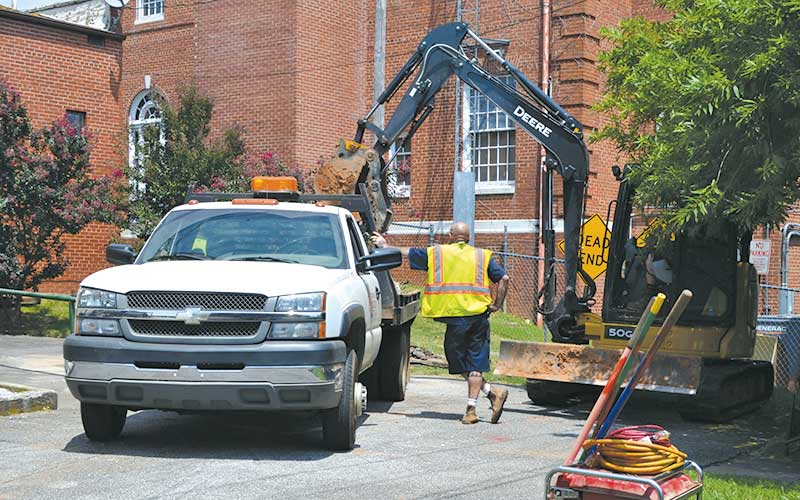
Crews were working at the end of Stewart Street in downtown Franklin on Monday unearthing “potentially hazardous waste” believed to have been buried there decades ago.
Franklin Town Manager Amie Owens said the town was aware that the material, believed to be low-level radioactive waste used in medical facilities, was there. She said the area was surveyed 15 years ago and it was determined there was no risk to the public.
However, the decision to leave it buried changed after a company from Arizona recently contacted the town about removing the material. Owens said their claims sounded fishy, so the town contacted the state’s Radiation Protection Section of the Department of Health and Human Services. She said they learned the company was not licensed to do that type of work in North Carolina and she doesn’t know how they heard about what might be buried there.
The N.C. Radiation Protection Section conducted a survey of the site on May 2 and a second survey was conducted on June 4 by a qualified remediation company, which confirmed there were two small areas containing source material.
The Radiation Protection Section (RPS) recommended the material be removed. “We have a really good working relationship with the Radiation Protection Section,” Owens said, adding that RPS said since the town was aware of the material to go ahead and remove it as it would be “better to be safe than sorry.”
Owens said they received a list of approved vendors from the state, and Chase Environmental Group of Lenoir City, Tennessee, was the only company that responded. The company is an environmental contractor specializing in environmental cleanup, radioactive decontamination and decommissioning, drilling support for field investigations, treatment technologies, tank removal and other specialty field services.
The excavation work was completed Monday afternoon. Owens said they found two very small radium needles about three inches below the asphalt, about six inches deep.
“They had not been damaged, and the material was contained inside the double walled sheath,” Owens said. “As the material was still well contained, soil readings were taken, and no additional remediation was required.”
Owens said no infrastructure was compromised, and the town has been continuously monitoring the water and sewer systems as part of the daily operations. She said they should have a final report from Chase and RPS within the next couple of weeks.
Owens said the Chase team confirmed the material had been there for some time and the needles are not medical technology currently in use. “It is not known whether the needles were purposefully buried or discarded, or if the material was from fill dirt used in the alleyway,” she said.
Owens said according to urban legend or lore, someone who worked at the old hospital took the material and buried it, but that is not known for fact. Vice Mayor Stacy Guffey said he has heard that story before and he wonders what happened to the person or people who took the material and why they never came back for it. He believes the story dates back to when a hospital was on Main Street, before the hospital moved to the former Angel Community Hospital site on Riverview Street in 1924.
On Monday, asphalt and soil were removed in two 3-foot by 3-foot squares over the areas where the needles were found. Owens said gravel and cold patch have been placed in the holes until improvements in the alleyway can begin.
The town had already begun talking about making improvements to the alleyway. Owens said they want to level the area and improve the drainage because water gathers at the bottom. She said they have not decided if they will resurface it with asphalt or concrete. There’s also been consideration of adding some Edison lighting in the alleyway.
“One of the goals of Town Council is to make Franklin as pedestrian-friendly and walkable as possible. No matter what prompted it, improving this alleyway as a connector from the public parking areas to Main Street is another positive move in achieving that goal,” said Guffey.
Owens said the initial cost for the removal of the material was $40,000 and there will be a disposal cost. She said the town will use part of its American Rescue Plan Act funding to pay for the removal, disposal and alleyway improvements.