
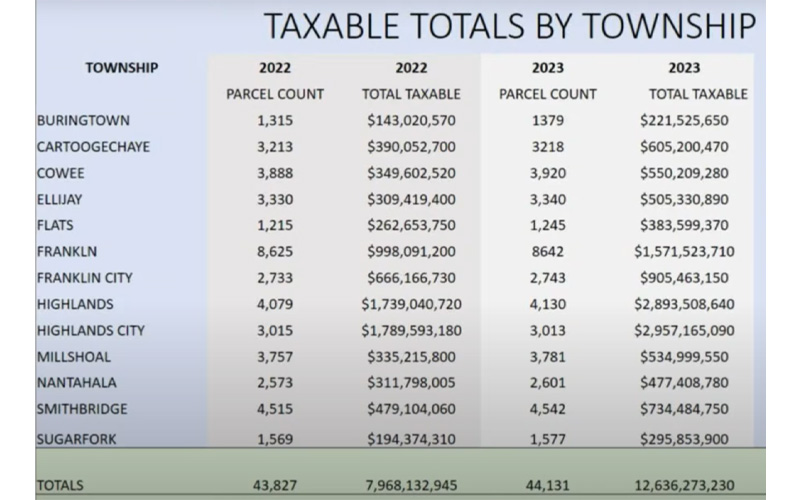
The value of taxable properties in Macon County has increased by an average of 58.58% since the last revaluation four years ago, but that doesn’t mean everyone’s property taxes are going up that much.
According to updated totals collected by the Macon County Tax Office, the sum of all taxable land in the county has gone up from $7.968 billion from the last revaluation in 2019 to $12.636 billion.
Macon County Tax Administrator Abby Braswell said many people don’t need to fear such a large tax increase.
“I wanted to also explain that just because the average increase is 59% that doesn’t mean everyone will go up 59%,” Braswell said in a Jan. 11 email. “If you take a property that goes up 20% and one that goes up 80% the average of that is 50%. It is important for people to understand that the percentage is just an average of thousands of properties and that some will go up more and some will go up less.”
Out of the county’s 13 townships, the percentage increases range from an average of 35.92% for properties in Franklin to an average of 66.39% for Highlands. In total, the county’s parcel count has gone up from 43,827 to 44,131.
At the Jan. 10 Board of Commissioners meeting, Commissioner Josh Young asked Braswell if there’s ever been an taxable value average increase this large. Braswell responded that 2005 came close, but no.
Responding to Commissioner Gary Shields, Braswell said people were very nice during the pandemic and that the tax-paying rate is the highest it’s ever been.
The county has finished with the 2022 property sales, Braswell said, and will send out revaluation notices to property owners the second week of February. The mass appraisal, ongoing since the summer, is done through analyzing all sales to show what the 100% market value of a property is, based on state statute.
Braswell explained that sales ratio to value was near 100% in 2015 but has gone down in recent years to 75%. The state recommends anywhere between 90% and 110%, with the sweet spot being between 95% to 105%.
“If we did not reassess the property then the value of the public utilities would be assessed at a lower percentage in this year because we are not within the state guidelines for the 100%,” Braswell said. “This would mean the public utility companies would pay less in taxes. They would be unfairly taxed at 100% of value when Macon County taxpayers are not paying taxes on 100% market value. It is all about being equal and fair to all taxpayers.”
Reasons for increases
One reason for the increase in taxable land value is that the deferred per acre price for forest land, which accounts for nearly half of Macon County’s acreage, and farmland have both gone up. Per the North Carolina Department of Revenue, forest land is up to $380 per acre from $195 and agricultural uses is up to $1,200 per acre from $790.
The second reason is the pandemic house-buying boom. During her presentation at the commissioners meeting, Braswell went over some of the examples of assessments increasing values of houses by up to 100%, driven entirely by sales. One Highlands property previously assessed at $889,270 sold in December 2022 for $2 million, leading to a valuation of $1,884,140. A tiny house in the Franklin township went from $103,310 to $179,150, a 73% increase, after being bought in December 2021 for $182,500.
“It increased because somebody had the money and wanted that property and paid it,” Braswell said to the commissioners. “That’s what we had to go by.”
Qualified sales decreased from 1,857 in 2021 to 1,479 in 2022. Despite the decrease in sales quantity, the price range averages are holding steady, Braswell said.
Braswell doesn’t feel like it’ll be like 2008 when the subprime mortgage crisis started after years of housing demand because most of the buyers are now paying with cash instead of financing.
“If you have the cash and you want it bad enough, you’ll pay for it,” Braswell explained.
Review and appeal process
After the revaluation notices are sent out the second week of February, Braswell told the commissioners that the informal review process goes through April. Those review requests must be done in writing. Braswell said she’s hoping the new online portal will be ready by then. Parcel owners can appeal the informal review within 30 days and go to the board of equalization. Those hearings start in April and go until they are all finished.
Braswell said in 2019, there might have been 35 appeals, but in 2015 there were 300, which took from April through July to finish. Those decisions can be appealed to the state Property Tax Commission, which issues a final ruling.
“All of those appeals will affect the base of your budget” Braswell said to the commissioners about the upcoming process.
Braswell said that the mass appraisal system isn’t perfect and can be merit-based.
“We are not 100% right, we don’t go into houses, we can’t see what’s happened to your house, we don’t know you’ve improved it, especially if there’s not…a permit,” Braswell said, adding that people tell on their neighbors’ improvements all the time, saying that’s how they learn about property additions or renovations.
Macon County does revaluation every four years, while the state only mandates at least one county revaluation every eight years. Braswell said Macon County does this for several reasons.
“The first reason is because the market changes yearly,” Braswell said. “The goal of a reappraisal is to ensure all property owners in the county pay their fair share in property taxes. The goal is tax equity. Properties appreciate at different rates. Over eight years some may appreciate more than others and in some years they may go down. To keep the values constant over an eight-year period would reward the owners of more desirable properties at the expense of owners with less desirable properties.”
Property taxes
The property revaluation could lead to people paying more in property taxes if the property tax rate stays the same. The property tax rate in Macon County is currently at 40 cents per $100 valuation, the fifth lowest out of the state’s 100 counties, according to 2022-23 N.C. Department of Revenue figures. Property taxes are one of the biggest revenue generators in a county. The tax rate is controlled by the county commissioners, who can vote on a new figure for every new fiscal year as part of its budget process.
Out of neighboring counties, Macon’s 40 cents per $100 valuation is slightly higher than Jackson (38 cents) and Swain (36 cents), which are third- and fourth-lowest in the state. Macon’s rate is less than Clay (43 cents), Haywood (53.5 cents), Transylvania (60.33 cents), Cherokee (61 cents) and Graham (65 cents) counties. The state average of the 100 counties is 66 cents, with the highest being Scotland County, east of Charlotte along the South Carolina border, at 99 cents.