
No quorum for Planning Board
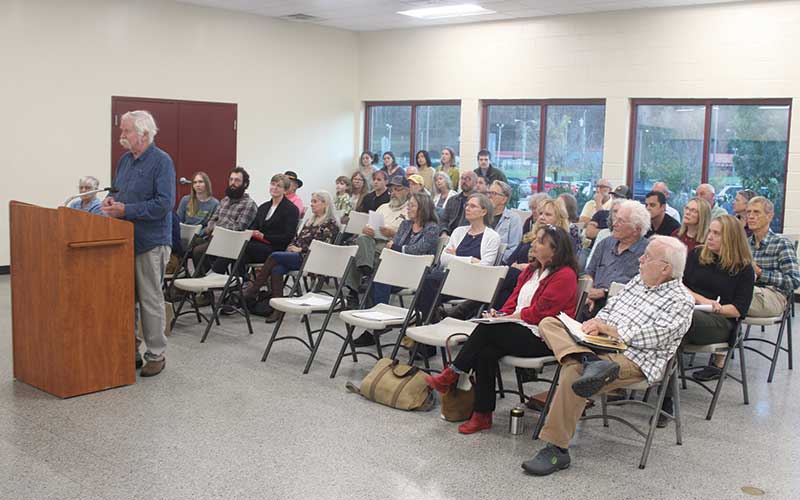
Being two members short of a quorum, the Macon County Planning Board couldn’t officially hold a meeting as scheduled on Thursday, Nov. 7, but did listen to 90 minutes of public comment and presentations from those who showed up and one of their members.
Only five of the 11-member board attended the meeting, short of the seven-member quorum needed to officially hold business.
The meeting was supposed to include the Planning Board’s recommendation regarding proposed changes to the Macon County Flood Damage Prevention Ordinance. The proposal is to allow outside fill up to 25% per floodplain acre without a No Adverse Impact study signed by a civil engineer. A copy of the proposed changes available Thursday also defined “adverse impact.”
The five planning board members in attendance were board Chair Jean Owen, Lee Walters, Ben Laseter, Justin Setser and Larry Lackey.
After the presentations and public comments, board Chair Jean Owen said “yes” when asked if she had anticipated a quorum of at least seven members.
“There’s just some things that came up,” Owen said of the planning board members who didn’t show up.
Owen and County Planning Director Caleb Gibson anticipate having a planning board meeting in December. The next regular meeting is likely to be held on Thursday, Dec. 5, at a location to be determined.
Thursday’s “meeting” took place in the Robert Carpenter Community Building on Georgia Road. The meeting had to be moved due to FEMA using the Health Department’s meeting room, where the county Planning Board usually meets. Gibson said FEMA will remain there through the end of the year, so a December planning board meeting will likely be elsewhere.
At the start of the meeting, Owen addressed the crowd of roughly 30 people, explaining the lack of quorum. Commissioner Josh Young, who is the liaison to the Planning Board and has pushed for the recent floodplain and watershed changes, said they would listen to those who showed up.
Bill McLarney led off the speakers, saying he hasn’t seen any argument on how the changes would benefit the general public.
Lewis Penland gave a PowerPoint presentation on stream restoration work he’s done, tying to the idea that having no fill in the floodplain is a good idea. Messing with floodplains can lead to sheer banks, faster water flows and stormwater eating into someone else’s land downstream.
“Mother Nature always wins. She’s patient,” Penland said.
Penland talked about how floodplain decisions made years ago have led to Tessentee Creek sediment ending up in Lake Emory and advocated for riparian buffers and sloped streambanks.
Walters asked Penland several questions, including what is the solution. Penland said there are multiple ways to tackle streambank issues and pointed to the Water Quality Advisory Committee report’s executive summary.
“We firmly oppose this change and instead advocate for a variance process to allow for exceptions to the Flood Damage Prevention Ordinance, while keeping floodplain protections intact,” the first paragraph of the committee’s executive summary stated.
Penland said there’s a difference between giving a farmer a variance to reach their land and building another Dollar General.
Macon County Farm Bureau President Kenneth McCaskill said the state Farm Bureau is recommending the N.C. General Assembly not allow outside fill in floodplains.
“We missed a bullet folks,” McCaskill said of Hurricane Helene, saying it could have been way worse in Macon County.
McCaskill said the proposed floodplain change directly conflicts with the Farmland Protection Plan the Macon County Commissioners recently approved.
“The more you allow in [the floodplain], the more it’s going to cost the citizens of this county and other counties,” McCaskill said.
McCaskill said there are people in Macon County who don’t leave despite their residences flooding during most storms.
“Well some of us [first responders] have gotten sort-of hard-hearted about that and we say ‘get you a permanent marker and write your name and a good phone number on your arm and an extra phone number so when we fish your body out of Fontana Lake we can identify you and can get you back to your people,’” McCaskill said.
Maria Grove talked about being in south Louisiana during and after Hurricane Katrina. Maria said that she saw a rash of suicides from people whose lives were upended after that storm, saying people’s welfare outweighs landowner benefits.
A man named Roger said when he lived in Columbia, S.C., they had two 1,000-year floods in two years and that we need to be smart when building.
Franklin Fire and Rescue Chief Ben Ormond spoke not as a town representative but based on his 35 years of first responder experience. Ormond opposes outside fill in the floodplain, saying the displaced water would increase the risk for first responders of faster floodwaters carrying E.coli and other waste and chemicals. Ormond asked the Planning Board to consider the increasing rate of natural disasters and the mental health toll it takes on the first responders, saying it’s resulting in burnout and disaster fatigue.
Otto resident Sarah Johnson said not changing the floodplain ordinance would save a lot of heartache. Lisa Waters said her family has been on the Little Tennessee River in Cowee since 1865 and is against messing with the river.
Franklin Vice Mayor Stacy Guffey said he was not representing the town in asking the board to consider the implications. Guffey said Helene’s floodwaters came within three feet of the Town of Franklin’s main water pump, which would have devastated the town’s water system.
Chris Baxter said over the last several months, the overwhelming majority have spoken articulately and with research against this proposal.
After the public comments, Walters made a PowerPoint presentation about his research on the ordinance. This included a summary, “inconsistent modifications,” “modification opportunities” and conclusions.
“The proposed changes are not consistent with the original objectives and are actually in direct conflict with the stated objectives, as significant amounts of fill added to a flood fringe has a direct and calculable waterflow impact to the floodplain, thereby rendering existing flood maps obsolete,” one of Walters’ conclusions stated.
Another conclusion was that the water displacement effects from the outside fill “directly and negatively impacts every landowner downstream.”
Walters also said the change to the flood maps and thus the Flood Insurance Rate Map will correspond to flood insurance calculations, changing some areas from buildable to non-buildable and decreasing land values.
“A landowner that could prove a direct correlation between a reduced property value as a result of poor governing policy may win a lawsuit against that governing body,” Walters’ fourth conclusion stated. The fifth conclusion was that the changes could reduce the financial incentives given to Macon County through the National Flood Insurance Program Community Rating System.
Walters requested not changing the flood ordinance until a “minor fill allowance” study is completed and asked that the county commissioners establish a study group of the Planning Board, code enforcement and the water quality advisory committee to determine that “minor fill allowance” language.
After the presentations, since it was not an official meeting, Young thanked those present for showing up and the unofficial meeting ended.