
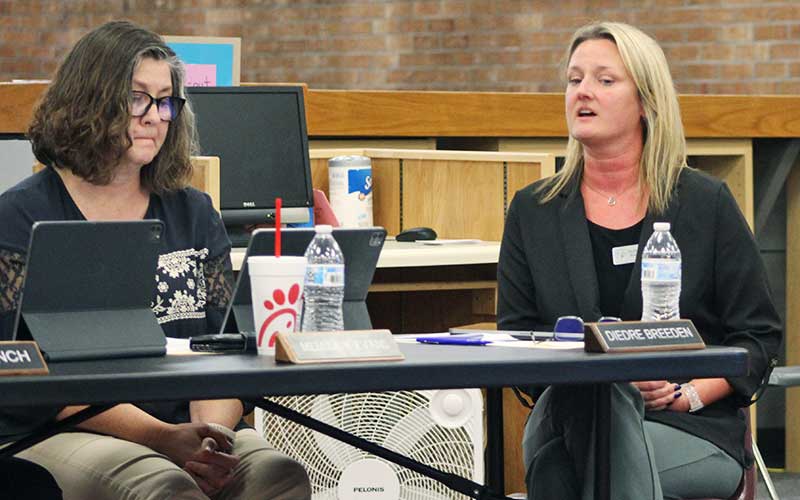
The Macon County Board of Education approved a new policy banning wireless devices from “bell to bell.”
Most Macon County Schools have policies forbidding the use of wireless devices during educational time in line with House Bill 959, which requires all local boards of education to adopt policies preventing use of devices such as cell phones, tablets, laptops, pagers, two-way radios and gaming devices during instructional time.
The new policy, passed during the board’s Sept. 22 meeting, is stricter than state requirements and disallows all wireless devices from use during school hours, from “the beginning of the first class period of the day to the end of the last class period of the day.” The board’s policy includes smart watches in the list of banned devices.
Devices will still be allowed for students under certain conditions or in an emergency. The policy was approved in a 3-2 vote with board members Diedre Breeden, Melissa Evans and Stephanie Laseter voting in favor and Hilary Wilkes and Jim Breedlove voting against.
“They’re on this all day long for school,” Breeden said, pointing to her tablet. “Their brain is getting that exposure to this all day long and they just don’t get breaks because they’re allowed to have it during breaks or they’re allowed to have it during lunch … I love hearing reports of them saying they’re interacting with each other, they’re making eye contact, they’re talking, they’re gaining those skills back that we really saw a decline in since COVID … I think they would be better off not having [devices].”
Breeden also noted that allowing devices during breaks and lunch would create problems as faculty spent more work and more class time getting students to put their phones away as classes start. She said enforcement will not be as necessary once students and teachers have gotten used to the policy.
Dissenting board member Hilary Wilkes said she voted based in part on requests from different school administrators not to change the policy.
“My preference is for principals to decide what strategies work best for their schools to operate within the guidelines of phones and devices being prohibited during instructional time,” Wilkes said.
“I will say on my part,” Breedlove said, “I’ve talked to some of the teachers at the high school … and they all said their preference was to maintain current policies … trust their students to follow it, ask them to be adults and I think everything is working very, very well.”
Facilities use
The board approved an amendment to a policy to allow community users to apply to use school facilities on weekends for periods of 90 days or more, given the board approves the use. According to Breedlove, this decision came as multiple organizations have approached the school system about using facilities on weekends for extended periods of time. The system previously allowed applications for individual and short-term repeat uses of the properties but had no provision explicitly allowing or disallowing long-term use.
The measure passed 4-1, with Breedlove voting against. He said he was opposed to any long-term use of school property.
Facilities updates
In a facilities update, maintenance director Tracy Tallent said construction of the new high school stadium and three stadium buildings is underway. The field should be completed by June 2026, ready for players to get used to the field for the 2026-27 school year.
Tallent said he purchased a crack filler with almost $7,000 in maintenance funds to help the school system save money on its capital projects. Tallent said that will allow the maintenance department to fill minor cracks in asphalt rather than contract the work out. Once the filler arrives and has been tested to make sure it is effective, Tallent plans to purchase a sealing machine from the same company to complete the set. The sealer will ensure that more water cannot seep into the filled cracks and reopen them. Breedlove said the maintenance fund should be reimbursed through capital outlay funds for the expense.
“I think y’all are aware of some of the damage we’ve had at our parking lots … We’re able to repair those with very little expense, basically our maintenance crew can do that,” Breedlove said.
Testing report
CTE director Allison Guynn gave a testing and accountability report to outline the school system’s progress toward meeting its testing goals for the 2024-25 academic year. From the beginning to the end of the 2024-25 year, 277 more K-3 students were above the benchmark, resulting in a 61% proficiency rate. The goal for the 2025-26 year will be to increase that proficiency rate to 70%.
Summer reading camp trends show 2025’s third grade proficiency rate at a 10-year high. The second-best score in that time was 2019’s 50% rate, and has since recovered from a post-COVID-19 dip that resulted in a low of 26.4% in 2022.
Proficiency percentage growth for Macon County is flatter than the slow and steady growth for the rest of the state. While the state has seen approximately nine points of net growth since 2021 – jumping from 46% to 55% in four years – the county rate has fluctuated between 50% and 53%, landing at 51% in 2025.
“Those kids that aren’t proficient, are they passed on each year?” Wilkes asked.
“We’re doing extra things for them; we’re putting them in Title 1 services … giving them extra support,” Guynn said. “Not every child comes with all the support that others do, so sometimes there’s a gap that’s got to be filled.”