
Macon County Schools Superintendent Josh Lynch got approval for a conceptual strategic plan with four pillars to build on during the July 22 school board meeting.
Lynch presented an outline of the plan, including the four pillars of community engagement, curriculum and instruction, professional development and technology. He said the four pillars are not in any particular order, although the presentation had the four pillars numbered in the order above. Board member Stephanie Laseter said the public will perceive the four as prioritized if they are numbered.
After the presentation, board member Hilary Wilkes asked about codifying the strategic plan.
“It will not be in a binder, it will be a living document for individuals to be able to access,” Lynch said, noting it will be an accessible platform where everyone can see the progression.
Wilkes and Board Chair Jim Breedlove confirmed staff will bring the strategic plan to the board for approval. There was no indication of when that final approval will happen, although principals will begin implementing certain aspects immediately with administrators presenting the plan to their faculty and staff at the start of the school year.
Lynch’s presentation included highlights of what will be in the plan. One expectation is to prepare students to “enroll, enlist or secure employment.”
In the presentation, the purpose of Macon County Schools was stated as “to create a dynamic educational ecosystem that empowers students with global skills, fosters innovation, inspires a love of learning, and prepares students for their tomorrow.”
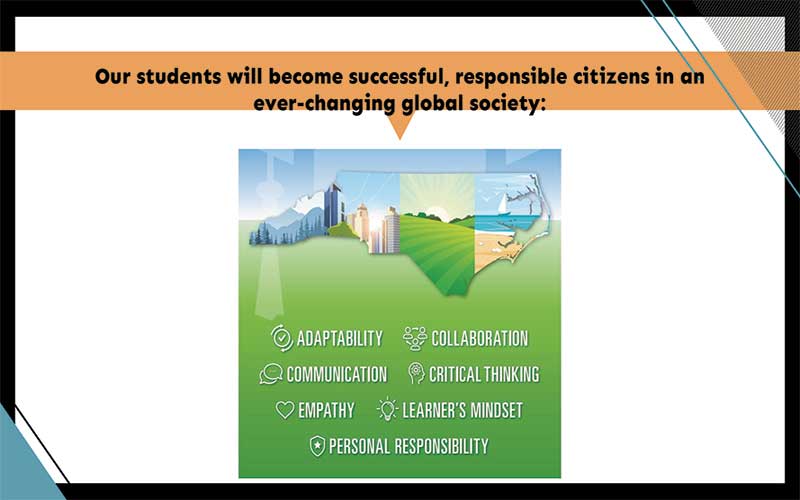
To help students be successful in a global society, there is an emphasis on adaptability, collaboration, communication, critical thinking, empathy, learner’s mindset and personal responsibility.
Leadership team members spoke on different pillars. In speaking on community engagement, MCS Career and Technical Education Director Colleen Strickland said they have abundant resources to utilize.
“Our goal is to build strong, meaningful relationships between our schools and various community stakeholders including local businesses, nonprofits, government agencies and cultural institutions,” Strickland said. “We want to make sure that our students have equal access to these valuable connections regardless of the school they attend.”
Planned incentives include recognition programs, family involvement activities and co-curricular learning opportunities. Strickland said multiple people mentioned the Heritage Days hosted at some schools.
Chief Academic Officer/Federal Programs Director Mickey Noe presented the curriculum and instruction pillar. The plan includes developing curriculum maps and pacing guides so “all of our schools are on the same level and using the same pacing guides to make sure we get a proper scope and sequence from kindergarten all the way through 12th grade,” Noe said. There will be implementation of high-impact teaching strategies and assessments, along with a change in the current grading system to a standards-based system, but Noe didn’t expound on what that is.
Noe said there will be a review and revision of the homework policies, saying those are becoming a thing of the past.
“We’re looking at doing a project-based type of grading system where students are graded on projects they’re doing throughout the classroom, throughout the year and offer incentives for that type of learning as well. Basically, changing the way we’re doing business and moving forward in the next five years.”
Later, Wilkes said there have been rumors about doing away with homework. Lynch said big policy changes like that would come before the board for a vote.
Noe said there will be an emphasis on professional learning communities for faculty. One idea was occasionally dismissing students halfway through the day and teachers from the same grade level at different schools meeting to do professional development from 1-3:15 p.m. Noe said this helps with teacher retention and supports their needs.
STEM Director Jennifer Love presented on professional development. Love said they’re looking at recruiting new teachers, professional advancement and retaining teachers. Data shows teachers are burning out and leaving, so providing certain training will aim to help, such as running professional learning communities and providing mental health support. Love said there will be new science standards coming out this year and new math standards in the next couple of years.
Love pointed out that teachers at Highlands and Nantahala want to meet other teachers of the same subject or grade level, noting they’re feeling isolated due to the geographical features of those schools. Another professional development suggestion is more recognition of teachers.
Finance Director Laney Ledford said the overall goal of the technology pillar is to help students in an ever-changing digital world.
“It’s only getting more techy, the world is,” Ledford said.
Ledford said professional development and device access are important, and touted a digital advisory committee to review continual changes.
Through a Dogwood Health Trust grant, MCS partnered with Open Way Learning for the strategic planning process. The process started in January, leading to on-campus “empathy interviews” in March. The board had copies of the empathy interviews. In total, there were 12 focus groups with 85 students, 36 educators, more than 55 community members, and they took place at Highlands, Nantahala, Franklin High and Macon Middle schools. Lynch said he was impressed with the students who offered their insight.
Lynch called the empathy interviews “a really good positive distribution of individuals.” The most common student words used were “mid,” “boring” and “OK” while the most used community words were “caring,” “behind” and “home.”
Strengths and assets include support for teachers, a sense of community/small classrooms, after-school activities and clubs and athletics, putting kids first, creative classes/electives, transparency, student opportunities, caring teachers, and friendly students.
Later, the MCS leadership team met with the principals in small groups to refine the plan.
“They’ve pretty much incorporated [the strategic plan] into their beginning-of-the-year slides,” Lynch said of the principals.
Laseter said she wants to hear the presentation multiple times to digest the plan and attend principal presentations to the faculty.
At the July 22 presentation, Mountain View Intermediate Principal Nancy Breedlove said she loves the autonomy, and how each of the four pillars can back them up and is a roadmap for them.
“Because of the four pillars, they serve as pegs to hang those initiatives that work for our schools,” Breedlove said. “By placing them on those pegs, we’re aligning them with the entire district. As a principal, I appreciate that because sometimes it can feel like…there’s no other school like us, so our initiatives could feel like a shot in the dark.”