
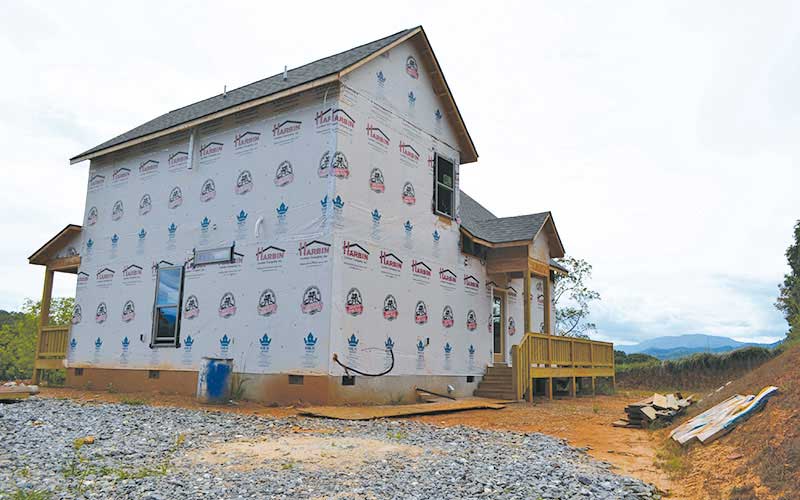
A recent housing study confirmed what many families already know: affordable housing is scarce in Macon County.
The study was conducted by Bowen National Research through a Dogwood Health Grant that the county’s housing department received. Reports from the study were presented at the Macon County Board of Commissioners meeting on Nov. 14 and a special called meeting of the Franklin Town Council on Nov. 15.
Patrick Bowen said they looked at demographics, current and projected growth, economics, the housing supply (rentals and for sale), senior care facilities, and special needs populations (such as homeless, disabled, veterans). In looking forward, they considered potential development sites, costs and government regulations.
In addition to the data collected, they got input from more than 800 people in the community, including stakeholders, residents, commuters and employers.
“We also got some good input from the employers, which I think you will find interesting,” Bowen said.
The employers noted they have difficulty recruiting and retaining employees due to the housing issues and therefore are unable to expand their businesses. Of the employers surveyed, 58.3% said they would hire more workers if the local housing issues were resolved.
According to the study, nearly 4,000 people drive into the county from elsewhere for work each day. About half (47.3%) of commuters are between the ages of 30 and 54 and 38.6% earn more than $40,000 annually. People from Jackson, Rabun and Haywood counties make up more than 1,300 of the commuters. Of the total number of commuters, 1,511 drive more than 50 miles one way each day.
“You can see there’s a large base of folks that could be potential residents,” Bowen said during his presentation to the Franklin Town Council.
He said of the people interviewed about 36 of them did not live in the county, but 78% of those people said they would move to the county if housing was available and affordable. Bowen said they get similar responses when they conduct studies in other areas.
“You’ve got a lot of people that work in one area, live somewhere else, and they do want to live in the place that they work, or at least close to it.”
Population growth
The number of households in the county (including the towns of Franklin and Highlands) increased by 1,788 from 2010 to 2020, according to U.S. Census data. From 2020 to 2023 it is estimated another 591 households were added, bringing the total to 16,790. Bowen projected that number would reach 17,518 by 2028. The 3.2% growth rate is on track with the state’s projected growth rate of 3.5%.
The projections through 2028 show the greatest growth will come in households age 75 and older with an estimated 745 more households. There also will be notable growth in households between the ages of 35 and 44 (203) and 65 to 74 (116). The projected growth for the Town of Franklin is similar with 42 households being added in the 35-44 age range and 66 households with people 75+.
Bowen said those trends will drive a demand for family- and senior-oriented housing.
The projections show a decline in population for people under 25, 25-34 and 55-64.
“One of the things I think is holding you back is housing,” Bowen said during his presentation to the Town Council. “You don’t have a lot of housing that’s available to you and that limits your ability to grow as much as you have and then the potential for where you’re heading.”
More than 28,000 people in Macon County are considered to fall within the special needs population: seniors, veterans, people with disabilities and mental illness. Very few housing options are available to meet the needs of those people.
Renters
Bowen said there are not a lot of multi-family apartment complexes in the county and they are all full. During the study period, there were no vacancies in the multi-family properties surveyed and all maintain waiting lists. According to Bowen’s presentation to the commissioners, there are 221 households on the wait list for a Housing Choice Voucher.
“In other smaller communities we’ve looked at, it’s incredibly rare that you don’t have something available, so that is a challenge for this community,” Bowen said, adding that “healthy, well-balanced markets” operate at occupancy rates of 94%-96%.
Bowen said full occupancy is “great for the owners of these properties, it’s great for investors of these properties. This is not good for the citizens and it’s not good for the market.”
The study noted that “non-conventional” rentals make up 84.3% of the rental products – that includes single-family homes, duplexes, mobile homes, and units over storefronts. During the study period in March there were only seven available non-conventional units in the county.
Of all Macon County rentals, 64.7% charge rent below $1,000, which is more than the state share of 39.6%.
Approximately 57.5% of the county’s renter households earn less than $40,000. It is projected the greatest renter household growth over the next five years will be among those earning $60,000-$99,000. Bowen said some of that growth could be people who already live here and whose incomes are expected to increase, while people moving into the area also will account for some of the growth.
“Just because there is a decline among the lower income households does not mean you don’t need affordable housing. You absolutely do need it.”
Homeowners
More than half (53.25%) of Macon County homeowners earn over $60,000 annually. The greatest growth in the county over the next five years is projected to be among those making over $100,000.
“You have a lot of high-end for-sale product in this county. You’ve got a lot of growth coming your way among these higher-income households,” Bowen said. “So the county and even the municipalities need to think about what type of housing do we need to have. Well, absolutely there’s a need for affordable workforce housing, affordable senior housing, moderate-priced housing, but even this high-end housing is going to have to be on the radar for the community as it continues to grow.”
Bowen said although it is projected there will be 1,057 households added in the $100,000+ income category, there will still be 26.6% of all owner households that earn less than $40,000.
Like many areas, Macon County saw a spike in home sales and prices during the COVID pandemic as people sought out more rural areas, especially if they had the option to work from home. That has started to moderate some in the past year. The median sales price of homes sold increased by 33.8% from Jan. 1, 2020, through the end of 2023, according to the Bowen report. However, the median sales price of $305,000 through July 14, 2024, is 9% lower than the median sales price of $334,500 reported in 2023.
During the March study period, there were 179 homes available for sale in the county at the following price points:
• Up to $99,999: 2
• $100K-$199,999: 15
• $200K-$299,999: 19
• $300K-$399,999: 23
• $400,000: 120
In Franklin there was only one home under $200,000 during that time.
“So if you think about first-time homebuyers, some of these renters that might want to transition into home ownership, there’s one house in the town of Franklin,” Bowen said.
Another similar trend that creates a challenge for buyers and renters is the number of houses being taken out of the market because they are being converted to vacation rentals (Airbnb and VRBO). Macon County has a long history of second-home ownership, but the number of seasonal/recreational homes declined between 2010 and 2020.
Housing conditions and cost-burden
Bowen said that while housing condition problems do not appear to be widespread in the county, 322 households live in substandard housing with 227 overcrowded housing units and 95 housing units with either incomplete plumbing or kitchens.
Twenty-three (23) residential units were identified as having a notable level of exterior blight, which can create potential nuisances, safety hazards and considered potentially detrimental to nearby properties and property values.
The study estimated 1,900 Macon County households live in severe cost-burdened housing, meaning more than 50% of their income goes toward housing; 891 renters and 990 owner households experience that financial burden.
Tourism plays a large role in Macon County’s economy and it is estimated 1,706 people are employed in tourism-related jobs in the county, which represents 14.5% of the people employed in the county. However, the study pointed out that very few tourism-related jobs pay sufficient wages that enable workers to afford to rent or buy a home in Macon County.
Bowen said there is a disproportionately high share of higher-priced homes and a very low share of lower-priced homes. When looking at area incomes and housing availability, Bowen said the market is “out of whack” and that is happening across the country.
“Employers are telling us their workforce cannot afford to live here,” Bowen said. “This is a significant economic challenge. So it’s not just a challenge for your citizens. This is a challenge for your employers and economic growth and opportunities here in Macon County, but also in Franklin.”
Housing Gap
The study conducted by Bowen National Research shows the county has a housing gap at all income levels for both rentals and for-sale properties.
A housing gap exists when there is a lack of units available that are affordable based on incomes and the number of people who need housing.
In the rental market, the study shows a rental housing gap of 629 units in the county with 108 in the Town of Franklin. In both the county and the town, the greatest gap is for units with rent from $917-$1,466 for households generally earning $36,651-$58,640 annually. At that income bracket, the study shows a housing gap of 209 units.
In looking at for-sale housing, there is a gap of 1,491 in the county with 140 in the Town of Franklin. The greatest gap is for 670 housing units priced at $195,468-$289,200 for households earning $58,641-$86,760.
What’s needed
In talking to the Franklin Town Council, Bowen said they should consider their goals.
“When you look at housing, it is an objective to create more housing opportunities, to encourage development. But it is another goal for this town to look at the existing housing stock and make efforts to improve it, to enhance it, to help people repair housing. Certainly, you have some households living in housing conditions that could be improved,” he said.
During the study, stakeholders noted a need for rentals with rent less than $1,250 a month and properties for sale at less than $200,000 or between $200,000 and $300,000. A mixture of housing is needed including multi-family apartments, duplexes, triplexes and townhomes.
Residents and commuters said they wanted rents of $500-$1,000 per month. Potential homebuyers are looking for homes with at least two bedrooms in the $100,000-$200,000 range with a preference for single-family, move-in ready homes. They also identified a need for housing for people ages 25-40 and for senior independent living. For older residents, single-floor plans/ranch style homes are preferred.
In a following edition of the Press, we will look at the study’s recommendations and potential development.