
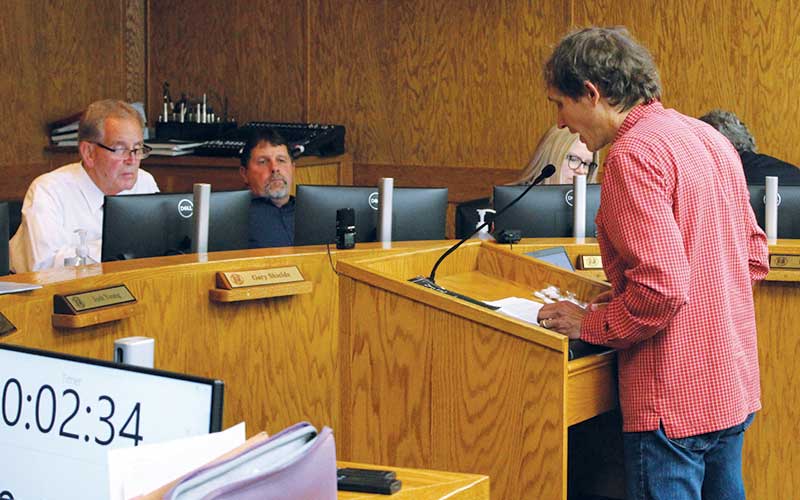
Dozens of locals filed into the Macon County Board of Commissioners meeting room during its meeting on Tuesday, May 13, to signal support for public issues, most of which were not on the agenda.
Following a brief period of announcements from board members, 13 people spoke, using around 25 of the allotted 45 minutes for public comment.
The first issue was the U.S. Army Corps of Engineers’ efforts to remove storm debris from local waterways following Hurricane Helene. Many residents, biologists, environmentalists and business owners reliant on local waterways have expressed concern that the Corps has been removing more debris than necessary, creating unnecessary disruptions for natural habitat and harming rare and endangered species.
County Manager Warren Cabe, Board Chair Josh Young and Commissioner Gary Shields spoke about the state of the waterway cleanup.
“It’s still ongoing,” Cabe said, “but that’s set to wrap up on June 1, and we’ve learned a lot in the process. There’s some things that we’ll know next time to manage … a little bit differently.”
Cabe added, “There’s nothing set to be taken out north of the Iotla Bridge, and there’s no points that have been approved by the Corps between the dam and Iotla Bridge.”
“We opted to go with the Army Corps of Engineers to work on our waterways because … they are the authority,” Young said. “I think we have a lesson learned here, as Mr. Cabe said, as this is about to wrap up, I think we’re all a little frustrated; some of the worst parts of the river haven’t been cleaned up yet. I think that’s one of the big issues, is having vested people from the community overlook these creeks. Thanks for coming out tonight in person to stand up for that.” Shields likewise voiced his disappointment with the cleanup efforts.
Biologist Jason Love highlighted the importance of having some organic debris in local waterways to preserve micro ecosystems for wildlife, and the shame of cutting down live trees by the water’s edge.
“Like many of you, I was caught off-guard by the scale and scope of this work,” Love said. “I expected a more targeted approach … I assumed cleanup would be limited to significant hazards like the log jam and crushed motorboat on the Cullasaja. What we’re seeing isn’t careful cleanup, it’s widespread clearing that is especially destructive.”
Zach Tallent, an environmental and natural resources teacher at Macon Middle School, said, “I taught and coached several of your children as well as the children and grandchildren of the people in the audience. I’m here to speak on … the presence and preservation of woody debris in our waterways … these features provide critical habitat to fish, especially for native species like brook trout and smallmouth bass that rely on shaded pools and complex structures for shelter, feeding and spawning.”
Tallent also lauded the natural environment of the Little Tennessee River as a source of education that gives students a personal connection to scientific study, saying, “This understanding is foundational not just for their education but for cultivating a lifelong sense of responsibility and stewardship.”
Leland Shockley, a fishing guide, told the board that “June 1 is not soon enough to get these clowns out of the river and quit destroying our native fish and habitat. We are supporting and encouraging the careless removal of natural debris, living trees from our river and encouraging these guys to do that for larger payouts.”
“This is a good place and it’s worth protecting,” Shockley said. “Protect our home. Quit letting the senseless destruction of our rivers going on.” Other speakers shared similar concerns.
Funding pool
During the public session, community members also spoke about the Community Funding Pool, a fund that allows the county to administer grants to local nonprofits and organizations. During April’s board meeting, Shearl floated the idea that the pool should be abolished and absolved so the county is not spending taxpayer dollars on services not owned or administered by the county. The pool is $75,000 per year, roughly $2 per Macon County resident. The funds are managed by a committee consisting of 13 members, as set by county bylaws.
Shearl’s idea received immediate pushback in the same meeting from local nonprofit leaders, who pointed out they often apply for funding from outside grants or foundations that want to know how the nonprofits receive community support. The funding pool allows these nonprofits to show larger grantors that the county has already invested in their projects, making them eligible for funding they may not otherwise have a shot at.
For the 2024-25 fiscal year, Cabe said there had not been enough applications to fill the 13 necessary task force positions and was therefore unable to distribute the funding pool. Funding for the present year will be rolled over into next year’s pool. Cabe said he hoped the Community Funding Pool Task Force would receive more applications in the next fiscal year starting July 1.
Betsy Baste encouraged commissioners to preserve the Community Funding Pool, saying, “I certainly hope that you decide not to visit this issue again, because this does good for our community … some people in this room have used free vaccines for their pets at the Macon County Animal Services, which is supposed to help people who can’t afford to pay for vaccines.”
Bill Trick said, “I would like to see commissioners require some kind of financial disclosure as to what other sources of funding the charitable organizations that apply for funding from the county are receiving. I’d also like to make sure there’s some way to verify they’re doing what they say they’re doing, and I’d like to see that be a part of the criteria of any award that’s made of any of those funds.” The community funding pool application requests details on operations and programming of applying nonprofits alongside details on grant or donor funds secured by applicants.
Echoing Trick’s concerns, Dylan Castle added, “I help a lot with nonprofits, so I understand the benefit they are to our community … my big concern is making sure that our tax dollars are spent appropriately and with oversight.”
Other business
Sheriff Brent Holbrooks presented his office’s annual report. Holbrooks reported deputies had responded to 14,730 calls over the last year. The office has investigated a total of 259 cases, including 131 felony cases. Narcotics seized roughly $73,000 worth of drugs and $25,000 in currency.
The board approved funding to purchase five SUVs at $38,858 apiece and one truck at $45,760.70 for the Sheriff’s Office. Cabe said the funding must be approved now to ensure an order can be placed before the next fiscal year, to avoid pricing increases.
The board approved an updated resolution for the Macon County Fire and Rescue Commission that would add gender-inclusive language and shift the board’s makeup to add the Macon County EMS Coordinator and remove some other members. Chairman Dustin Pendergrass also requested funding for a new Fire Safety Trailer to serve as an educational tool for Macon children. The trailer would cost in excess of $300,000, and the board said they would consider the request.
The board approved a new process for requesting public records to cement an unwritten policy already in place. Those looking to request public records from the county may request a form at the county offices or find one on the Macon County website.
The next regular Board of Commissioners meeting will be at 6 p.m. Tuesday, June 10.