
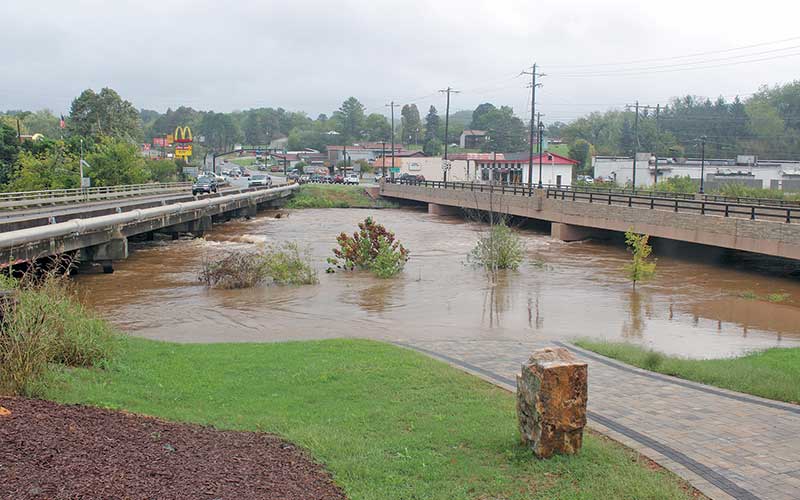
Between Sept. 26 and 27, 2024, Hurricane Helene struck the U.S. and carved up devastation through several southeastern states, including many communities in Western North Carolina. A year later, much of the recovery has been completed, while some efforts still have a long way to go.
While Macon County fared far better than towns and communities like Asheville, Morganton, Swannanoa and Spruce Pine, the county still saw a significant impact from the storm. County departments, nonprofits, community groups and individual volunteers came together to help the area recover, more resilient than before.
Casualties
To date, Macon County has two known casualties from Helene: sheriff’s deputy Jim Lau, 75, whose truck was caught in the flooding and swept into the Cullasaja River on Sept. 27, 2024; and Keith Marvey, 68, who went missing two days later on Sept. 29 and was later found dead along the Little Tennessee River.
Local damage
In an Oct. 8, 2024, report to county commissioners after the storm, then-EMS director Warren Cabe shared details of the storm’s impacts. Cabe said Macon County saw between 10 and 15 inches of rain, with 57 total structures damaged and 27 with serious damage.
Highlands saw the most severe storm effects, with more than 15 inches of rain and 50+ mile per hour gusts of wind. A total of nine water rescues were conducted and six adults and four children were displaced by flooding. Cabe said there were six known slope movements that did not result in structural damage and one inconsequential dam failure.
In the first two weeks after the storm, 150 pallets of food and 30 pallets of water were distributed.
Cabe said two fiber-optic communications systems running through Macon County were cut, causing unexpected communications failures.
Immediately after the storm, a rush from Macon County residents on available food and gas stores strained the local supply chain.
“I think it has made us as a population think more about the supply chain and how frail it can be and make appropriate arrangements,” Cabe said.
N.C. Department of Transportation Communications Manager David Uchiyama said despite damages on N.C. 106, U.S. 64 and Cold Springs, Ellijay, Henry and Sassafras Gap roads, all damage has been repaired except for two sites on U.S. 64 near Bridal Veil Falls.
“A lot of the engineering, a bulk of the work that is ongoing right now across Western North Carolina is the planning and designing to build roads and bridges stronger and more resilient,” Uchiyama said. “A lot of the roads were built in the 1940s, 1950s, with bridges being built in the 1960s and bridges in 1970s. Now, we’re using current standards, updated water flows data, new storm information to design permanent repairs to our current standard. That makes them resilient, more likely to have a longer service life and while spending less taxpayer dollars on repairs for the type of storms that we normally experience.”
Nonprofit and community response
Dozens of churches and nonprofits stepped up to the plate after the storm to offer funds, supplies and assistance to Helene’s victims, including No Wrong Door and Discover Church. No Wrong Door used its “Downtown Door” location to house 31 people between Sept. 26 and 27. Discover Church’s location was used as a hub for the Gr828 Center, which collected supplies to deliver to storm victims throughout the region.
Vecinos, which works closely with Macon County’s Spanish-speaking community, moved in immediately after the storm to provide food, money, information, support and medical care.
“More than 577,000 people … in the disaster-declared counties of North Carolina were highly vulnerable to disasters,” read a report from Vecinos’ Yolanda Pinzon on the nonprofit’s response between September 2024 and May 2025. “Among them, migrant and seasonal agricultural workers were among the most at risk, living in remote housing with few resources, language barriers and limited access to public aid.”
Pinzon said a combined effort from Vecinos’ volunteers and outreach, clinical and mental health teams delivered food aid to 726 people. The organization began to distribute emergency support funds of $100 apiece to 499 patients in the first two weeks. The organization held community events to give support and medical checkups, medication and referrals to patients.
CEO Marianne Martinez said Vecinos is “focused on helping our community be prepared and educated on how to address disasters from all angles, from logistical to healthcare/medication to nutrition.”
Medical care
Angel Medical Center’s division director of public and media relations, Nancy Lindell, said the storm was the hospital’s first real test of the disaster-response protocols developed by HCA Healthcare’s Emergency Management Team.
Recalling the storm, Lindell said, “Our primary focus remained on patient care and comfort. The resilience of our team was inspiring and through this challenge we became more confident in our ability to continue serving our community under any circumstance … that preparedness minimized disruption, maintained patient safety and highlighted only targeted areas for future improvement.”
Over the past year, HCA healthcare has conducted training and readiness exercises and adjusted its “downtime playbook” to prepare for future power, communications and water system failures. The company also launched BlueNet, a satellite communication system, to prepare for future outages.
Electrical service
Of the more than 29,000 Duke Energy customers in Macon County, more than 10,000 lost power, with 3,300 of the outages in Highlands.
In April 2025, Logan Stewart of Duke Energy said 14,000 power poles and nine million feet of wire statewide were damaged and needed to be replaced due to damaged infrastructure.
“Hurricane Helene was one of the most impactful storms in the company’s history and required an unprecedented response to ensure swift power restoration to over 1.4 million impacted Duke Energy customers in North Carolina,” Stewart said. “Strategic resource staging, helicopter operations, mobile substation deployments, advanced mapping techniques and close coordination with local, state and federal partners were critical to the success of the company’s historic restoration operation in the mountain region.”
Stewart said the company was continuing to work on improving the grid, rebuilding substations and other infrastructure while repairing critical equipment and assessing damaged trees that could still pose a threat months later.
Forests
According to the U.S. Forest Service, approximately 187,000 acres, 900 miles of road and 800 miles of trails were damaged by Hurricane Helene, with Pisgah National Forest taking the most severe damage. On Sept. 17, a spokesperson from the USFS said Nantahala National Forest “also experienced wide-ranging impacts to its natural resources and infrastructure. Hundreds of acres of downed trees still litter the forest, creating potential fuel for wildfires or heightened risk for invasive species to take root.”
The spokesperson said, “Forest Service personnel were able to quickly assess the damage to roads, trails and recreation areas across the Nantahala. With the exception of a small handful of roads and trails that required emergency repair, we were able to welcome the public back to the forest within two weeks of the storm.”
The typical wildfire season lies between October and December. Even a year later, wildfire risk remains heightened due to increase of debris downed by Helene. The spokesperson said, “most wildfires are caused by people, so it’s important to use extra caution this fire season. Check for any red flag notices or burn bans in your area before any outdoor burning. Make sure to have all the right equipment, such as a water hose, buckets and a shovel. Don’t overload your debris pile; keep it small and manageable. Never leave a fire unattended once it starts and douse the ashes when it’s out.”
Waterways
Macon County’s waterways drew local attention when contractors with the United States Army Corps of Engineers (USACE) began a debris removal project in early 2025. Those protesting said the contractors were targeting live lumber and clearing waterways and streambanks of vegetation and dead wood that creates vital wildlife habitat for local fauna.
Once the contractors pulled out of the area in June, they were also criticized for failing to properly remediate ingress and egress sites for their work, leaving unseeded dirt and wildlife-entangling plastic erosion mats behind.
The nonprofit MountainTrue has partnered with the N.C. Department of Environmental Quality to further remove lingering river debris in the area.
Federal aid
Gov. Josh Stein has lamented that funds from the Federal Emergency Management Administration and U.S. Department of Transportation have amounted to less than $5 billion of the $60 billion in damages sustained by the state.
At a Sept. 17 meeting between U.S. Rep. Chuck Edwards, other representatives of WNC and Russ Vought, director of the Office of Management and Budget, Stein requested an additional $13.5 billion for recovery in WNC. Those funds would cover $8 billion for community block grants, $400 million for small business loan forgiveness, $1.6 billion for road restoration and nearly $2 billion for disaster loans for local governments. That would bring the total requested federal aid to $23 billion.
“North Carolina leaders have expressed appreciation for every dollar directed toward recovery, but current federal financial support falls short,” Stein’s office said. “Federal support to date amounts to approximately 9% of the total damage Western North Carolina suffered.”
On Sept. 22, U.S. Homeland Security said an additional $48 million would be allocated for North Carolina for 31 newly approved projects and 18 additional large projects, each being over $1 million.