
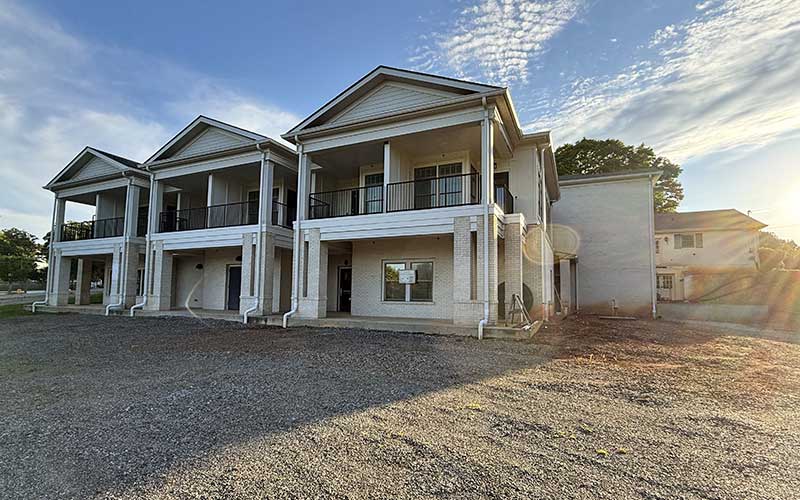
As work on the proposed hospice house on Maple Street has been paused for more than four years, many who contributed to the project, or needed its services, have been left wondering what happened.
Hospice House Foundation of WNC received a “Certificate of Need” from the state in 2012. In 2018 it contracted with Western Builders of Sylva to build the six-bed, inpatient facility and associated offices. A groundbreaking was held in February 2019 after the organization had raised more than $3.7 million, including a $1 million challenge grant from the State Employees’ Credit Union.
Work ceased on the building in 2021, and the foundation has been in arbitration with Western Builders related to the incomplete construction of the facility.
According to the order and judgement filed in Macon County Superior Court on May 29, Hospice House has received a judgement award of $600,000.
According to the court document, Hospice House filed a complaint and motion on May 3, 2024, “to compel arbitration” against Western Builders of Sylva, Travelers Casualty and Surety Company of America, Hospice Design Resource PLLC, and Thomas E. Mullinax Jr.
On May 13, 2026, an arbitrator issued an award in favor of Hospice House and against Western Builders. On May 28, 2026, the Superior Court of Macon County confirmed the award and entered judgment in favor of Hospice House.
Claims related to Hospice Design Resource (HDR) PLLC and Thomas E. Mullinax Jr. (principal for HDR) remain pending, according to the court document.
“The arbitration resulted in a substantial recovery for Hospice House. In addition to obtaining a $600,000 judgment, Hospice House successfully defeated Western Builders' counterclaim seeking payment of allegedly unpaid contract funds,” stated a June 15 release from Hospice House Project Administrator Terry Dalton.
The arbitrator denied Western Builders’ counterclaim that it was owed the balance of the contract, which was about $800,000. The release stated the judgment collected from Western Builders will be added to those available funds.
"The community entrusted Hospice House with significant resources to create a much-needed inpatient hospice facility for Western North Carolina," said Sallee Coss, president of the Hospice House board. "When the project encountered serious problems and was not completed, Hospice House had a duty to investigate what happened, pursue accountability, and protect the charitable assets entrusted to it. This judgment represents an important step in that process. The need for inpatient hospice care in our region has not changed, and Hospice House remains committed to ensuring that the resources entrusted to the organization are ultimately used to advance that mission."
The arbitration involved claims by Hospice House that Western Builders failed to construct and complete the project in accordance with its contractual obligations.
The award noted the project was affected by significant issues involving project drawings, specifications and regulatory approvals. According to the court document, the project designed by Hospice Design Resource did not receive approval from the North Carolina Department of Health and Human Services. Macon County Code Enforcement issued a Stop Work Order on Nov. 10, 2021, halting Western Builders’ work until “current up-to-date plans have been provided and approved by all required agencies.”
"We recognize the disappointment felt by many members of our community regarding the project's outcome," said Sara Stevens, treasurer of the Hospice House board. "Throughout this process, our board has remained focused on protecting charitable assets, honoring the intent of our donors, seeking accountability where appropriate, and preserving future opportunities to advance hospice care in Western North Carolina. We appreciate the patience and continued support of our donors, volunteers, and community partners."
The representatives from Hospice House say no final decisions have been made regarding the future of the project, but they will continue to evaluate opportunities “to use its assets and recoveries in a manner consistent with the charitable purposes for which they were originally contributed.”