
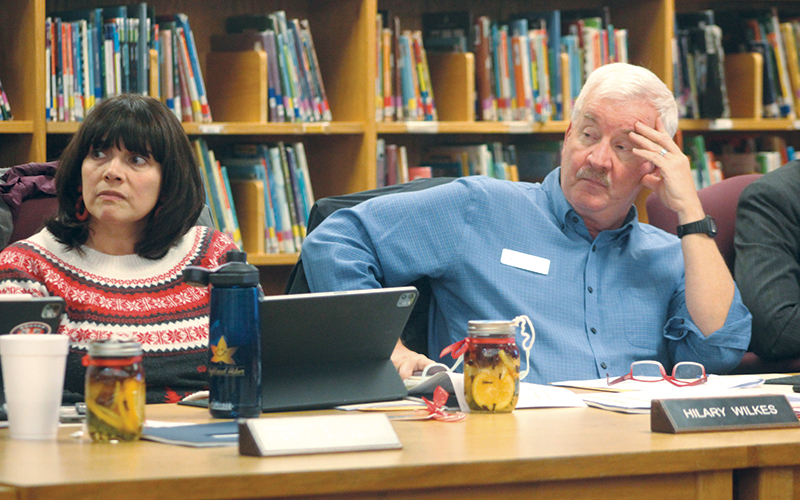
Recent tensions and finger-pointing between Macon County Schools officials and Highlands School construction officials regarding project specifics have led to blunt questions and demands to fix those issues.
MCS Maintenance Director Tracy Tallent discussed these developments with the Board of Education at its Dec. 16 meeting.
Work began in late October on the $9.5 million Highlands K-12 School project, which will add four new classrooms, renovate two existing classrooms into PreK rooms, add three project labs, renovate the medical center, add outdoor classrooms, renovate the middle school wing, deepen the school’s foundations, intercom, data and security additions, bi-directional radio amplifiers and a new middle school wing fire alarm system. The plan is to have the Highlands School project done by the first day of school in late August 2025.
One of the major issues over the last couple of months revolved around the newly installed LP (liquefied petroleum) tanks that fuel the school’s boilers. A late change switched the fuel source from diesel to LP gas as the 10,000-gallon underground diesel tank, originally installed in 1970, was found to be leaking.
Tallent told the board that during the recent cold snap, the Highlands boilers failed. It was determined there was an airflow switch problem and there wasn’t enough natural gas supply to fire both boilers. This led to not having the pressure in the tanks needed to push the heat out into the building and one day of school was canceled.
After reaching out to Vannoy, Tallent said he couldn’t get a hold of any of the subcontractors. Then after investigating, he found out there were only three 1,000-gallon tanks.
“They designed this with only three tanks, and I need a total of eight tanks,” Tallent said, noting that CMTA was the engineer on record.
Tallent asked Vannoy how they priced the tank purchasing and the document he showed had only three 1,000-gallon tanks listed.
Tallent said board members Jim Breedlove and Diedre Breeden had a call on Friday, Dec. 13 with Vannoy, LS3P, CMTA, Shofner Kalthoff (the burners installer) and Suburban Propane.
“They did not tell us why they came up with that design, other than they were using a conservative chart, a more conservative formula,” Tallent said, explaining that the Suburban Propane specialist on the call backed him up in saying they needed eight 1,000-gallon tanks to heat the school.
When Stephanie Laseter asked what Vannoy had to say on the call, Tallent replied, “not much.” Tallent said Vannoy has stepped up, putting a heat pump in every room to mitigate the lack of LP gas.
A follow-up meeting took place the next day, Dec. 17, to explore if there would be room for five more 1,000-gallon LP tanks. Tallent told The Franklin Press that the contractor agreed to install the five extra tanks.
However, you can only put four 1,000-gallon LP tanks next to each other. According to the code, other tanks have to be at least 25 feet apart (plus 25 feet away from each building). Tallent said the contractor and civil engineer at the follow-up meeting approved a concrete pad for the second bank of 1,000-gallon LP tanks.
Tallent said he would prefer to go back to fuel but that going to fuel at this point was likely cost prohibitive.
“All meetings were good and positive,” Tallent said on Dec. 19. “Hopefully we’ll have tanks installed by end of January, switch over on that weekend.”
Breedlove said he questioned how this could happen as the plans showed how many BTUs were needed. (BTU is a measurement of heat) Wilkes questioned if the contractor thought this was just for the new building additions.
Tallent noted the second Highlands School boiler was added in 1995 for the last school additions and that currently, only one of the boilers is working at three million BTUs. Tallent said the school requires 8.2 million BTUs to keep 382 children warm.
Breedlove said he asked “pretty blunt questions” of Vannoy and the other companies involved in the call. Breedlove also said he informed Vannoy and LS3P that the school board nor the county expects to pay extra for this.
“Any additional costs that came up, they were the ones that signed it, Vannoy’s the one that accepted it…and we did not accept any responsibility or felt like we had any liability,” Breedlove said.
Breedlove said he was probably harsh on the call because LS3P couldn’t get the right engineers on the line.
Tallent said that LS3P’s Emily Kite told MCS they would expect the county to pay for any tanks more than three, to which Tallent countered that the county voted on a guaranteed maximum price to include a system that was supposed to work.
Breeden asked board attorney John Henning for his legal opinion. Henning said this sounded like a version of the Spiderman pointing meme where no one wants to take the blame.
“It’s not Macon County Schools’ problem, it’s not Macon County’s problem,” Henning said, adding he wanted to look into the contractual issues further, saying he wouldn’t want to employ an engineer who makes that kind of mistake.
Wilkes called the mistake “unacceptable,” but complimented Vannoy for getting temporary heaters in. Wilkes noted Highlands School was out one school day due to this issue.
“We have a contract and they have to give us the product that they promised and they have to do that within the confines of the amount they told us,” Wilkes said.
Helical piers and elevator water
Tallent also updated the board of a potential change order regarding the structural support for the new Highlands School additions.
Tallent said he saw the design was for the 10-inch-diameter helical piers to go down 35 feet.
“There’s 108 helical piers in a footprint of about 25 by 6 (feet),” Tallent said, explaining that he wondered why and then saw “lot not suitable” on the plans.
Helical piers are deep foundation support systems to transfer the weight of a structure to either load-bearing soil or bedrock. MCS Grounds and Facilities Director Todd Gibbs compared them to the stilts that beach houses sit on.
Tallent found out that at 35 feet, the helical computers were not finding torque value, meaning they had to dig down to 52-55 feet to find appropriate torque. Tallent described the ground as “like a sponge” with how wet and soggy it is.
Tallent said with the extra 17 feet of digging and materials, he wondered if that would end up being a change order. Days later, Tallent said the contractor said there was some “buffer money” in their contract, but there was no clear answer if a change order would be needed.
One last issue was groundwater permeating into the Highlands School elevator pit. The call came in Friday, Dec. 13, that water was coming out of the custodial closet. Tallent found water coming in through a block joint and that the water pump there was doing its job to get the water out.
Tallent said Kite told him that the helical pier drilling displaced the water and that it should stabilize and stop the leaks. Tallent said he’s keeping an eye on that and if it doesn’t stabilize, something will have to be done.