
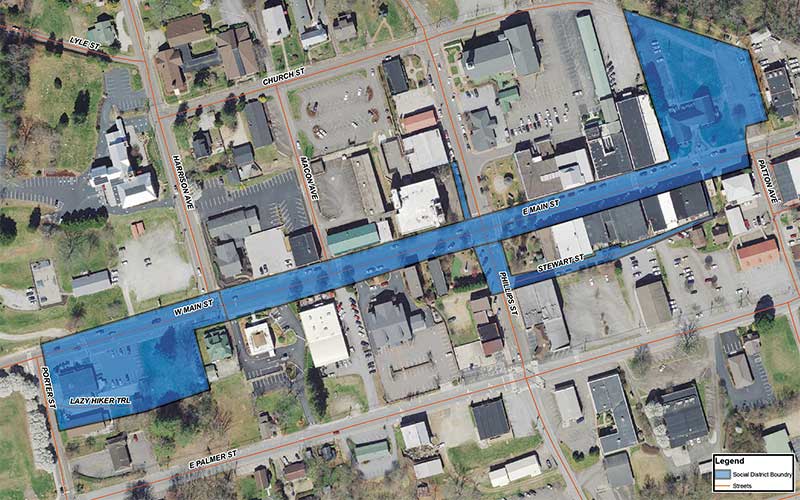
Franklin could have a social district by the time the summer tourist season starts. The Town Council approved on Jan. 3 an ordinance that would establish a social district in the Main Street area.
Town Manager Amie Owens said they still have some work to do to establish the district and get approval from the state. She said the process could take 3-4 months.
The town held a public hearing on the proposed social district during last week’s Town Council meeting. With 13 people speaking during the hearing, two opposed the social district and one said he wasn’t opposed but had concerns about what type of festivals or events the district might attract.
Those in favor of the district said it would help Franklin compete with other nearby towns, give the town an economic boost and keep local dollars in town.
“The social district concept is based in economic development principles to attract citizens and visitors to the downtown leading to increased foot-traffic and provide new revenue opportunities for restaurants and retail establishments,” stated a press release from the town following the Town Council’s vote.
The N.C. General Assembly passed legislation in 2021 that allowed the establishment of social districts. A social district is a designated outdoor area where people can legally consume alcoholic beverages. The districts are regulated by the N.C. Alcohol Beverage Control (ABC) Commission. Thirty-eight of the state’s 552 municipalities have adopted social districts.
The Franklin Town Council has discussed the topic off and on since its retreat in February 2023. In May, the council heard from Bernadette Peters, Main Street economic development director for Sylva, which has been the only Western North Carolina town to establish a social district. The discussion of a social district in Waynesville was tabled indefinitely this past June, and Murphy voted down a social district proposal in December 2022.
Business responsibility
During the public hearing last week, Amanda Harrold, a City Council member in Clayton, Georgia, spoke about their experience with testing social districts during the past year.
Harrold said she understands the concerns. “It’s a very had hard and challenging decision to make.”
She said in Clayton they are handling social district requests on a case-by-case basis and held four events in 2023 where alcohol was allowed. “It has been wonderful,” Harrold said.
To address concerns about overserving, Harrold said the bars and restaurants must be held responsible.
Graham Norris, head brewer for Lazy Hiker, echoed that thought. Lazy Hiker also has a location in Sylva, and Norris said they have not had any issues or seen an increase in alcohol-related violations since the social district was launched in April 2022.
He said business owners and bartenders must follow the law when serving customers whether it’s someone coming in from a hike or from another restaurant in the social district. “We still have a duty, and the liability is on us to make sure that we are serving them appropriately. And we have always taken that extremely seriously, in Sylva and in Franklin.”
Former Town Council member Adam Kimsey said in his nine years as the previous owner of Rathskeller Coffee Haus & Pub there was no problem with 95% of the people. He said as a bar owner the primary focus is to protect the customer by not overserving and to protect the business so it doesn’t lose its license. He said a social district could be beneficial for businesses so people can get a drink and spend more time walking around town.
Peters and Harrold said they had not seen an uptick in alcohol-related crime incidents in their social districts. Harrold invited people to attend their block party on March 16 in Clayton. “Come watch, come see. Come see that there is not this open drunkenness happening. It’s done responsibly if you do it right,” Harrold said.
Keep it family-friendly
In responding to comments about family-friendly events, Norris said people should visit their taprooms or events such as Concerts on the Creek in Sylva and see the number of families with their children who are attending and enjoying themselves.
In addressing concerns about “not being like the towns around us,” Norris said, “I would encourage y’all to take a look at who is walking around downtown Sylva and downtown Clayton on a regular basis, especially on the weekends and you’ll be pretty surprised to see the amount of Franklin locals that are in those towns because they don’t have the same opportunities here.”
Angela Martin, who serves on the Tourism Development Authority and operates Alarka Expeditions, was in support of the social district and said she likes the idea of her customers being able to stay downtown and enjoy a drink after hiking or kayaking. “I don’t think it will take away from the family aspect of our town,” she said. “We have a lot to offer families.” She said her main concern is keeping Franklin safe and enjoyable.
Economic development
Morgan Stewart, who has lived in Macon County for four years and is owner of Stewart Communications, said he believed there are “sound public opinion and economic development cases to be made for the social district.”
He said they conducted a survey of merchants that are within the district. The survey results were as follows:
65% said it would increase revenue for their specific business.
82% favored the social district as proposed.
86% felt the social district would attract visitors to Main Street.
100% said Franklin must compete with neighboring communities for tourism.
“In bottom line economic development terms, offering less to businesses and families is a losing formula,” Stewart said.
Lee Cloer, a longtime resident and operator of a travel/tourism website, 828 Vibes, also spoke in support of the district. “I love to see our mountain towns thrive,” he said. He does not believe having a social district will turn Franklin into a public bar scene as some fear.
Cloer recalled the concerns people had when alcohol sales came up for a vote and approved in 2006. Yet, the U.S. Chamber of Commerce recognized Franklin as Best Small Town in 2015 and then Best City to Live in North Carolina in 2019.
“Franklin will not lose its small-town charm because a food truck or restaurant or brewery is selling an adult beverage in the center of town. Franklin will not become a less desirable place to live or visit because someone is carrying a designated cup of beer or wine down the sidewalk,” he said.
Connie Stiles, Betsy Baste and Sandy Heaton all spoke in favor of the district as well.
My personal experience with social districts I have visited has been positive,” said Stiles, who cited some of the successes with social districts in Kannapolis and Norwood.
“The social district is another tool to encourage revitalization of downtowns,” Stiles said. “And to me, it seems both business owners and property owners benefit by having a vibrant downtown. I support social districting; I hope you will too.
Baste also noted economic development helps keep communities alive. “I personally don’t drink, and I support a social district,” she said.
Heaton said she lives two blocks from Main Street. “I think it will be great for our Franklin downtown, and I hope you will support it.”
Scott Baste said he was in favor of the social district. “I would like to see the businesses – if we have a social district – take advantage of that,” he said.
Norris had addressed that as well saying, “A social district is one small piece of bringing more business to downtown, to bringing more tourism to downtown.” He said the social district may encourage businesses to stay open because they seeing people walking by their business after five o’clock rather than people going to another town.
Roger Schweitzer said he was in favor of the social district but had some concerns about what types of festivals or music events the social district might draw. He asked about what type of procedures are in place should there be a request for an event such as a hip-hop band. “Maybe we need to study a little bit further down the road,” he said.
Opposed to social district
Bob Scott and Katherine Williamson spoke in opposition of the district. “I think you are making a mistake,” Scott said. “You’re offering a solution to something which was not a problem. A solution that is not being driven by data.”
Scott, Franklin’s former mayor and a former council member, does not find validity in the reasoning that other towns are doing it and that it sounds like a good idea. “Ideas that sound good are not always sound,” he said.
Scott pointed out that Sylva is a college town, and Clayton can draw from wealthy residents and visitors, especially from the lake community there.
“We have something no other town has,” he said. “We are unique in many ways. Let Franklin be Franklin.”
Williamson said she was pro-business but does not support the social district. “Franklin is just a wholesome town,” she said, adding there is nothing wrong with alcohol, but that it belongs in a restaurant, a bar or inside.
“Sometimes it is really good to go against the grain of what everyone is doing,” she said. “I don’t think you have to be like everyone else; I think that is one of the reasons that makes us special. We’re just kind of old-fashioned, like a little Hallmark town.”
Narelle Kirkland attended the meeting but rather than speak, submitted to the council written comments in opposition to the social district. “If what you crave from life requires excitement, drama, discord, or OK Corral-style arguments, go to Charlotte or Raleigh. They have plenty, even shootings. We residents live here to stay away from such goings-on,” she stated.
Kirkland said alcohol should be kept within the walls of the establishments offering it. “Please do not allow users of alcohol to be given public venues set aside for their selfish interests to the detriment of your non-drinking public,” she stated.
Mayor Jack Horton said although he understands the reasons people support the social district, he is against it. The mayor did not have a vote on the motion since there was not a tie.
More than a picture
During the council members’ discussion prior to voting, David Culpepper said, while Franklin is picturesque like a Hallmark town, that it is not a prop. He wants to see the town be more than just a place where people take a pretty picture and go home.
“I don’t want to be a prop town. I want to be a town that has young people that live here and are out and about and help our businesses thrive. I want a hospital that opens up a delivery ward again because it’s justified. I want young people in this town,” he said. “I don’t want to just be a picture. I want to be a real town that has different demographics – not just retirees; we desperately need young people in this town, we need professional people, and we need people having kids here. This is not the silver bullet for that. It’s the step in the right direction. It’s the tool in the toolbox that can help downtown become the downtown we all want it to be.”
District operation
The district hours will be noon until 9 p.m. Monday through Sunday. At all other times, unless a permit has been obtained for a special event, consumption of alcohol on sidewalks and in public areas is prohibited.
Drinks must be purchased from those businesses within the district that have alcohol permits, and they must be served in the specialized cups for use in the social district. Outside alcohol cannot be brought into the district.
Event sponsors will have the option to request that the social district be suspended during their events. The Town Council will consider the request at the same time as the street closure request for the event.
The squares downtown (Clock Tower, Gazebo and Rankin) will remain alcohol-free at all times as they are owned by Macon County, not the Town of Franklin, and are not included in the district. Individuals who are observed taking their marked cups into these areas will be subject to fines.
Next steps
“The Town Council was aware that there could be support for, and opposition to, the social district and are knowingly moving forward to provide new experiences and opportunities for citizens and visitors to Franklin,” said Owens.
Now that the ordinance is approved, the town will move forward with the next steps: signage requirements to indicate the geographical area for the district including entry and exit points; design of specialized cups required for use in the social district that includes required language “Drink Responsibly – Be 21” and submission of required registration with the ABC Commission in Raleigh.
“Education will be provided to those ABC permitted establishments and merchants within the social district during the next few months to ensure that when the district does go live, all will be prepared,” Owens said.
The town manager said as operations plan and educational materials are being developed they will be shared online and as hard copies available at Town Hall.