
The rising cost of food and other living expenses has made it harder for some people to provide meals for their families. That in turn has led to an increased demand for the organizations that provide food assistance to those in need
“We have seen our numbers increase – double on a daily basis,” said Tim Hogsed, director of Macon County Care Network (CareNet). “Before we were serving 25-30 clients a day, now we’re pushing 60 clients a day. We’re seeing greater need with people needing our services. People who haven’t been here in a long time are coming back, and we’re seeing a lot of new clients as well. People are just in a tight spot right now.”
MANNA Food Bank, based in Asheville, is one of CareNet’s food sources. “They’ve been hit just like everybody else,” Hogsed said, adding that with food prices going up, donations to MANNA have gone down, which in turn limits what CareNet can get from them. “They’re trying to help as many agencies as possible, so their hands are kind of tied.”
In addition to CareNet, MANNA supplies food for the monthly free Community Market and helps stock pantries at some of the local churches, the mobile market in Topton, the Highlands Emergency Council and the International Friendship Center pantry in Highlands.
During the fiscal year of July 1, 2022, to June 30, 2023, MANNA distributed more than 826,000 pounds of food to Macon County, according to Claire Neal, chief executive officer of MANNA. In September, MANNA sent 76,000 pounds of food, with 15,000 of that being fresh produce.
“What we’re seeing across all 16 counties is tremendous amount of need and less food,” Neal said. “Right now, we’re seeing more need at MANNA and our partners, and it’s higher than at the height of the COVID pandemic.”
Certain federal benefit programs led to more food being available during the pandemic, Neal said. But those benefits have since ended. “People are certainly feeling the crunch and our partners are as well,” Neal said.
Neal said when SNAP benefits ended in March that caused 20,000 more people to lean on MANNA for food. Add in the economic climate of inflation and wages not making up the difference, and it has led to an increased need.
“It’s not unique to Macon County or MANNA, it’s all across America,” Neal said. “Across the board, we’re trying to stretch every dollar we can.”
CareNet supply
CareNet can buy food at a discounted price through MANNA, but when those supplies are limited, they fill in the gaps by shopping directly from the local grocery stores. “So, it has caused our food costs to go up, and it has put a limit on our supply,” Hogsed said.
He estimates food costs have gone up from about $90,000 a year to $150,000.
Prior to COVID, CareNet was distributing about 300,000 pounds of food each year; now they are going on the third consecutive year of giving out more than 500,000 pounds. The first five days they were open in October, CareNet gave out 12,000 pounds of food.
The method of distributing food since COVID has also changed. Prior to COVID, people could come in once a month, go through the pantry and pick out the food they wanted.
During COVID, CareNet switched to giving out a pre-packed box of food and people could come pick up a box as often as they needed. Hogsed said coming out of COVID, they switched that to once a week and now because of the supply it’s once every two weeks.
He said many of the clients, especially those who work, prefer the current method because they can drive by on their lunch break and in five minutes have a box of food to take home. “We’re going to stick to that model right now,” he said.
There are no financial qualifications to receive assistance through CareNet, but they do ask that recipients be Macon County residents.
In addition to the pre-boxed food distribution, CareNet oversees the backpack program that sends more than 600 bags of food home with students each week during the school year.
“It’s a bag of food that a kid can prepare everything on their own,” Hogsed said. “That bag is slid into their backpack, so nobody knows that they’re getting it; you don’t want any stigma or anything like that.”
Hogsed said he has told the schools anytime there is a kid that needs multiple bags, give them what they need and if they run out to let him know and he’ll bring more.
The cost of the backpack program has increased as well. Previously the cost per bag was about $3 and now it’s $7. At 17,000 backpacks a year, that’s a cost of $119,000.
Donations and volunteers needed
“The community takes care of us, the churches take care of us,” said Hogsed, adding that donations and purchases at the CareNet thrift store also support their operations.
Hogsed said they expect to see their numbers increase during the holidays and they also tend to see more people in need during colder weather.
Hogsed said they can use donations of cash and food. Volunteers are also needed to help box up the food and to help fill the bags for the backpack program. “Come by and see us. There’s always something to do,” Hogsed said.
Prior to COVID, CareNet ran a soup kitchen, but it closed during the pandemic, and they lost a lot of their volunteers. Hogsed said he would eventually like to have enough volunteers to reopen the soup kitchen. They currently provide bag lunches to homeless people.
The CareNet office on Bidwell Street is also home to Macon New Beginnings. Hogsed said it has been a good partnership as clients for both organizations often need the same services and having everything in one location is convenient.
“We live in a country where people shouldn’t have to pick and choose,” Hogsed said, noting that some people have to sacrifice food for their families to pay for other living expenses. “We’re here to help and we want to help as many people as possible.”
Hogsed said during the holidays, it’s nice for the clients to get something special in addition to their regular box of food. He suggested putting together a meal kit with everything a family might need to make a holiday meal. “We’ll make sure to get it into the hands of the people who need it.”
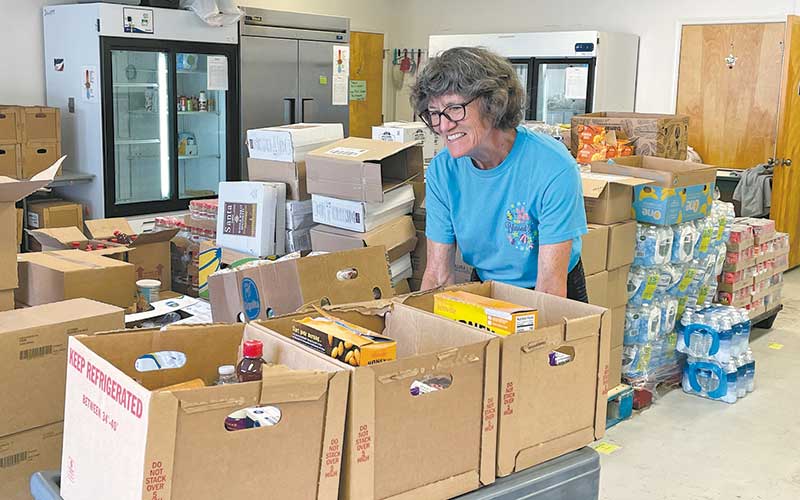
On a recent day in the warehouse, Hogsed pointed out empty shelves that once would have been full of food to give out. “It’s a pitiful state right now, but that’s a sign of the times.”
Food items needed on a regular basis include canned protein, vegetables, spaghetti sauce, peanut butter and jelly, macaroni and cheese, cereal, oatmeal, baking goods. He said they can also accept donations of paper products.
For more information on how to help or to volunteer, call 828-369-2642 or visit maconcarenet.org.
Free Community Market
Each month MANNA Food Bank offers a free community market at the Macon County Fairgrounds. The drive-thru market, held the fourth Monday of the month, usually serves between 200-260 households.
Felicia Roberts, who coordinates the market for Macon Program for Progress, said earlier this fall the numbers decreased to just under 200, but she thinks some people are now being served through the new Healthy Opportunities Program where food can be delivered to people’s homes.
The numbers were back up the last two months, with 230 families served in November. Roberts said she is seeing new faces come through.
Roberts said they serve a lot of senior citizens during the market and they have started creating senior boxes.
There are no qualifications for the free drive-thru market, but they do ask recipients how many people they are picking up for and how many are in each family.
She said some people who don’t have transportation come to the market, so they try to make their boxes lighter so they are easier to carry.
“We don’t judge people on what they drive or where they work,” Roberts said. “If they need food, they come and we give it, no questions asked.”
Roberts said the market is all volunteer run. “They are amazing. They own it,” she said. “Sometimes there are 40, sometimes 20.” She said community organizations have come in to help as well as students from the high school, the Job Corps and Men’s Challenge of the Smokies.
More volunteers are welcome. To learn more about volunteering, call Roberts at 828-524-4471, ext. 406.
Reporter Thomas Sherrill and intern Owen Marsten contributed to this report.