
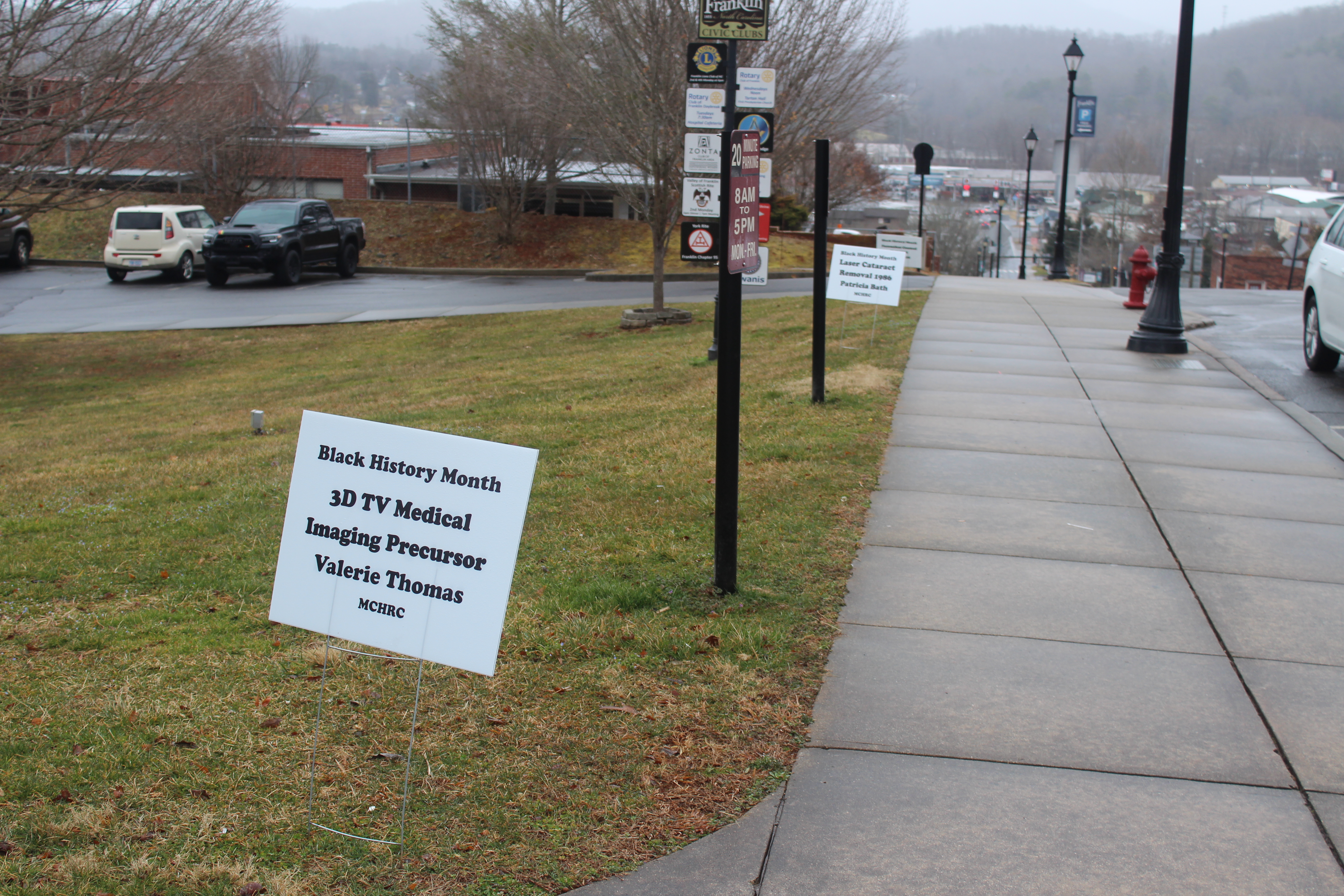
Did you know that the modern potato chip was invented by a Black chef named George Crum? Or that the refrigerated truck, the home security system and the gigahertz computer chips that allow for color displays were also created by Black people? Anywhere you look in modern technology, you might see the fingerprints of a black inventor and never know it. A Black History Month effort in downtown Franklin is helping passersby remember.
In acknowledgement of Black History Month, the Town of Franklin and the Macon County Human Relations Council have cooperated to set up a series of yard signs in the downtown area. These signs list several Black pioneers in a variety of fields and their inventions that we still use to this day. The MCHRC has used other media to spread this information in past years, but this is one of their most visible strategies yet.
“Not everybody listens to the radio, so I was trying to think of what else we could do to reach more people,” said Synethia Owens of the MCHRC.
In front of Town Hall, pedestrians can learn about Alexander Miles, who gave the world the first set of automatic elevator doors in 1887. Near the gazebo, there’s a tribute to Garrett Morgan, who invented the smoke hood, a precursor to the modern gas mask, in 1912 and then the three-light traffic signal 10 years later. In her research for the signs, Owens found a staggering number of advancements in the medical field – blood plasma preservation, 3D TV medical imaging, laser cataract removal, the pacemaker control unit, leprosy treatments and even the first smallpox vaccine can be traced back to Black trailblazers.
“Look at all the inventions that are connected to medicine,” Owens said. “Black people have been a huge benefit to our hospitals.”
Promoting Black history is a point of both social importance and personal pride for Owens. Her brother, Walter Scruggs, was one of three Black students in 1964 for whom Franklin High School was first integrated. Scruggs became a star athlete for the school and an important member of the community, and his is one of many stories that advocates feel go uncelebrated too often. Taking a few seconds to read about Black inventors during your next walk down Main Street is a simple way to honor those stories and the impacts those inventors still have today.
“It’s just about giving credit where credit is due,” Owens said. “For such a time as this, it’s so important for us to always keep learning and to keep wanting to learn.”
For more information on Black History Month in Macon County and on other projects from the Macon County Human Relations Council, call Synethia Owens at 828-421-1442.