
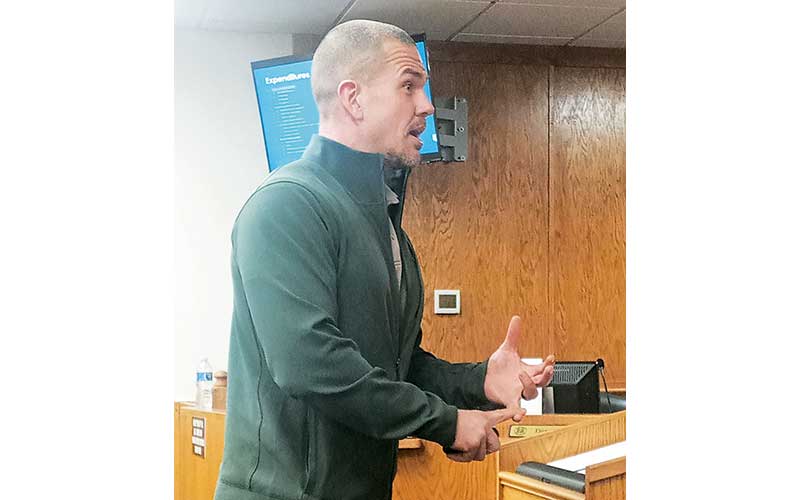
Macon County’s Emergency Services Director Warren Cabe plans to have all the fire departments sign a new service contract this year as part of a total review of how the county’s emergency services operates.
Cabe told the Board of Commissioners at the Feb. 9 budget kickoff meeting that in the next few months, his department will review and revise current fire department contracts, assess functionality of the current Fire and Rescue Commission and review the whole fire system for functionality.
Cabe said revising the service contracts will add safeguards and require a certain level of service going forward for the county’s nine rural and two municipal fire departments.
According to the presentation, Macon County has approximately 329 volunteers, 21 full-time employees and 24 part-time employees, the latter of which work sparsely to cover when full-time employees are out. Macon County provides four full-time employees. None of the 11 departments operate with completely full-time staffs; they rely on volunteers in addition to paid staff.
Cabe said some departments have good manpower, however some are struggling to keep up numbers as there’s a declining number of active members and a decline in junior members in the rural departments.
“You used to go by a parking lot on Thursday night and it’d be full, now you see five or six vehicles at most,” Cabe said about meeting nights at fire departments.
Part of the contractual changes Cabe wants to implement is to mandate that all county fire departments maintain at least a Class 7. The contracts last signed in 2014 show that a minimum protection is at Class 9, two rungs below Class 7.
Protection classes correspond to the level of service a fire district has, which goes from Class 1 through 10. A Class 9 rating is the worst a district with a fire department can have. Departments can move up as members receive certifications and departments receive certain equipment, as determined by inspections.
“That’s the thing that’s important to you when you pay your insurance bill,” Cabe told the commissioners, noting that the insurance premiums for residential houses level out once a fire department reaches a Class 6, while commercial buildings premiums still go down until Class 4 or 5.
Cabe said that currently, the fire departments’ district protection class varies from Class 3 to 6, with most at either Class 4 or 5.
Another update Cabe hopes to add to the contract are provisions ensuring the fire departments’ member meetings open to the public with requirements to keep minutes and issue public notices. He also wants to add a clause in case of a department’s liquidation or dissolution to make sure all equipment, assets and property either go to a successor department or neighboring districts at the behest of the county commissioners.
Cabe said in 2022, there were four departments with staffing issues, which he said is more than any single year he can remember, saying that while all four corrected those issues, he wanted to have something in case a department fails. Cabe said the Nantahala Fire Department had financial problems in 2015 and “it really could have gone either way,” but he lauded their administration for turning it around.
Cabe told the commissioners he hopes to have the contracts signed by July.
The Fire and Rescue Commission currently sits at 22 members with two from each department. Cabe recommended a commission with maybe just the chiefs of each department or something similar with less than 22 members. He said members typically don’t want to vote against another department in case they themselves might need help in the future.
When asked about the possibility of a county-wide fire department, Cabe said currently it’s not feasible, but said he will visit with Clay County, which has gone to a county-wide fire department. Cabe said such a process would not be easy and take one to two years in total to complete, if done.
While Cabe didn’t ask for any money during the meeting, he noted that the budget over the last five years has gone up from $3.176 million to $4.945 million, driven by inflation and increased equipment costs.
School building updates
Macon County Schools Superintendent Chris Baldwin told the commissioners they are working to address their budget so they won’t have to rely on using fund balance again as they did this year. Baldwin said MCS used approximately $500,000 of fund balance to balance its budget this year and that the budget spike was due to inflation, substitute pay and state-mandated salary increases.
Baldwin talked about the issues with the geothermal system at Iotla Valley Elementary, which have been ongoing for years, detailed how maintenance is turning off certain wells to help find the ongoing leaks. MCS put $770,000 in ESSER funding into the building.
Talking about the Macon Middle School sewer smell caused by poorly installed vent pipes back in the 1980s, the Emergency Management director said they have an air quality meter that can determine if the hydrogen sulfide in the air is at dangerous levels. MCS previously said they don’t think the smell is dangerous as there’s no recorded instances of anyone getting sick from it over the last 35 years, but don’t know for certain.
During a discussion about the Nantahala School sewer system, Baldwin said the most recent price MCS got for the full replacement is $365,000. Additionally, the replacement can be done in tandem with the current system, meaning no school will be missed. Board Chair Paul Higdon brought up the idea of replacing the discharge system with a septic system.
The Highlands PreK project is being put on the 10-year capital improvement plan list instead of the one-to-five-year list, according to County Manager Derek Roland.
The Highlands soccer field restoration project didn’t have any bids in a recent request for proposals, according to Finance Director Lori Carpenter.
Baldwin said MCS has $6.6 million of ESSER funding left and that they have developed a budget to use those funds, which must be spent by a certain date.
A “booming local economy”
Roland said the county is in the strongest financial position he’s seen in 10 years.
As far as sales taxes, five months into the fiscal year (July through November 2022) Macon County is up $848,000 compared to last year, from $6,715,777 to $7,564,467, a 12.64% increase. Last year during the same time, Macon County was up $955,000 from the year before, or 16.5%, at this point, according to Carpenter.
Roland said Macon County currently has the lowest unemployment rate since 1969. “If you want to work right now, you’re working, and employees that are working are getting paid more.”
Carpenter did warn that November, the latest sales tax figures available, was only up 3% compared to the year before and was curious how December would look.
Roland said the county is still growing at an unheard of rate.
This led into Roland’s budget timeline, where he said he’ll meet with department heads over the next two weeks, then work on the first draft after a March 13 deadline. The school system’s budget is due by April 14 after they get an idea of how much they’re getting from the state. The May 9 commissioners’ meeting will include the first draft of the county budget. A public hearing on the budget is slated for June 13. Budget workshops can be scheduled around that time, as long as the county approves a balanced budget for 2023-24 by midnight on June 30, the end of the county’s fiscal year.
Commissioner John Shearl advocated for making the entire budget process open to the public, including the department head meetings, for the sake of transparency.
“I think we as this board need to know where every bit of money goes …. there’s money going every which way in this county,” Shearl said, adding that a couple department heads told him they would retire before doing a public presentation, but did not elaborate on who they were.
Roland said the department head meetings, of which there are more than a dozen, can last several hours, noting that the Sheriff’s Office one usually goes eight or nine hours.
Shearl kept on pressing, talking about the cost of the new Franklin High School and other expenses. Shearl said the budget book he got contradicts itself, which both Roland and Carpenter disagreed with.
Other commissioners were less than enthusiastic about calling a public meeting for every single budget meeting. Commissioner Josh Young said his first budget as a commissioner blew his mind and he equated it to “drinking from a fire hydrant.” Commissioner Danny Antoine asked about how much detail they usually get, to which the response was that they get a line-item budget. Shearl spoke up and said he “wants to hear it, not just to see it.”
Commissioner Gary Shields equated looking at his first budget as a commissioner to looking at Greek and advised Shearl to owe it to himself to learn it first and listen. Antoine agreed with the idea of going through one to see how it feels.
Shearl made a motion for the county commissioners to sit in with every department head meeting. The motion died for lack of a second. Roland and Carpenter said Shearl could still sit in on those meetings if he chooses.