
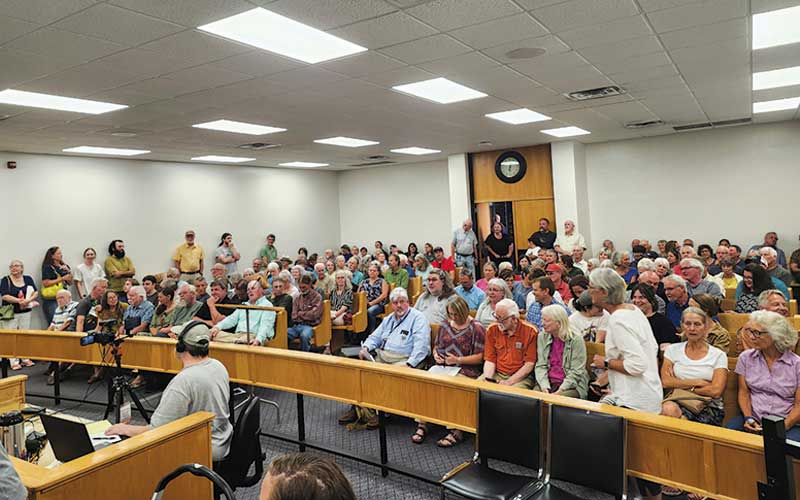
Before the public comments started, Macon County Board of Commissioners Chair Gary Shields told the overflow crowd at the July 9 meeting that he would ask to table three ordinance changes after each public hearing.
Shields and Commissioners Danny Antoine and Paul Higdon voted in favor of tabling the proposed changes to the Soil Erosion and Sedimentation Control Ordinance until the Aug. 13 meeting. The same ballot happened for the proposed Watershed Protection Ordinance changes, moving that item to the Sept. 10 meeting. In both votes, Shields did not call for the “nay” votes, so Commissioners Josh Young and John Shearl officially did not vote on either tabling.
The vote to move the proposed Flood Damage Prevention Ordinance changes to the Oct. 8 meeting was unanimous.
The motions were to table each vote. There was no board discussion of revisiting any of the proposed changes in any capacity.
In his preamble before the public hearings started Shields complimented the members of the public who had opposed any of the ordinance changes. Shields said in “over 100” emails he received about this issue, not one was rude or crude, saying he doesn’t tolerate rude emails. Shields said this is not his area of expertise and he wasn’t 100% prepared, so he wanted to listen.
“I want to get it right the first time,” Shields said.
Young, who presented the ordinance changes earlier this year, said the emails he got were “professional and thought out.” Young complimented the crowd for expressing their voices in a democracy and agreed with Shields’ idea to table the Flood Damage Prevention Ordinance.
Macon County Planner Caleb Gibson led off all three public hearings with a recap of what each ordinance change would do. Later in the meeting, the commissioners approved appointing Gibson as ordinance administrator, the position previously held by former planner Joe Allen, who resigned at the end of June.
The commissioners had scheduled all three public hearings and possible votes for this July 9 meeting. The crowd size caused Shields to move the meeting from the commissioners’ chambers upstairs to the larger fourth-floor courtroom.
Eight people spoke during the Soil and Erosion Sedimentation Control Ordinance public hearing, seven during the Watershed Protection Ordinance public hearing and 21 people during the Flood Damage Prevention Ordinance hearing. Additionally, two others spoke during regular public comment later in the meeting on the ordinances. Some speakers signed up and spoke for all three public hearings. None of the 38 public commenters supported the proposed ordinance changes, although a couple said they could see both sides. The rest of the public comments opposed loosening floodplain restrictions or wanted to strengthen them.
Soil and Erosion Sedimentation Control
Gibson told the board he has inspected 15 parcels that are over an acre and only two parcels between half an acre and a whole acre. Gibson said the state recommendation is mandating a study for a land disturbance permit of an acre or more.
During the public hearing, Sarah Johnson asked the commissioners to pay attention to scientific studies and showed various charts of habitats that could be affected if the new ordinance passes.
Susan Ervin said she’d seen the streams and rivers run dirty before the county passed floodplain protections, saying the current regulations keep the mud out of the waterways. Callie Moore of MountainTrue said the nonprofit opposes the changes. Rob James talked about how his uncle lost his leg in the 2004 Peeks Creek landslide and how growing up, he would see the Little Tennessee River as “thick, orange and soupy,” but that it’s nowhere near that today.
Don Reis advocated for strengthening the ordinances and said a full acre is a big change. “Do the right thing,” he told the commissioners.
Pam Walker spoke more about the proposed change to allow fill in the floodplain, saying our grandkids will thank the commissioners for saying no.
Stephanie Almeida of Smoky Mountain Harm Reduction spoke in place of her husband Brian who had signed up. She questioned the commissioners’ priorities of focusing on these ordinances while children are dying from drug overdoses.
After the public hearing, Commissioner John Shearl said instead of regulating a study, there should be hefty fines for erosion issues on construction sites. The crowd got combative with Shearl, especially after he asked how many people there lived on a river, to which many raised their hands.
Commissioner Paul Higdon said an ordinance is worth nothing without enforcement, saying the board was doing lip service. Higdon wanted a comprehensive review of the ordinance as there are multiple issues he has with it.
“A driveway can be half an acre,” Higdon said.
Watershed Protection Ordinance
Gibson started the second public hearing by saying that allowing RV parks to have a Special Nonresidential Intensity Allocation would allow up to 70% impervious surfaces in the watershed, but “must minimize built-upon surface area, direct stormwater away from surface waters and incorporate Best Management Practices to minimize water quality impacts.”
Lee Walters, a Macon Planning Board member who said he’s a floodplain property owner, believes RV parks should have the same density allocation as houses.
“High density is not consistent with rural housing,” Walters said.
Johnson said most RV parks discharged septic and it will be more than one family per acre doing so if allowed. Betsy Baste referenced Shearl’s earlier point, saying hefty fines make zero difference for developers. Reis, a former sewer installer, expressed amazement that Macon County wasn’t expanding its sewer systems and said RV parks need to be tied into a sewer system.
Angela Faye Martin said every RV park on a river is a habitat loss for animals, and that when people clear stream banks to keep out snakes, they make it a better habitat for venomous snakes and destroy dragonfly habitats. Martin said as a kayaker, she’ll never put her head in the Little Tennessee River due to the RV parks already grandfathered in.
James said septic contents can end up in the river even if they’re not intended to be. Paul Crew told the commissioners a lot of sedimentation in the rivers comes from roads up the mountain and said that’s not being addressed.
Shearl defended his right to camp, saying people in the audience should respect his rights. He said he has three campers and has never put sewage in the creek and that Franklin couldn’t be built outside a floodplain. Shearl said to Martin, “You take your little tours down the river.” The crowd booed in response.
Young said with this ordinance, you’re danged either way.
Flood Damage Prevention Ordinance
Bob Cook said during the Hurricane Ivan flooding he saw the rivers swell 10 feet. He said property owners upstream and across from him putting fill into the floodplain will affect him. “Our property and the river bring in tax revenue,” Cook said.
Walters said the problem with this proposed ordinance is that it says nothing about volume, just surface area. Walters believes this could lead to mountains of dirt, and that county engineers won’t consider the cumulative effects of many floodplain properties having the maximum amount of fill.
Johnson criticized the county for not calling any experts when forming these ordinances.
Jordan Smith, executive director of Mainspring Conservation Trust, said the organization is against the changes, which will harm the bottomlands of the mountains.
Doug Woodward talked about the landfill site subcommittee he was on 30 years ago and how it came about because of a need. Woodward asked where this need was coming from. He said the ordinances would affect people 100 miles down the rivers going to the Mississippi River and Atlantic Ocean.
Bill McLarney said if the commissioners vote for this, their interests are not for those who voted them in. Alex Haiss talked about a petition he helped create opposing this ordinance, which he said had 292 signatures, including those from area visitors, saying their voice matters too.
“I think the message is clear, don’t mess with the floodplain,” Haiss told the commissioners.
Canyon Woodward opposed all three ordinances and said he got the impression that the commissioners were not listening. Mark Little said while he hadn’t read the ordinance and was still on the fence, he thought allowing up to 25% fill in a floodplain was “out of whack.” Scott Baste said this ordinance creates a problem that doesn’t exist.
James opposed the proposed changes and brought up the 2004 Hurricane Ivan flooding in Otto. Moore noted that Henderson County, on which this proposed ordinance is based, has additional stormwater ordinances to protect floodplains.
Kenneth McCaskill of the Macon County Farm Bureau pointed out that several types of crops will never grow again in floodplains that are filled up. McCaskill said you can replant 40 acres of corn but it’s harder to rebuild 40 acres of houses and the dead from an emergency flooding event.
“Why can’t we have the best ordinance in Western North Carolina?” McCaskill asked.
Monica Barbour presented a petition signed by 32 Cherokee Landing residents to oppose any changes. Johnson noted the Little Tennessee River is part of the Blue Ridge Snorkel Trail and would be affected by this ordinance.
Lewis Penland said he was disappointed in how the commissioners went from discussing a subcommittee to having an ordinance ready to vote on. Penland said he knows of one project where workers were told to put fill into the river/creek and how heavy fines cost jobs, but work-stoppage regulations work better.
Carolyn Porter spoke on the tax benefits of the properties in the current floodplain and said the bare minimum in Raleigh is not good enough here. Chris Brower talked about how the Fishhook Mountain development failed and how mud continues to flow and turns the river brown.
Reis said he was baffled about why this was an issue, believing something was fishy with the commissioners pushing this through.
Martin asked everyone in the crowd with a degree in hydrology or a related field to stand up; around 15 people stood. Martin said Macon County has a huge responsibility to “not be Anywhere, America” and that we protect this place.
After the public comments, Commissioner Danny Antoine spoke for the first time, calling the comments very educational. Antoine said personally, he’s not in favor of the government telling landowners what to do, but he understands being a good neighbor.
“Currently, I’m for keeping these ordinances with no changes,” Antoine said, wishing they would have voted on the ordinances that night. Antoine also said he’s heard a lot from one side of the issue and said there’s a lot to be said from the other side.
Young shared the issues he’s heard about the current ordinance, such as a farmer west of Franklin wanting to fill some land. Young said it’s hard when other counties allow certain fill exceptions and Macon County doesn’t. Young did say he felt the conversation was worthwhile. Additionally, regarding the ordinance, Young said he was “fine if it goes nowhere.”
Regarding public comments about Young buying land in Otto along the Little Tennessee River floodplain, Young said he did not buy the land to fill, saying he didn’t know what he would do with the land.
The back and forth between Young and the audience got contentious. At this point, Chairman Shields threatened to remove people from the meeting if they didn’t calm down. An unidentified audience member responded to the commissioners saying that the other side wasn’t there.
At the end, Shields said he’s heard about people needing to access their properties and there needs to be a site-specific process.
Later during regular public comment, Andy Muncey said he once saw a map showing Coweeta River as the cleanest river east of the Mississippi. Muncey said he’s seen his neighbor bring in loads of fill and while code enforcement gave him a talking too, the county did nothing. Muncey also said his neighbor had a pipe for septic going straight into the river.
Ryan Kuba, from the Cartoogechaye Campgrounds, asked about taking care of an abandoned property. Board Attorney Eric Ridenour said they would discuss the property in a closed session.