
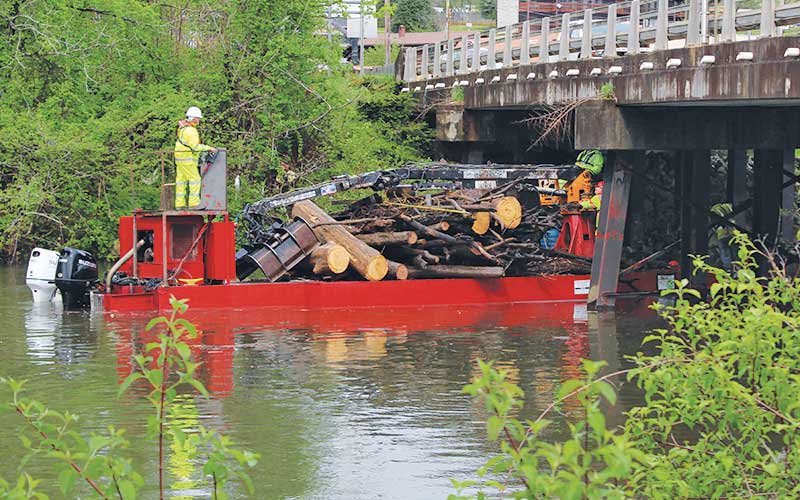
On Monday, April 28, representatives from the United States Army Corps of Engineers, Corps contractor Kituwah Services and Macon County met to discuss the local response to debris removal efforts in local waterways, according to County Manager Warren Cabe, who attended the meeting.
Cabe said the Corps had agreed to avoid “pertinent” sites to lower the risk of damaging certain sections of the river, and to provide the county with the high-quality habitat maps contractors use to indicate which zones are cleared for work. The Corps also will provide the county with work timeframes to help the public know when and where work will be taking place and invite subject matter experts to observe the work as it is underway. No work is currently scheduled upstream of the Cartoogechaye Creek water treatment facility.
Cabe said Kituwah will bring in some additional smaller barges to reduce the need for large equipment in the water, which had been a concern of several local observers, and added the county would push for greater transparency from the Corps to allow for more information to be made public.
Cabe described the meeting as productive.
Bobby Petty, a public affairs specialist for the Army Corps of Engineers, defended some of the contractors’ practices by noting that specialized forester equipment moving up and down waterways prevents the need for pathways to be cut through plains and forests, and over private property, to reach the waterways from accessible roads.
Petty also said the necessity of organic debris removal extends beyond the economic and cosmetic to preventing the risk of further flooding and erosion and improving the functionality of waterways as natural fire breaks.
An April article by Petty further discussed the process of debris removal in Western North Carolina. The article states heavy forestry vehicles use biodegradable hydraulic fluid to reduce the risk of pollution and eliminate clear-cutting at stream edges. The Corps partners with biologists and “Quality Assurance specialists” to assess the state of waterways prior to operations, Petty said.
Once removed, debris is stored at temporary sites on timber matting to prevent damage to the soil until it can be disposed of or recycled.
“The effort is fully coordinated with FEMA, the North Carolina Department of Environmental Quality and other state, county and local jurisdictions,” Petty said. “Workers in the field consult with FEMA Environmental Historic Preservation experts to ensure extremely sensitive sites receive special attention to minimize environmental impact.”
Petty said since April 15 the Corps would meet with the North Carolina Wildlife Resources Commission to prepare before working in any sensitive areas, and the Corps has been meeting with a host of organizations to discuss how mapping data should be interpreted.
Petty also said 21 of 142 Macon-identified sites for debris removal had been cleared, amounting to 20,590 cubic yards of debris removed, and debris that is organic will be mulched. Wood suspected of contamination would be chipped and sent to landfills.
“Tree removal requires selective removal guided by a forestry expert. It may seem haphazard, but it’s not — and the debris left behind by … Hurricane Helene is considerable,” Petty said. “In Macon County alone, the estimated total of 127,500 cubic yards of waterway debris identified by county officials to be removed by USACE is equal to roughly 12,750 dump trucks. End to end, they would all stretch 53.1 miles — about the distance from Franklin to the Tennessee state line. And Macon County represents 2.5% of the nearly 5,000,000 cubic yards of waterway debris requested by 16 western North Carolina counties for removal.”
Petty denied claims that contractors were collecting more than necessary or violating FEMA guidelines, saying, “This is not the case — over-clearing is not tolerated. Contractors know they will be penalized: they won’t be compensated, and/or could have their current contract cancelled if they take more trees than they’re authorized to remove. Even with relatively minor infractions, poor performance will count against them in the future and affect their ability to bid on future government contracts. There’s little incentive for contractors to take more trees and debris than they are told to remove. If it happens, we identify it quickly and either retrain that specific worker or have them leave the project.”
Cabe said the county had already received and posted high-quality habitat maps to the Macon County website and Facebook. Other assurances seem promising, but MountainTrue Director Callie Moore said the Corps has given similar assurances in response to community concerns in the past without following through. It will take time to see whether the organization responds to this current pushback or amends its future policies to account for it going forward.
Correction: The article in last week’s edition, titled “Community pushes back on debris removal efforts,” contained a sentence that read, “Love said he had seen easily 12 trees removed from the waters’ edge due to contractor activity” that should have read 120 trees removed.