
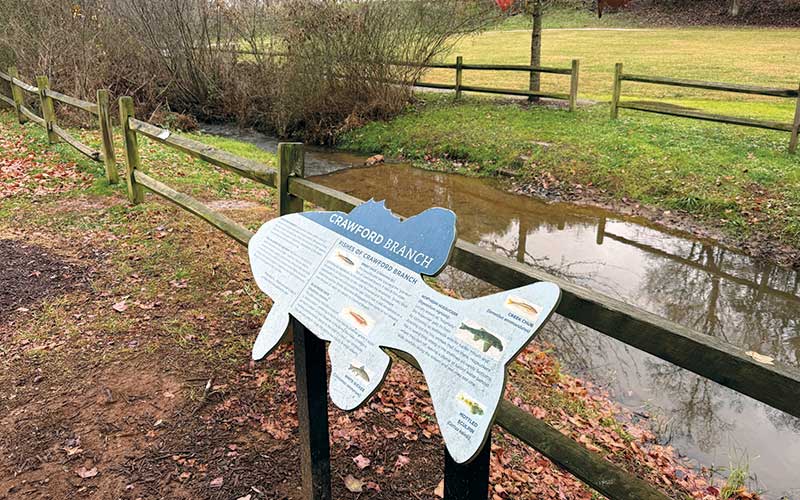
A proposed greenway along Crawford Branch would allow people to walk safely from one side of Franklin to the other.
The Town of Franklin received a grant in 2023 from the N.C. Department of Transportation’s Integrated Mobility Division to study the feasibility of building a pathway connecting Memorial Park on West Main Street with the Little Tennessee Greenway in East Franklin. The town worked with TPD, Inc. to conduct the study between June and September 2024.
Kristy Carter, senior project manager with TPD, presented the study results at the Dec. 2 Franklin Town Council meeting.
The goals of the project would be to enhance safety, maximize connections, expand mobility and transportation choice, and support downtown.
“How can you enhance safety if you want to travel through town on foot or by bike? How do you give people the option to travel by foot or by bike?” Carter said.
While traffic congestion is usually not an issue in Franklin as it is in some places, Carter said there are people who may prefer to walk or bike or who may need to because they don’t have access to a car or can’t afford transportation.
“Right now, people don’t realize that there is an option to get out of the car and to walk or bike and seeing a greenway such as the Crawford Branch Greenway, which is a little different than your Little Tennessee River Greenway, which is really more of a recreational experience,” she said. “This one is more designed as a transportation and recreation experience. It really does get you from one side of town to the other. And that’s part of the goal – maximizing those connections and then just supporting the ongoing efforts of downtown Franklin. This is a way to get people out and about.”
Community input
In conducting the feasibility study, TPD and town staff visited various sites along the possible routes noting opportunities and challenges. They also held a series of stakeholder meetings, met with property owners and conducted an online community survey. Carter said 517 people visited the survey with 59 completing it and 85 comments collected.
Route selection
In looking at possible routes, Carter said they quickly realized the path could not just follow the creek. “It’s very tight, very constrained. There’s lots of infrastructure down there, buildings right on the creek.”
She said they also had to take into consideration the need to design a path that is ADA compliant. “It would be hard to get a project like this funded without some type of either NCDOT or federal funding,” she said. “It’s not good enough to just say, ‘Oh, we can just create a path and they can walk along that.’ To set you up for funding, to put you in a good funding position, we wanted to make sure we could come up with an ADA compliant route.”
Carter said this pathway would not look like the Little Tennessee River Greenway with one paved path from beginning to end.
“This winds its way through. There would be a multi-use path along the road and off-road greenway that doesn’t look like the Little Tennessee Greenway. There’s some parking reconfiguration that’s needed and potential for a shared street where pedestrians, bicycles and cars would kind of share the space on the road,” she said.
With technology advancements since the town did its bike plan in 2017, Carter said there are better ways to protect pedestrians that share road space with cars.
There had been talk about building a boardwalk through the wetlands, but Carter said that might be cost prohibitive. “You can do it and it would be a lovely experience. It’d be a really expensive endeavor.”
She said they did not include the boardwalk in the plan since the “whole project is kind of expensive.” The estimated cost for the 1.2-mile project is $1.3 million.
Additionally, she said there is a lot of unknowns with property owners along the proposed route with property acquisition and getting right of way agreements.
Another suggestion in the plan is repairing the bridge in Heritage Hollow but making it for pedestrians only.
Next steps
Carter said the next step would be for the council to adopt the plan. She said that is an important part of the process when seeking funding from DOT or federal sources.
“You’re not on the hook for spending the money, but if the money comes along, you need to have it adopted.”
Carter said the town would also need to start talking with property owners along the route. She suggested partnering with an organization such as Mainspring Conservation Trust that has more experience talking with property owners and getting easements.
Town Council member Joe Collins said he’s not sold on the project unless there is funding available for it.
“Is there a need for this project, to get people a different way to get from one part to the other?” Collins asked. “I don’t see it, but somebody might can satisfy me that there is.”
Carter replied, “In general, communities that are thriving and growing are the communities that are generally saying ‘we want more places to walk and bike.’”
She said in surveys that have been done in Franklin as part of the bike plan and the comprehensive plan, people have said they want more places to walk and bike and to be able to walk and bike to places.
Carter did note that sometimes that sentiment can change when it comes down to saying, “It’s going to go in front of your yard.”
To answer Collins’ question about the need, she said, “Are you seeing people make that walk now? No, because it’s not safe. It is not fun, it’s not pleasant.”
Town Planner Justin Setser said the census shows that there are census tracts on the west side of town, but still within the town limits, with a high number of people who do not have access to vehicles. “A safe walk or route would be useful to get across town,” he said.
Mayor Jack Horton said working people who live in town may not be able to go to the Little Tennessee River Greenway to walk after work. He pointed out that from time to time he sees people after business hours walking along Main Street in well-lit areas.
“If this provides a well-lit safe place to walk after work hours, I think that would be an attraction for some folks,” Horton said.
Carter said some places have seen an economic benefit to having a walking trail through their towns as it helps bring people to the area. “To have the economic benefit, it’s going to need to be really thought through and designed well,” she said.
The mayor said the two questions that come up when talking about bike trails, walking trails or greenways are: is it safe and what does it take to maintain it. He said he also understands people’s concerns about having others walking along their property.
Horton said people need the opportunity to see and learn more about the plan before they can understand if they would use it and how it might enhance the town. “I think once they get more familiar with it, they may see some benefits,” he said.
Vice Mayor Stacy Guffey said people have been talking for 15 years about the idea about how to get people from the Greenway in East Franklin to the other side of town without going uptown through the Main Street area.
“Walking to the grocery store, walking to the dog park or something like that. We consistently heard that people wanted that kind of connection,” Guffey said, adding that business owners in West Franklin say sometimes they feel disconnected from the more active side of town, East Franklin, and recreation.
Horton suggested they not take action on the study at the Dec. 2 meeting as council members David Culpepper and Rita Salain were not present. The plan may be on the agenda for the Town Council meeting on Monday, Jan. 6. The council meets at 6 p.m. in the board room on the lower level of Town Hall.