
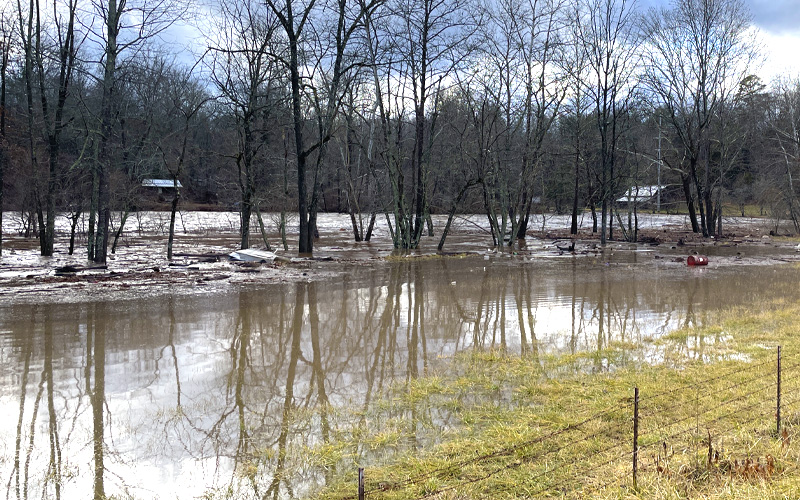
With discussions continuing about the use of fill dirt in the floodplain, the Macon County Board of Commissioners will hold public hearings on July 9 to get input on allowing RV parks in the county watershed and changing the mandate for a soil erosion and sedimentation control plan.
The discussions at the May 14 commissioners meeting follow the May 2 Macon County Planning Board meeting where multiple people spoke against a possible change to the floodplain ordinance to allow more fill. Many said the fill would negatively impact the county’s waterways, including the Little Tennessee River. The current county ordinance is strict against development in the county floodplain, something Commissioner Josh Young would like to change.
During the May 14 public comment, multiple people spoke about the floodplain ordinance. Jason Love of Otto, immediate past chair of Mainspring Conservation Trust, brought up that the strengthened floodplain ordinance happened after the Peeks Creek mudslide that killed four and destroyed many homes. Love mentioned how Tropical Storm Fred destroyed 450 structures in Haywood County in 2021 and implored the commissioners not to weaken the floodplain ordinance.
Kelly Penland, a local real estate agent, spoke on behalf of her clients in urging the commissioners to use caution in potentially changing the floodplain ordinance, talking about the lack of flood insurance requirements and what property owners could do if something were to happen.
Lewis Penland, a former Planning Board member and contractor who spoke on May 2, asked for a subcommittee to look into the floodplain ordinance. Bill McClarney, who owns land on the Little Tennessee River, urged the commissioners to follow the golden rule and not pass on their issues to their neighbors downstream.
Angela Faye Martin spoke on the ecotourism the river can bring to the community. Susan Ervin, who was on the Planning Board when Macon County strengthened the floodplain ordinance 20 years ago, said FEMA standards wouldn’t protect property owners and said property owners don’t have a right to and said property owners don’t have a right to pollute the rivers with fill.
Sara Johnson of Otto asked Young to recuse himself from any vote and said that Otto “deserves clean water, not RV sewage.”
David Culpepper, a Little Tennessee River landowner who spoke May 2 in favor of changing the floodplain ordinance, said he wasn’t pro-fill and is a kayaker and canoer. Culpepper again said the current ordinance doesn’t work and that it’s turning landowners into criminals. Culpepper said the Macon County Recreation Park being in the town is a benefit so they can add recreational opportunities despite being in the floodplain, which they couldn’t do if the park was outside town limits.
Later in the meeting, Young referenced his recent purchase of three parcels along the Little Tennessee River and said he’s in the process of deed-restricting that property so no fill can be added to them. “That bug is squashed,” he said.
Multiple times, Young said this issue had been brought up to him by various people and that he simply wanted to discuss it.
Commissioner John Shearl said Macon County standards should reflect state standards, mentioning that previously, he shut down a campsite he owned because the county told him to, despite an attorney telling him that the campground was grandfathered in. Shearl also chided “conservation groups” for their land buying.
“You got questioned about some property you bought, well I question about the property that is now going into conservation, that’s coming off the tax rolls…because the people that own it can’t use it,” Shearl said. “Well, then your conservation organization ends up with that property for pennies on the dollar because people have no use for it….these conservation groups are doing the same thing.”
Mainspring Conservation Trust owns several tracts of land in Macon County, purchased at various times over the years.
Shearl said campsites are designed to be on the river and that landowners have a constitutional right to use it for their best interest.
After repeating Culpepper’s point about how it’s good that the Macon County Recreation Park is in the Town of Franklin limits, Shearl suggested a public hearing. Commissioner Danny Antoine agreed.
Macon County Erosion Control Officer and former Planner Joe Allen said the Town of Franklin floodplain ordinance is the base state level. Allen said he could make an argument either way.
Young said he liked Lewis Penland’s subcommittee idea but wanted to keep that subcommittee small. That committee would likely be two commissioners and two planning board members who could listen to expert testimony from various people.
Lewis Penland said you need to deal with each property individually, saying he has a problem with the state minimums because they’re dealing with Raleigh-area floodplains, which are different than mountain floodplains. Penland said even different areas of Macon County are different, with Highlands at 4,000 feet and Franklin at 2,000 feet. Allen brought up the idea of a no adverse impact study attached to any floodplain fill ordinance.
Macon County Solid Waste Director Chris Stahl asked about insurance, saying that after the 2004 Peeks Creek landslide FEMA was begging Macon County to stop building houses in the floodplain. Allen said any floodplain map would have to be reviewed by FEMA and if not approved, flood insurance rates will go up.
The commissioners took no action on the floodplain fill ordinance. Shearl recommended Commissioner Paul Higdon and Young serve on that subcommittee, but there was no formal vote.The Macon County Planning Board is set to meet Thursday, June 6, if there’s a quorum.
Public hearing on ordinance changes
Young also spoke on two other ordinance changes he’s interested in. One would increase the minimum acreage required for a soil erosion and sedimentation control plan for land disturbance activities from half an acre to a full acre, which the planning board discussed in March. Young said this will follow N.C. state statute.
The second would essentially allow property owners to develop RV parks in floodplains, Young said. On May 2, Culpepper talked about a developer who bought the Tyler’s Motel property and wanted to open an RV park but got denied a permit because of the floodplain ordinance.
“This board wants to talk about economics and being competitive … look at the Tuckaseegee, look at all the homes along the river,” Young said. “At the end of the day, we have to find common ground.”
Young made a motion to hold a public hearing on the two ordinance changes on July 9; the motion passed unanimously.
During the floodplain fill discussion, Higdon mentioned the future of the Lake Emory Dam, saying they have to address it. Higdon said the dam is losing power generation ability due to silt and said the reservoirs are sand traps. Young said Northbrook Energy owns the dam and doesn’t want it anymore. The commissioners took no action on the dam.