
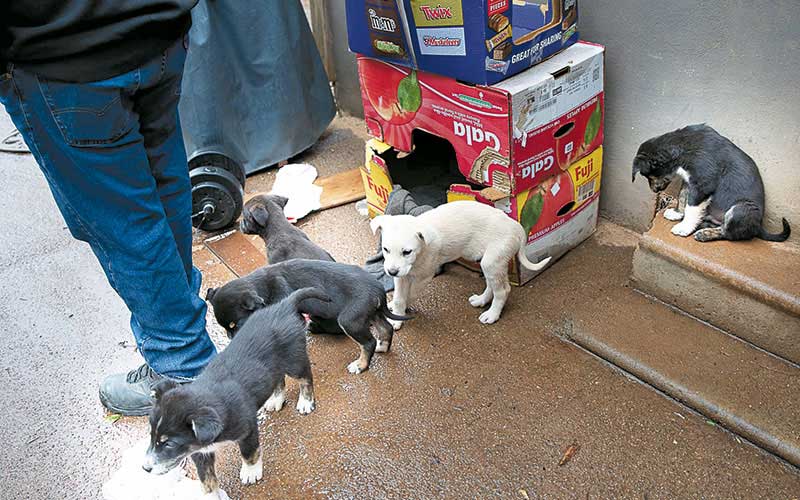
Five priority areas were identified in a report that aims to improve Macon County Animal Services, leading to an immediate ask for a new kennel worker.
This came after multiple volunteers and staff members attended the Board of Health meeting in September and shared their experiences at the animal shelter, talking about the lack of help, overcrowding, building issues and more. The board promised they would look into the issue.
At the Nov. 19 Board of Health meeting, staff presented a report that came from an Oct. 21 planning process meeting with 16 people, ranging from Macon County Public Health employees, shelter attendants and volunteers.
The report includes a SWOT analysis (Strengths, Weaknesses, Opportunities and Threats) and five critical priority areas.
Strengths were effective adoption and return-to-owner marketing, the animal fostering initiative, a dedicated volunteer group, community donations and the staff, leadership and volunteer commitment to higher quality animal care.
Weaknesses were inadequate full-time equivalent workers, high staff turnover due to low pay, the mandated 10-day stray holding period, insufficient facility security with no fire alarms, the current camera system, capacity limitations and lack of comprehensive volunteer training.
Opportunities were potential grants, updating the county’s animal control ordinance, expanding vetting for adoptions, funding and promoting spay/neuter programs, updating the phone system, clarifying donations versus county expenses, compiling data on adoption returns, and ordering and budgeting training for staff.
Threats or challenges were staffing on weekends, adoption returns, the lack of enforcement in the current ordinance, understanding what animal control can and can’t do, the increased need to handle unusual animal calls and inadequate full-time equivalent hours.
The five critical priority areas were increasing Animal Services’ budget, improving volunteer and staff training, improving facilities, updating the county’s animal control ordinances and offering community spay/neuter programs.
In identifying budget priority needs, the main goal is to increase the number of full-time equivalent shelter attendants. Macon County Health Director Kathy McGaha said that will be an issue because there was a memo that due to the county’s human resources department going to a new system, they asked for a hiring freeze until mid-January.
After discussion between the board and people in the audience, it was determined the top job needed was a kennel worker. Currently, volunteers are having to clean the kennels. The board then unanimously voted to pursue a kennel worker.
They hope to develop a comprehensive, required volunteer training program by Jan. 31, 2025.
On building and facilities, a list will be developed to present to the commissioners. Volunteers said the biggest issue was the current kennel doors. A new issue that came up that week was the HVAC system went out, so space heaters were brought in to help the animals. Some volunteers in the audience pointed out that having space heaters in a building with no fire alarm is a bad idea.
The board also discussed the future of the current Animal Services space. Board members Garrett Higdon and Matt Corbin talked about needing to look into the future and determine if the county should find a new shelter space or if can they expand the current one. Public Health Section Administrator Jimmy Villiard said they asked the county years ago to expand the shelter and add a surgical suite but didn’t receive it.
In updating the county’s animal control ordinance, the goal is to decrease the number of days a stray animal is held before adoption. Currently, the number is 10 days, which would require an ordinance revision to change. The idea is to reduce the number of days to five or seven. The state only mandates a 72-hour hold.
Veterinarian Dr. Ray Lenzo said rabies symptoms can start manifesting up to 10 days after intake and warned against decreasing the 10-day hold.
In having community spay/neuter programs, the idea is to decrease intakes and also prevent unhealthy animals from procreating. Lenzo said a spay and neuter program is the best way to fix the overcrowding problems the shelter currently has and decrease the workload.
Animal shelter staff will start working with ASPCA (American Society for the Prevention of Cruelty to Animals) of Asheville to supplement their work, taking animals to Asheville for spay and neuter services, Villiard said. The belief is that ASPCA will come once or twice a month and hopefully will expand into the community.
Villiard said the goal is to make Macon County Animal Services a true no-kill shelter. The shelter only euthanizes a small number of animals each year, and Villiard said he doesn’t want to put the animals on a clock or anything like that.
Going forward, staff will prioritize which of Animal Services’ needs are the most important and plan a presentation to the county commissioners.