
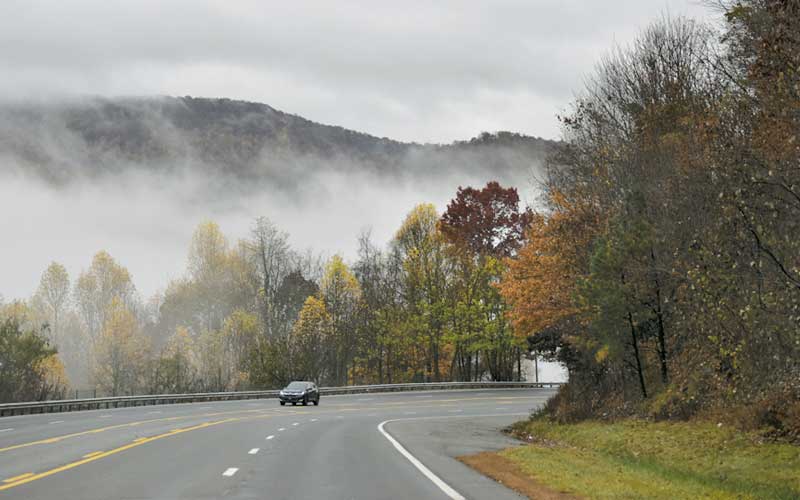
There are two things fall foliage prognosticators generally agree on. The first is that you can’t predict what day the leaves will turn, and the second is that due to elevation changes and different tree species, you can view multiple peak seasons around Macon County for most of October.
Linda Harbuck, executive director of the Franklin Chamber of Commerce, said they constantly get questions from visitors about when the best week or day is to see the prettiest leaves.
“The leaf season is one of our largest seasons,” Harbuck said. “It’s the final big push before winter.”
Beverly Collins, a recently retired associate biology professor at Western Carolina University, sees the long-term forecasts that could make 2023 different from 2022’s explosion of color.
“The long-term weather forecast is that it’s going to be warmer than normal, with normal precipitation,” Collins, who gave WCU’s “Fearless Fall Foliage Forecast” for years, said.
Howard Neufeld, a biology professor at Appalachian State University, is known as the “Fall Color Guy” for his weekly blogs this time of year about the state of the foliage for the entire mountain region of North Carolina.
Neufeld said this year, there was a tremendous heat dome over many parts of the country that made it unusually warm. To have vibrant fall foliage like last year, Neufeld says the weather has to change for the rest of September.
“What we want to see starting in September, particularly in the second half, are the nights starting to cool off, no clouds so the heat radiates away, crisp fall evenings, then cool, clear sunny days,” Neufeld said. “If we get those conditions, and not a freezing night…that pushes the trees toward making color.”
Warmer daytime temperatures for longer could mean a more gradual foliage season, Collins stated. This would happen as different species of trees would slow the production of chlorophyll at different temperatures. Chlorophyll turns sunlight into glucose and feeds the trees, giving off the green color that is so vibrant in the late spring and summertime. As the days get shorter and cooler and the chlorophyll evaporates, tree leaves turn into their “true” color, whether it be orange, red, brown or yellow.
“I think the combination of current conditions and forecasted conditions means that we return to the fall we had before last year [in 2021],” Collins said. “Last year was the perfect occurrence of a cooldown with bright sunny days, cool nights to let us get that right flush of vibrant colors.”
Neufeld concurred, saying the 2022 foliage was the best he saw in 15 years, as the cooldown happened perfectly. This led to most tree species changing together from the south through New England.
Collins said around Franklin, with elevations around 2,000 feet above sea level, it’s likely to see the brightest colors in late October, usually around Oct. 23-25. But with the potential for gradual foliage, Collins feels the color change can last into November, as it did in 2021.
But not all of Macon County is at 2,000 feet like Franklin. Highlands sits above 4,000 feet while the county’s highest point, Standing Indian Mountain, is 5,499 feet. This means that on many drives from Franklin to either Nantahala or Highlands in October, you could see a peak season.
“You can come here if you’re a tourist, anytime from the second week of October to first week of November, and you’ll find color somewhere,” Collins said.
Neufeld says there’s good color above 4,500 feet in Macon County the last week of September or the first week of October. The 3,000-4,500-foot range typically peaks Oct. 10-20, Neufeld said. Asheville, which is 2,400 feet, is the week after, then you get into the foothills and northern Georgia, mostly below 2,000 feet, peaks in November.
One aspect of leaf season is how different elevations at different latitudes correspond. Neufield said that his foliage map considers latitude, since the more north you are, the shorter and cooler the days are. Neufeld said Highlands at 4,000 feet is equivalent in foliage timeline to Boone, elevation 3,300, due to Highlands being two degrees south in latitude.
Collins and Neufeld said certain trees are prone to turn colors first, such as sourwoods and black gums, whose leaves turn red. Maples, which can produce red and yellow leaves, are a little later, as are witch hazels. Later in the season, different oak trees can change.
“A lot of people from the north don’t realize how good fall color we have,” Neufeld said. “There are over 100 species of trees. Some unique species that get more prominence down here.”
The leaf season combined with the Great Smoky Mountains National Park being the most visited national park creates a major tourism attraction.
Collins said that the drives through the Cullasaja Gorge and on the Blue Ridge Parkway yield peak leaf seasons on multiple weeks due to the elevation changes.
Neufeld tells people to go early in the day and go during the middle of the week to avoid the bigger crowds. Neufeld also said going into the morning yields better color saturation in photographs.