
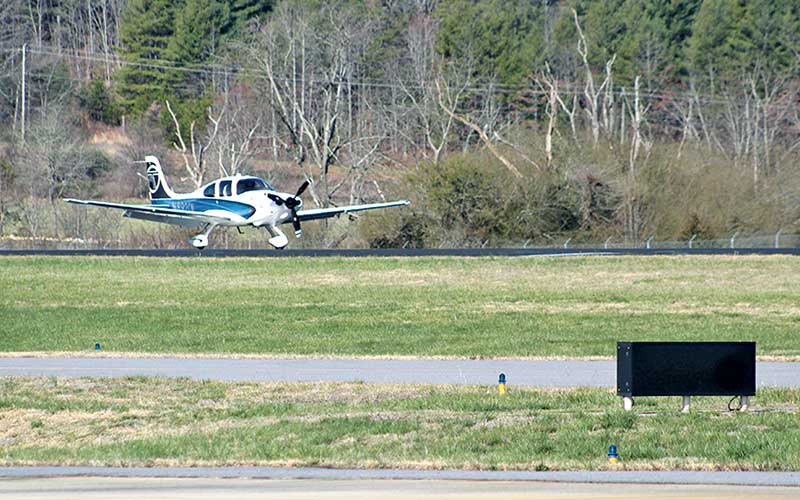
Sometimes when a plane lands at the Macon County Airport during the daytime, students at the neighboring Iotla Valley Elementary School can be seen at the fence looking on.
While those kids look on in wonderment, to the employees of the airport and airport authority board members, those landings mean something else. Be it an old friend coming in for the summer, a local taking their plane out for a spin or a trainee learning how to fly in the mountains, they all equate to something else: Economic impact.
“There’s a lot of people fly into this airport that own houses,” said Gary Schmitt, Macon County Airport Authority board chair. “They use them more year-round than they did years ago. But they own homes in Macon County, and they pay taxes. That’s a strong part of our tax base for Macon County. And a lot of it is made possible because of this airport. Made possible for them to come here to play golf for the weekend, to do this, to do whatever they do. And a lot of business comes in through this airport for Macon County.”
The Macon County Airport and its 5,001-foot runway remain busy throughout the year.
“We have some that are in once a week, once every other week, and then there’s some people that may come in once a year,” said Sabrina Crone, airport manager. “A lot of them are from Florida, but not all of them.”
During the airport’s busy season, August through November, there will be as many as 25 arrivals and departures in a day. Crone said activity starts to pick up in mid-April when Florida snowbirds start flying up.
“It’s much busier than most people realize,” Crone said. “Unless you live right here, you don’t realize how busy it actually gets.”
“You can get some pretty good-sized airplanes into a 5,000-foot runway,” Schmitt said. “So that allows them to bring their friends up and come play golf for the weekend. A lot of the business goes to Highlands.”
Many fliers go to Highlands or Harrah’s Casino and Resort in Cherokee.
“A lot of companies and businesses come in and they’ll rent a house for a week and do business retreats up there,” Crone added.
Peter Holsten, whose primary residence is in the Turks and Caicos, commutes between Franklin and the Caribbean. He originally came to Macon County a few years ago to fly an airplane the airport owned and used to teach pilots. Holsten bought the plane and loves the area so much that he flies up every four to six weeks.
“It’s a lovely little airport and it’s set in a beautiful position and the weather’s generally good up here,” Holsten said during his pre-flight checks before flying down to the Turks and Caicos. “It makes a nice difference to living on the islands. I don’t like the cold much, but I’ll get over it.”
According to the North Carolina Division of Aviation’s 2023 State of Aviation, the Macon County Airport brings an economic impact of $18.54 million per year, $1.546 million in state and local taxes, and supports 100 jobs.
Crone said typically in the fall, departures don’t happen until 11 a.m. due to the fog, which she says can stick around due to the topography of the Iotla Valley.
“If you don’t see the mountaintops, it’s not a good thing to come,” Crone said.
Schmitt noted that Macon County Airport does have an instrument flight rules approach, meaning pilots can get in with a low ceiling and fog present.
The Macon County Airport is only one of three general aviation airports in WNC. Besides the Asheville Regional Airport, which is a primary airport, there’s the Jackson County Airport in Sylva, the Andrew-Murphy Airport in Andrews and the Macon County Airport.
Macon Air, a part of Drake Enterprises, runs the airport’s operations as the fixed-based operator, with Crone as manager. Macon Air rents the building from the county and offers fuel, pilot training and more. The county owns the airport and the Airport Authority is part of the county’s oversight.
The picturesque setting is also not to be taken lightly. Schmitt said pilots call in ahead of time to find out about the airport and the approach due to unfamiliarity in the mountains.
“It’s just like landing at any other airport, really, if you take away the mountain picture around you,” Schmitt said. “And that’s what kind of makes some pilots uneasy. And so that’s why we always recommend to get instruction in the mountains because it makes you feel better about the mountains being so close.”
“We have several people that have flown in and they say, ‘Hey, we want some instruction time in the mountains to get used to the terrain and the weather,’ which in that case they just call us and we set it up for them,” Crone said.
Growing demand
Even though the Macon County Airport has 20 hangars and 22 tie-down spots, there’s a demand for more.
“We’ve got over 80 names on a waiting list right now for hangars,” Crone said.
When asked how many hangars they are looking for, Schmitt said they’ve just started drawing up some schematics. Their first option would be another community hangar that can hold several airplanes.
Crone said some people require a hangar before deciding to buy a home in the region. “They don’t want to buy a house until they get a hanger because they don’t want their plane sitting outside,” she said. “So that would be a huge help to the county for taxes.”
“People don’t realize how much money comes into the county through this airport. A lot,” Schmitt said, noting that it’s more than fuel, home sales and hangar rentals.
Hangar development could come in the 2024-25 fiscal year, as the draft version of the Macon County capital improvement plan has $1,822,600 earmarked for that purpose, with 90% of that covered by federal grants. Over three years, hangars would cost $9,214,751, with 90% of that covered by FAA grants.
“We have gotten a lot of grants over the years,” Schmitt said. “And what the FAA requires to get a grant is that you do a 10% match, which the county has done for us graciously over several years. And we put all that money into the airport. …And it’s well worth what it costs for what we get out of it.”
Another item the county had on its list for airport upgrades is the installation of runway end identifier lights (REIL), which can help approaching pilots make sure they’re not short or long, and an extended safety area for Runway 25, the east end of the runway. Those are estimated to cost $1,765,920, paid for in the 2025-26 fiscal year.
Another airport improvement that came up in the draft capital improvement plan is a runway extension.
“There’s a lot involved in it, so I don’t know how close that is. Nothing happens quick in aviation, believe me,” Schmitt said of the runway extension. “We’re talking about 500 to 1,000 feet right now, which would give us 5,500 to 6,000 feet total, which just makes it safer for every airplane that comes in here just to have more runway.”
The draft plan has a 1,000-foot runway extension costing $13,474,400, paid for over three years starting in 2026-27.
Along with a $538,608 relocation of Airport Road away from the runway planned for 2027-28, airport projects over the next five fiscal years would cost $24,991,679. Of that, the county would only pay $2,499,168. County Manager Derek Roland previously said all these timelines are subject to change based on FAA grants.
Pilot training
The Macon County Airport offers training for pilots who want to learn how to fly in the mountains. Military pilots train frequently in the mountains to mimic conditions they’ll see overseas.
“It’s a whole lot different to fly up here than it is in the flatlands,” Crone said. “If we weren’t here, they wouldn’t have an area that was as much similar to what they’ll be working in.”
“And if you’re going to fly in the mountains, you need to take some instruction for flying in the mountains,” Schmitt added. “Because of the winds, because of different factors, the weather, it’s good for you to take some instruction in the mountains.”
Besides offering a mountain airport for transplants and fliers, the Macon County Airport offers a strategic base for forest service operations during fire season.
“We’re a good location for them because they can hit Tennessee, South Carolina, North Carolina, Georgia,” Crone said. “We’re right there, a good central location. We have them here several months out of the year.”
The airport also hosts the Franklin High School aviation class, with most of the students having already flown for real after numerous hours in a simulator.
“A few of them have already started lessons,” Schmitt said. “I mean, you can solo an airplane when you’re 16. You can get your pilot’s license when you’re 17. So, you can actually start your lessons earlier than that; at 15 and 14.
“Once they go through all the aviation requirements, they’re a pilot just like I am.”
Crone and Schmitt pointed out that these courses could help with a need for pilots.
“There’s a huge calling for pilots,” Crone said. “I went to a career fair at the high school the other day…I was impressed at how many people were interested in aviation and getting started in the high school program to lead up and potentially come in here. … They’re all very interested and eager to learn, and excited to have something to look forward to. It can be careers for them.”
“There’s no young pilots,” Schmitt said. “The more young people we can bring into this, the better it is for the whole aviation world. We have training here.”
“You can come and get a discovery flight and see if it’s something you like or not and set up more lessons for you if you do, and get more people up and going,” Crone said.
Barriers to becoming a pilot are cost and lack of awareness.
“I grew up here, I live just right [nearby the airport], I’ve heard airplanes, and I never once thought about learning how to fly,” Crone said. “I didn’t know it was a reachable goal. A lot of people just don’t know.”